
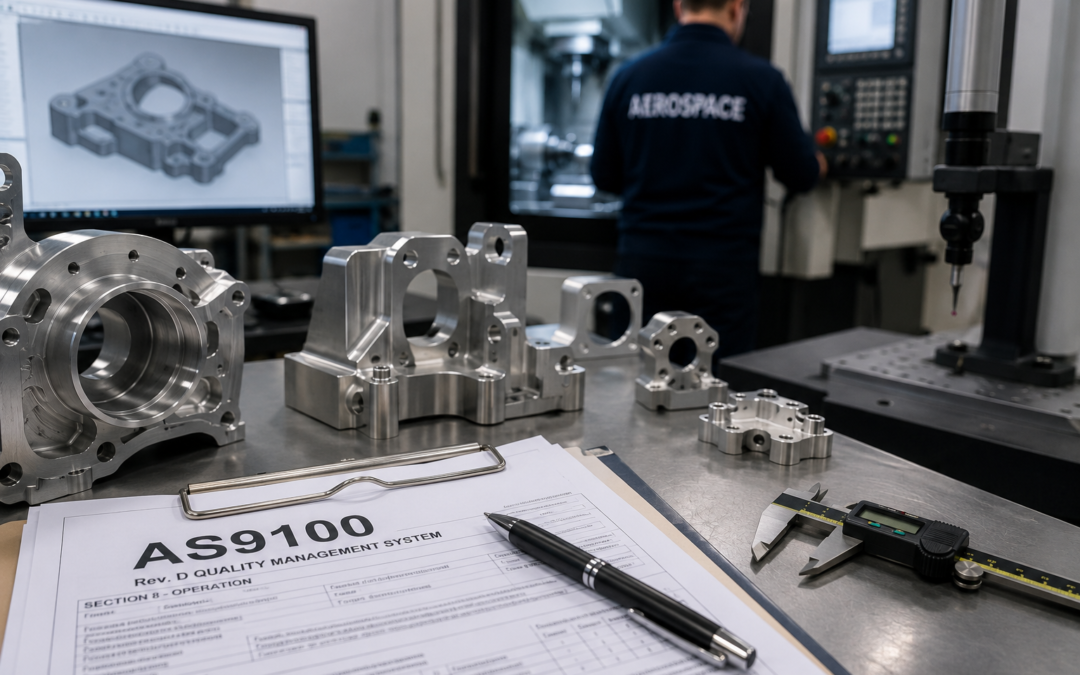
Choosing an aerospace component manufacturer is not simply a matter of finding a machine shop with available capacity. Aerospace buyers must assess whether a supplier can manufacture the required components consistently, control materials and revisions, verify critical features and respond effectively when technical or production issues arise.
The right manufacturing partner should be able to support the full commercial and technical requirements of the project. This may include early-stage prototypes, development batches, repeat production, detailed inspection reports, material certification, special process coordination and long-term configuration control.
A supplier may have advanced CNC machinery, but equipment alone does not guarantee reliable aerospace manufacturing. Buyers should also consider the manufacturer’s experience, inspection capability, production planning, traceability systems and approach to communication. This guide explains how to evaluate an aerospace component manufacturer before issuing a request for quotation or placing an order.
What Does an Aerospace Component Manufacturer Do?
An aerospace component manufacturer produces parts, assemblies and machined features for aircraft, defence platforms, aerospace systems, ground-support equipment and related applications. Depending on the project, these components may be used within structural systems, mechanical assemblies, fluid-control equipment, instrumentation or specialist aerospace machinery.
The scope of supply can vary considerably between manufacturers. Some companies focus on producing individual CNC machined parts, while others can also coordinate finishing, inspection, non-destructive testing, assembly and supporting documentation. Typical aerospace manufacturing capabilities may include:
- Multi-axis CNC milling
- CNC turning
- Prototype component machining
- Small and medium batch production
- Repeat production programmes
- Precision inspection
- First article inspection
- Surface treatment coordination
- Part marking and identification
- Sub-assembly work
- Material and process certification
- Controlled packaging and delivery
Understanding the complete scope of a supplier’s capability helps buyers identify whether the company is suitable for a single project or could support a longer-term manufacturing relationship.
Relevant Aerospace Component and Material Experience
When comparing suppliers, buyers should look beyond general statements about precision engineering. Relevant component and material experience can reduce technical risk because the manufacturer is more likely to understand the machining behaviour, inspection challenges and production controls associated with the work.
A capable aerospace component manufacturer should be able to explain the types of parts it regularly produces without disclosing confidential customer information. This may include gearbox casings, CNC machined housings, brackets, manifolds, shafts, covers, mounting components, structural parts or precision assembly components. Buyers should consider whether the supplier has experience with:
- Components of a similar size and complexity
- Comparable tolerances and geometric controls
- Thin-walled or distortion-sensitive parts
- Multi-operation components
- Critical bores, threads and sealing features
- Complex five-axis geometries
- Parts requiring extensive inspection
- Components involving external special processes
Material experience is equally important. Aerospace parts may be manufactured from aluminium, stainless steel, engineering steel, titanium, nickel alloys, copper alloys or specialist plastics. Each material presents different machining, workholding, tooling and inspection considerations.
For example, aluminium alloys can often be machined efficiently, but large or thin sections may move as internal stresses are released. Stainless steels can require careful control of tooling and heat generation. Titanium and nickel-based alloys can create additional challenges relating to tool wear, cutting temperatures and production time.
A manufacturer with relevant material experience is better placed to select appropriate machining strategies and identify potential issues before they affect delivery.
Aerospace CNC Machining Capability
Machining capability should be assessed in relation to the actual component rather than the number of machines listed on a supplier’s website. A large equipment list is useful, but the important question is whether those machines are suitable for the required geometry, tolerance, volume and lead time.
Aerospace CNC machining may involve a combination of milling, turning, drilling, boring, thread machining and multi-axis operations. Some parts can be completed efficiently in one or two setups, while others require several carefully controlled operations and dedicated fixtures. When reviewing machining capability, buyers should consider:
- Maximum component dimensions
- Available machining envelope
- Three-axis, four-axis and 5-axis aerospace machining capability
- CNC turning capacity
- Live tooling and driven-tool capability
- Suitable workholding methods
- Tool measurement and probing systems
- Availability of backup machinery
- Capacity for unmanned or extended-hours production
- Experience with complex multi-operation parts
The manufacturer should also be realistic about whether the component fits its preferred type of work. A technically capable supplier may still be unsuitable if the part is far outside its normal size range, batch quantity or production process.
Machining Capacity and Realistic Aerospace Lead Times
Lead time is one of the most important commercial considerations when selecting an aerospace component manufacturer. However, buyers should distinguish between a quick quotation response and a genuinely achievable manufacturing schedule.
A realistic lead time should take account of programming, material availability, tooling, fixture manufacture, machine capacity, inspection requirements and any external processes. If the part requires anodising, plating, heat treatment, painting, non-destructive testing or other subcontracted operations, these stages must also be included in the production plan. Buyers should ask how the quoted lead time has been calculated and whether it includes:
- Material procurement
- CNC programming
- Fixture or soft-jaw manufacture
- First-off production
- In-process inspection
- Final inspection
- External special processes
- First article documentation
- Packing and delivery
An unusually short lead time may appear attractive, but it is only valuable if the manufacturer can achieve it without compromising process control or repeatedly changing the delivery date. Reliable suppliers should be willing to state their aerospace component lead times, explaining current capacity and flagging potential scheduling constraints before the order is placed. Honest planning is generally more useful than an optimistic commitment that later becomes unachievable.
Inspection and Measurement Capability
Aerospace components often include tolerances and geometric requirements that cannot be verified using basic measuring equipment alone. Buyers should therefore review whether the supplier has suitable inspection equipment, trained personnel and controlled measurement processes. 
The required inspection approach depends on the part. Some components can be verified using micrometers, height gauges, bore gauges and other conventional equipment. More complex parts produced by aerospace CNC milling services may require coordinate measuring machines, optical systems, surface measurement equipment or dedicated inspection fixtures. A supplier’s inspection capability may include:
- Coordinate measuring machines
- Manual measuring equipment
- Digital height gauges
- Bore measurement equipment
- Thread gauges
- Surface roughness measurement
- Optical measurement systems
- Inspection fixtures
- Calibrated reference equipment
- Temperature-controlled inspection areas
- Automated inspection report generation
Buyers should also ask how inspection results are recorded. A simple certificate of conformity may be sufficient for some orders, while others may require dimensional reports, ballooned drawings, first article inspection reports or customer-specific documentation.
The manufacturer should confirm that it can measure the drawing requirements before accepting the order. A component should not be machined to a tolerance that the supplier cannot reliably verify.
First Article Inspection and Aerospace Documentation
First article inspection provides structured evidence that a manufacturing process can produce a component in accordance with the specified requirements. It is commonly requested for new parts, revised drawings, production transfers or significant changes to an established manufacturing process.
The precise documentation requirements should be agreed before quotation because detailed reporting can require considerable engineering and inspection time. Buyers should not assume that every quotation automatically includes a complete first article package. Documentation requirements may include:
- Ballooned engineering drawings
- Dimensional inspection results
- Material certificates
- Certificates of conformity
- Special process certificates
- Manufacturing route information
- Approved deviation records
- AS9102 forms where required
- Customer-specific inspection templates
AS9100 certification may be an important supplier-selection checklist item, but it should be assessed alongside practical manufacturing capability. Certification supports a structured quality management system, while the manufacturer’s equipment, people, processes and experience determine whether it can successfully produce the component.
Prototypes, Batch Sizes and Repeat Production
Not every aerospace component manufacturer is suited to every production volume. Some companies specialise in prototypes and high mix low volume manufacturing work, while others are structured around larger repeat batches. Buyers should confirm that the required quantity fits the supplier’s normal production model.
Prototype manufacturing often requires flexibility, rapid programming and close communication with designers. Repeat production places greater emphasis on stable processes, dedicated workholding, controlled setup information and reliable scheduling. A suitable supplier may be able to support:
- One-off development components
- Prototype aerospace parts
- Pre-production batches
- Small batch manufacturing
- Medium-volume repeat orders
- Scheduled call-off production
- Long-term component supply
- Spare and replacement parts
Where a project may progress from prototype to repeat production, it can be beneficial to involve the manufacturer early. The supplier may identify opportunities to improve workholding, simplify inspection or reduce unnecessary machining time before the design is fixed.
Buyers should also discuss likely future volumes. A process that works well for five components may not be the most efficient approach for fifty or five hundred parts.
Drawing, Revision and Configuration Control
Drawing control is essential in aerospace manufacturing because components must be produced to the correct technical definition. A supplier should have a clear process for receiving drawings, identifying revisions and preventing superseded information from being used in production.
Configuration control becomes particularly important when several versions of a part exist or when engineering changes are introduced during an ongoing programme. The manufacturer should be able to demonstrate how updated drawings are reviewed and communicated to production and inspection personnel. Effective drawing and revision control should address:
- Drawing number
- Drawing revision
- Customer purchase order revision
- Three-dimensional model version
- Specification revisions
- Approved concessions or deviations
- Manufacturing instructions
- Inspection requirements
- Special process requirements
- Retention of production records
Buyers should provide complete and consistent information at the RFQ stage. Where a drawing and CAD model conflict, the discrepancy should be resolved before manufacture begins.
A responsible manufacturer will query unclear or contradictory requirements rather than making unsupported assumptions.
Material and Process Traceability
Material traceability allows the finished aerospace component to be linked back to the material from which it was manufactured. The level of traceability required will vary by customer, programme and component application, but it should be agreed before order placement.
Aerospace material documentation may include details such as the material grade, specification, batch or heat number, supplier and test certification. The manufacturer should have a method of maintaining identification as material is cut, stored and transferred through production. Buyers may need to specify requirements relating to:
- Material certificates
- Heat or batch traceability
- Country of origin
- Approved material sources
- Identification of cut material
- Control of customer-supplied material
- Material certificate retention
- Part marking
- Serial or batch numbering
Process traceability is also important when components undergo external operations. These may include anodising, plating, heat treatment, painting, passivation, non-destructive testing or other specialist processes.
The aerospace component manufacturer should be able to link the returned process certificate to the relevant parts and purchase order. Where approved processors are required, this should be confirmed before quotation.
Special Processes and Supply Chain Management
Many aerospace components require more than machining. The selected manufacturer may need to coordinate several approved or specialist suppliers before the finished parts can be delivered.
Managing these external processes effectively requires clear purchase specifications, reliable transport, documentation control and inspection after the parts return. Buyers should establish whether the machining supplier will take responsibility for the complete finished component or supply the parts in a machined-only condition. Externally managed processes may include:
- Anodising
- Alochrom or chemical conversion coating
- Painting and primer application
- Plating
- Heat treatment
- Passivation
- Non-destructive testing
- Laser marking
- Grinding
- Specialist cleaning
Where the manufacturer manages these services, the quotation should state which processes are included. The buyer should also clarify whether certifications, masking, testing and post-process inspection are part of the agreed scope. A well-managed supply chain can simplify procurement by giving the buyer one point of contact for the completed component.
Communication and Problem Escalation
Good communication is a practical manufacturing capability. Aerospace projects often involve technical queries, material delays, drawing discrepancies, special process issues or changing delivery priorities. The way a supplier handles these situations can have a significant effect on programme performance.
Buyers should assess whether the manufacturer communicates clearly during quotation and technical review. Slow, incomplete or vague responses at the RFQ stage may indicate how future issues will be managed. A reliable supplier should be able to explain:
- Who manages the customer account
- Who handles technical queries
- How drawing questions are raised
- How delivery risks are reported
- How non-conformances are escalated
- How corrective actions are managed
- How urgent priorities are communicated
- How progress updates are provided
Problems can occur even within controlled manufacturing environments. The important distinction is whether the supplier identifies issues early, contains affected work, communicates honestly and agrees an appropriate resolution.
Buyers should be cautious of manufacturers that avoid difficult questions or provide assurances without supporting information.
Manufacturability Support Before Production
Early manufacturability input can help reduce unnecessary cost, production risk and inspection difficulty. An experienced aerospace component manufacturer may be able to identify design features that are technically possible but inefficient to machine. This does not mean changing functional requirements without approval. Instead, the manufacturer can highlight areas where a small design adjustment could improve access, workholding, tool selection or measurement. A manufacturability review may consider:
- Tool access
- Internal corner radii
- Deep pocket dimensions
- Thin wall sections
- Hole depth-to-diameter ratios
- Thread selection
- Tolerance requirements
- Datum structures
- Surface finish callouts
- Inspection access
- Material availability
- Special process allowances
The buyer remains responsible for design approval, but a collaborative review can help ensure that the drawing communicates the intended function without adding avoidable manufacturing complexity.
This is particularly valuable for new aerospace components, prototypes and parts moving from development into repeat production.
Questions to Ask an Aerospace Component Manufacturer Before an RFQ
A structured supplier review can help buyers compare potential manufacturers more effectively. The questions should reflect the actual project rather than relying on a generic supplier questionnaire alone. Before issuing an RFQ, buyers may wish to ask:
- Have you manufactured similar aerospace components?
- Do you regularly machine the specified material?
- Can your equipment accommodate the part dimensions?
- Can you achieve and measure the required tolerances?
- What batch sizes are best suited to your operation?
- Can you support prototypes and later repeat production?
- What is your current manufacturing capacity?
- What does the quoted lead time include?
- How do you control drawing revisions?
- How do you maintain material traceability?
- Can you provide the required inspection reports?
- Can you coordinate the specified special processes?
- How are technical queries and non-conformances managed?
- What information do you need to provide an accurate quotation?
- Is any part of the requirement unclear or difficult to manufacture?
These questions can reveal whether the manufacturer has reviewed the enquiry carefully. A supplier that raises relevant technical questions is often demonstrating useful attention to detail rather than creating unnecessary delays.
What to Include in an Aerospace Component RFQ
An accurate quotation depends on the quality of the information provided. Missing drawings, unclear specifications or incomplete documentation requirements can result in assumptions, revised pricing or delays after order placement. A well-prepared aerospace component RFQ should include as much relevant information as possible. This may include:
- Current engineering drawing
- Correct drawing revision
- Three-dimensional CAD model
- Required quantity
- Expected repeat quantity
- Material specification
- Customer-supplied material details
- Surface treatment requirements
- Special process specifications
- Inspection and reporting requirements
- First article requirements
- Part marking instructions
- Packaging requirements
- Required delivery date
- Applicable quality clauses
The buyer should also identify which requirements are mandatory and which are open to manufacturer recommendation. This allows the supplier to quote on a clear basis and offer alternatives where appropriate.
Comparing Aerospace Component Manufacturer Quotations
Price is naturally important, but the lowest quotation does not always represent the lowest overall procurement cost. Buyers should compare the complete scope of supply, including documentation, special processes, inspection, delivery risk and technical support.
A lower unit price may exclude work that another supplier has included. Differences may relate to material certification, first article reporting, finishing, tooling, inspection or packaging. When reviewing quotations, buyers should compare:
- Manufacturing scope
- Material supply
- Special processes
- Inspection requirements
- Documentation
- Tooling charges
- Lead time
- Delivery terms
- Quote validity
- Assumptions and exclusions
- Payment terms
- Repeat order pricing
The most suitable aerospace component manufacturer should offer a credible combination of technical capability, quality control, communication, delivery performance and commercial value.
Building a Long-Term Aerospace Manufacturing Relationship
The best supplier relationships develop through consistent performance and clear communication. Once a manufacturer has successfully produced a component, repeat orders can benefit from established programs, proven fixtures, inspection data and documented production knowledge.
Long-term relationships can also support more effective capacity planning. Advance visibility of expected demand allows the manufacturer to plan material, tooling, machine time and external processes more efficiently. A strong manufacturing partnership may provide benefits such as:
- More consistent lead times
- Improved production planning
- Reduced technical clarification
- Stable component quality
- Better understanding of customer requirements
- Faster response to repeat orders
- Opportunities for cost reduction
- Support for design changes
- Improved supply continuity
However, long-term supply should still be supported by controlled drawings, clear purchase orders and regular performance review. Familiarity should strengthen process control rather than replace it.
Choosing the Right Aerospace Component Manufacturer
Selecting an aerospace component manufacturer requires a balanced review of technical capability, production capacity, inspection, traceability and communication. Buyers should look for evidence that the supplier understands both the component and the wider requirements associated with aerospace manufacturing.
Relevant certification can support the selection process, but it should not be the only consideration. The manufacturer must also have suitable machinery, experienced personnel, effective inspection resources and realistic production planning. Before placing an order, buyers should confirm that the supplier can:
- Machine the required geometry and material
- Achieve and verify the specified tolerances
- Support the required batch quantity
- Meet a realistic delivery schedule
- Control drawings and revisions
- Maintain material and process traceability
- Provide the required documentation
- Coordinate external processes
- Communicate risks and technical questions clearly
A detailed RFQ and early manufacturability discussion can help both parties identify potential issues before production begins.
Speak to Tarvin Precision About Aerospace Components
Tarvin Precision manufactures CNC machined components for aerospace and other demanding applications. We support customers with precision milling, turning, inspection, prototype quantities, repeat production and the coordination of additional processes where required.
Our team can review component drawings, material requirements, tolerances, batch quantities and inspection expectations before preparing a quotation. Send us an RFQ or a Quick Message today.