
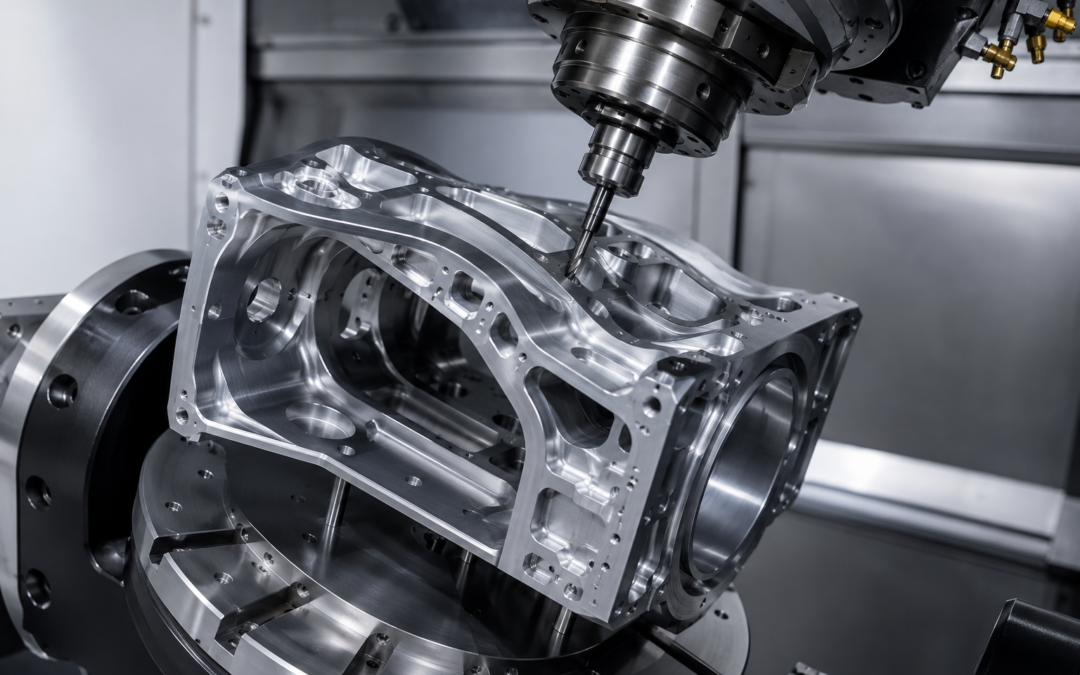
For aerospace manufacturers, buyers and design engineers, machining is rarely just about removing metal. It is about producing flight-critical components with repeatable accuracy, controlled documentation and minimal risk from the first article through to production. That is why 5 axis aerospace machining has become so important for teams looking for advanced CNC capability, especially where complex geometry, tight tolerances and reduced handling are essential.
What is 5 Axis Aerospace Machining?
5 axis aerospace machining refers to the use of advanced CNC machining centres that move a cutting tool or workpiece across five axes rather than the traditional three. Standard CNC milling uses the X, Y and Z axes. 5-axis machining adds two rotary axes, commonly referred to as A and B, allowing the tool to approach the component from multiple angles without repeated manual repositioning. UK aerospace suppliers commonly describe this as a way to machine complex forms and reach multiple faces of a part in fewer setups.
In aerospace work, that flexibility matters. Brackets, housings, manifolds, structural fittings, turbine-related parts and lightweight aluminium components often include angled faces, deep pockets, blended surfaces and hard-to-reach features. With 3-axis machining, each new face may require a fresh setup. Every setup introduces possible alignment error, extra inspection time and more labour. A 5-axis approach helps control those risks by keeping more operations inside one controlled machining cycle.
Why Aerospace CNC Machining UK Suppliers Use 5-Axis Technology
Aerospace CNC machining UK suppliers invest in 5-axis technology because aircraft components often combine complexity with strict quality expectations. The sector needs parts that are light, strong, traceable and repeatable. Many UK aerospace machining companies position 5-axis capability alongside quality management systems such as ISO 9001, EN 9100 or AS9100 because buyers want both advanced manufacturing equipment and controlled processes.
The main advantage is process control. When a part is machined in fewer setups, there are fewer opportunities for movement, incorrect datum selection, fixture variation or manual handling damage. This does not remove the need for inspection, but it can make inspection easier because the machining strategy is more stable and more repeatable.
Reducing Setups With 5-Axis Machining Processes
Reducing setups is one of the strongest arguments for 5 axis machining aerospace projects. In a traditional workflow, a component may be machined on one side, removed, re-fixtured, clocked, probed, machined again and repeated several times. Each stage takes time, but more importantly, each stage creates a new opportunity for error.
With 5-axis CNC machining, the machine can reach several faces of the part from a single clamping position. That means less time spent building complex fixtures, fewer datum transfers and less variation between operations. For high mix low volume manufacturing aerospace work, this can shorten lead times. For repeat production, it can improve consistency across batches. Typical benefits include:
- Fewer manual setups and interventions
- Reduced risk of tolerance stack-up
- Better access to angled and undercut features
- Improved repeatability between parts
- Less reliance on complicated secondary fixtures
- Shorter total manufacturing routes
Precision 5-Axis Milling for Complex Aerospace Components
Precision 5 axis milling is particularly useful where component geometry is too complex for simple prismatic machining. Aerospace parts often need weight reduction pockets, thin walls, curved surfaces and compound angles. These features can be difficult to machine accurately if the tool is forced to work from limited directions. 
A 5-axis machining centre allows the cutting tool to maintain a better angle to the surface. This can improve tool engagement, reduce tool deflection and help achieve a better surface finish. For components with deep cavities or fine details, the ability to use shorter tooling can also support accuracy because shorter tools are generally more rigid than long-reach alternatives.
How 5-Axis CNC Reduces Aerospace Inspection Problems
Inspection problems often begin long before a component reaches the quality department. They can start with datum confusion, fixture movement, inconsistent clamping or small errors introduced between operations. 5-axis CNC machining helps reduce these problems by simplifying the route from raw material to finished component.
When more features are machined in one setup, the relationship between those features is controlled by the same datum structure. This can make dimensional results easier to predict and easier to verify. It can also reduce the number of times a component needs to be checked between operations, although aerospace parts still require the appropriate inspection plan, documentation and final verification. Common inspection improvements include:
- Clearer datum control
- Fewer accumulated alignment errors
- More consistent feature-to-feature relationships
- Easier first article inspection preparation
- Reduced need for repeated in-process checks
- Better repeatability during batch production
5-Axis Aerospace Machining for Risk Reduction
Risk reduction is a central reason to choose 5 axis aerospace machining for critical projects. In aerospace manufacturing, a scrapped part is not only a material cost. It can also delay assembly, disrupt schedules and create additional documentation work. If the component is made from an expensive alloy or has already passed through several operations, the cost of failure increases significantly.
A 5-axis process helps reduce risk by making the manufacturing route shorter and more controlled. Instead of relying on several machines, fixtures and manual transitions, the part can often be completed using a more integrated strategy. This is especially valuable for prototype, development and low-volume aerospace components where there may be limited opportunity to refine the process over many batches.
Materials Used in UK Aerospace Multi-Axis Machining
UK aerospace 5-axis machining often involves materials that are selected for strength, weight, heat resistance or corrosion performance. Aluminium alloys are common for structural components and housings, while titanium, stainless steel and nickel-based alloys may be used where strength, temperature resistance or durability are critical. Some UK precision engineering firms also machine plastics and composites for aerospace applications.
Each material changes the machining strategy. Aluminium may allow high-speed material removal, but thin-wall distortion must be controlled. Titanium requires careful heat management and toolpath planning. Nickel alloys can be demanding on tooling and machine stability. The value of 5-axis machining is that it gives engineers more freedom to select efficient tool angles, maintain rigidity and reduce unnecessary handling.
Design For Manufacture in Aerospace Machining
Design for manufacture is essential if a company wants to get the full benefit from 5-axis aerospace machining. A part may be possible to machine, but that does not automatically mean it is efficient, repeatable or cost-effective. Early collaboration between design engineers and machinists can prevent avoidable problems.
The best results often come when the machining supplier reviews the CAD model before production release. They can assess access, tool reach, datum strategy, wall thickness, tolerances and inspection requirements. Small design changes can sometimes reduce cycle time, simplify workholding or improve inspection reliability without affecting the function of the part. Useful design considerations include:
- Avoiding unnecessarily tight tolerances on non-critical features
- Providing clear datum structures
- Considering cutter access during design
- Reducing deep, narrow pockets where possible
- Allowing realistic radii in internal corners
- Discussing inspection access before final release
Workholding and Datum Control
Workholding is one of the most important parts of aerospace CNC machining UK projects. Even the most advanced 5-axis machine cannot compensate for poor clamping, unstable material or unclear datum selection. The fixture must hold the component securely while allowing tool access to as many features as possible.
In 5-axis machining, fixture design is often more strategic than in conventional milling. The aim is to expose the maximum number of machinable faces while maintaining stiffness and repeatability. When CNC machining aerospace parts, the fixture strategy must also support inspection, traceability and process control. A well-planned fixture can reduce setup time, protect the part and improve confidence in dimensional results.
Surface Finish Benefits for Aerospace Components
Surface finish is not just a cosmetic issue in aerospace machining. It can affect fit, fatigue performance, sealing surfaces and assembly behaviour. 5-axis machining can support improved surface finish because the tool can be positioned at a better angle to the workpiece, helping maintain consistent cutting conditions across complex profiles.
This is particularly useful on sculptured surfaces, curved faces and blended transitions. Instead of machining with awkward tool projection or poor contact angles, the toolpath can be programmed to follow the surface more effectively. The result can be fewer witness marks, less hand finishing and a more predictable inspection outcome.
Choosing a 5-Axis Aerospace Machining Supplier in the UK
Choosing the right supplier for 5 axis aerospace machining means looking beyond machine capacity. A modern 5-axis machining centre is important, but aerospace buyers also need process discipline, quality systems, material traceability and experience with complex components. Some UK suppliers promote 5-axis CNC machining specifically for aerospace and defence work, including complex parts and rapid turnaround requirements.
A good supplier should be able to discuss manufacturability, tooling, inspection, documentation and delivery risk before production starts. They should also understand how to manage changes, control revisions and support first article inspection where required. Key questions to ask include:
- Do they have proven 5-axis aerospace machining experience?
- Can they support the required quality documentation?
- What inspection equipment and reporting can they provide?
- Do they understand the material and tolerance requirements?
- Can they advise on design for manufacture?
- How do they control repeatability across batches?
Quality Assurance in 5 Axis Aerospace Machining
Quality assurance is central to 5 axis aerospace machining because aerospace components must be manufactured under controlled conditions. Advanced machining alone is not enough. The supplier must be able to prove that the part has been made to specification and that the process is repeatable.
This usually involves controlled drawings, revision management, material certification, inspection reports, calibrated equipment and documented procedures. For more demanding aerospace programmes and AS9100 machining, first article inspection may also be required. The goal is to create confidence that the part is not only accurate, but also traceable and compliant with the buyer’s expectations.
Cost Advantages of Reducing Setups and Rework
The cost of aerospace machining is not only determined by machine cycle time. Setup time, programming, inspection, fixtures, tooling, material risk and rework all contribute to the final price. A 5-axis strategy can reduce total cost by simplifying the manufacturing route and improving first-time-right performance.
Although 5-axis machine time may appear more expensive per hour, the total project cost can be lower when fewer setups, fewer fixtures and fewer inspection problems are considered. This is especially true for complex components where conventional machining would require several operations across different machines.
When 5-Axis Machining is the Best Option
5-axis machining is not always necessary for every aerospace part. Simple plates, spacers or blocks may be more cost-effective on 3-axis equipment. However, 5-axis machining becomes highly valuable when a part has multiple angled features, complex surfaces, tight feature relationships or high setup risk.
It is often the best option when the component is expensive to scrap, difficult to fixture or challenging to inspect after multiple operations. It is also useful when lead time is important and the buyer wants a more streamlined production route. Strong candidates include:
- Lightweight aerospace brackets
- Complex housings and enclosures
- Manifold-style components
- Structural fittings
- Prototype flight hardware
- Components with compound angles
- Parts requiring close feature relationships
Common Mistakes in Aerospace 5-Axis Machining Projects
Many 5-axis aerospace machining problems are preventable. They often come from incomplete drawings, unrealistic tolerances, poor communication or late supplier involvement. When the machining team is only consulted after the design is fixed, opportunities to reduce cost and risk may already have been missed.
Another common mistake is focusing only on the machining operation and ignoring inspection. A part must be designed and manufactured in a way that allows critical features to be measured reliably. If inspection access is poor, even a well-machined component can create delays during approval.
A Practical Guide to Starting a 5-Axis Aerospace Machining Project
A successful 5-axis aerospace machining project starts with clear information. The supplier needs the latest drawings, CAD data, material requirements, tolerance priorities, surface finish requirements and expected quantities. They also need to understand whether the part is a prototype, first article, low-volume batch or repeat production component.
From there, the supplier can review the model, plan the workholding strategy, select tooling, create the CNC programme and define the inspection method. This joined-up approach reduces uncertainty and helps prevent problems later in the process. A good starting package includes:
- 3D CAD model
- Fully controlled 2D drawing
- Material specification
- Quantity and delivery requirement
- Critical-to-quality features
- Surface finish requirements
- Inspection and certification requirements
- Any assembly or functional context
The Future of Multi-Axis Aerospace Machining in the UK
The future of 5 axis aerospace machining is likely to be driven by tighter supply chains, shorter lead times and higher expectations for documented quality. Aerospace companies want suppliers who can manufacture complex parts accurately, prove compliance and help reduce risk before production begins.
As aircraft designs continue to demand lighter and more efficient components, machining strategies must support complexity without creating unnecessary setup or inspection problems. 5-axis machining is well suited to that challenge because it combines flexibility, precision and process consolidation.
Reducing Setups, Risk and Inspection Problems
5 axis aerospace machining is more than a manufacturing capability. It is a risk-reduction strategy for complex aerospace components. By reducing setups, improving datum control and simplifying inspection, 5-axis CNC machining can help suppliers deliver accurate parts with fewer delays and fewer avoidable problems.
For buyers, the key is to choose a supplier that combines advanced 5-axis equipment with aerospace manufacturing discipline. For engineers, the key is to involve machining expertise early so the part can be designed for accuracy, efficiency and inspection. When those elements come together, 5-axis aerospace machining becomes a powerful way to improve quality, reduce waste and keep critical projects moving.