
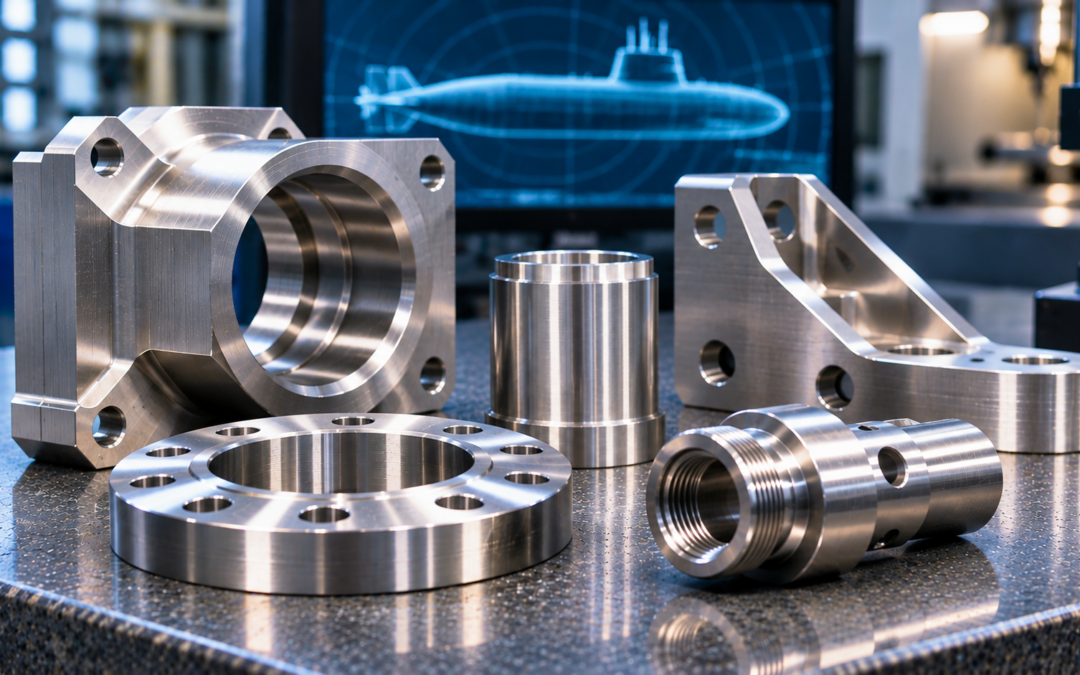
The UK submarine manufacturing industry depends on one of the country’s most technically demanding engineering supply chains. Behind the construction and maintenance of modern naval submarines is an extensive network of specialist manufacturers producing everything from sophisticated electronic systems to precision-engineered mechanical components.
For companies operating within this sector, submarine CNC machining forms an important part of the wider manufacturing process, supporting the production of accurately machined housings, brackets, shafts, sleeves and structural components.
Submarine equipment manufacturers require more than simply accurate parts. Depending on the application, they may also need documented material traceability, controlled manufacturing processes, inspection records and suppliers capable of meeting demanding quality requirements.
As the UK continues investing in its submarine programmes, the importance of a reliable domestic precision engineering supply chain is becoming increasingly apparent.
This article examines where CNC machining fits into submarine equipment manufacturing, the technical challenges involved and what defence suppliers should consider when selecting a UK subcontract machining partner.
The Growing Importance of the UK Submarine Manufacturing Supply Chain
The UK’s submarine industry supports the design, construction, maintenance and ongoing development of some of the most complex engineering systems manufactured in Britain.
Major programmes include the Astute-class attack submarines, the Dreadnought-class ballistic missile submarines and the future SSN-AUKUS attack submarine programme.
These projects involve extensive collaboration between the Ministry of Defence, major defence contractors and a broad network of specialist suppliers.
BAE Systems is responsible for submarine design and construction at Barrow-in-Furness, Rolls-Royce Submarines supplies nuclear propulsion technology, and Babcock provides important through-life engineering and maintenance support.
However, the wider industrial supply chain extends far beyond these major organisations. According to the UK government’s Submarine Delivery Agency, more than 1,000 suppliers contribute to the submarine supply chain.
These businesses provide specialist materials, manufacturing services, mechanical equipment, electrical systems, instrumentation and engineering expertise.
The scale of the opportunity is reflected in the government’s September 2026 Defence Nuclear Enterprise update, which identifies supply chain capacity, specialist manufacturing and precision engineering as important areas for continued investment.
For smaller and medium-sized engineering companies, this reinforces the importance of developing the capabilities and quality systems needed to support established defence manufacturers.
Rather than supplying complete submarine systems, many subcontractors contribute by manufacturing individual precision components to the technical requirements of their customers.
Where CNC Machined Components Fit into Submarine Manufacturing
A submarine incorporates an extensive range of mechanical and electrical systems, each containing components designed for a particular purpose.
These may include equipment associated with monitoring, control, fluid handling, communications, instrumentation and mechanical support.
While larger assemblies are often produced by specialist equipment manufacturers, many of their individual components can require precision CNC milling or turning.
Examples of component types that may be suitable for subcontract CNC machining include:
- Precision-machined equipment housings and protective enclosures
- Structural mounting brackets and support plates
- Cylindrical shafts, bushes, sleeves and spacers
- Machined flanges, adaptors and connecting components
- Instrumentation mounts and mechanical interfaces
- Valve bodies, manifolds and associated mechanical parts
- Specialist components for maintenance and equipment upgrades
These examples represent general machining applications within naval equipment manufacturing. The suitability of any subcontractor depends on the component’s specific design, criticality and applicable programme requirements.
For the equipment manufacturer, the priority is obtaining components that conform to the approved engineering drawings and can be integrated reliably into the wider assembly.
Precision Housings, Mounts and Structural Components
Housings and mounting components are particularly relevant to specialist submarine equipment manufacturers. Although their geometry can vary considerably, they often incorporate multiple features that must maintain accurate relationships with one another.
Machined Housings and Enclosures
A precision-machined housing may provide physical protection for instrumentation or establish the mechanical interface between different elements of an assembly.
Depending on the design, it may contain internal pockets, precision bores, threaded connections, sealing faces and accurately positioned mounting holes.
Manufacturing these features can require carefully planned machining sequences and workholding arrangements. For example, where a housing contains a critical bore and several associated mounting positions, the manufacturing process must account for the specified dimensional relationship between those features.
Surface finish, deburring and cleanliness requirements may also be important, particularly where the component forms part of an enclosed mechanical or electronic system.
Mounting Brackets and Support Structures
Machined brackets and supports can be used to position equipment, connect assemblies or provide rigid mechanical interfaces.
Such components may require accurate hole patterns, defined mating surfaces and controlled geometric tolerances. In some cases, removing unnecessary material can reduce component weight while maintaining the structural characteristics specified by the designer.
For complex brackets containing multiple features across different faces, multi-axis CNC machining can offer advantages by reducing repositioning and supporting accurate feature relationships.
Shafts, Sleeves and Cylindrical Components
CNC turning is particularly suited to producing cylindrical components with controlled diameters, shoulders, bores, threads and surface finishes.
These parts may be incorporated into specialist mechanical assemblies, rotating equipment or instrumentation.
Where a component requires both turned and milled features, a combined manufacturing strategy may be appropriate. The most suitable process depends on the drawing requirements, material, batch quantity and inspection criteria.
Why Manufacturing Accuracy Matters for Submarine Components
Submarine equipment can be subject to demanding operational conditions, but different mechanical components have different functional requirements.
Some must maintain precise alignment within an assembly. Others may need to accommodate specific loading conditions, sealing arrangements or thermal changes.
For a CNC machining subcontractor, the central requirement is to manufacture each component in accordance with the approved drawing and specification. This involves more than achieving a nominal dimension.
Geometric tolerances, surface finish, feature position, material condition and inspection requirements may all contribute to the definition of an acceptable finished component.
For example, a machined mounting plate may require controlled flatness across a particular face, while a cylindrical housing may need accurately manufactured mating diameters. A shaft may require closely controlled dimensions and surface texture where it interfaces with another mechanical component.
These considerations explain why engineering drawings often use geometric dimensioning and tolerancing, or GD&T, to define the required relationships between features. However, applying unnecessarily restrictive tolerances can increase manufacturing cost and complexity.
An experienced machining subcontractor can review the drawing during quotation and identify features that may require special tooling, additional setups or more detailed inspection. This early communication can help equipment manufacturers balance component functionality, manufacturability and cost.
Material Selection for Naval and Submarine Equipment
Selecting the appropriate engineering material is an important responsibility for submarine equipment designers.
Depending on where the component is installed, material requirements may be influenced by mechanical loading, corrosion resistance, temperature, vibration, compatibility with neighbouring materials and relevant technical standards. Precision CNC machining suppliers may work with several material families.
Stainless Steels
Stainless steels are widely used for components requiring useful mechanical properties and corrosion resistance.
Different grades offer different characteristics, and material suitability must be assessed against the intended service conditions. For certain marine environments, resistance to chloride-related corrosion can be particularly important.
Aluminium Alloys
Aluminium alloys offer good machinability and favourable strength-to-weight characteristics.
They may be considered for equipment housings, brackets and structural components where weight and manufacturing efficiency are relevant. The chosen alloy, surface treatment and operating environment must be assessed together, particularly where corrosion is a concern.
Engineering Steels and Specialist Alloys
Some applications require engineering steels or specialist alloys selected for specific strength, wear, temperature or corrosion-resistance characteristics.
These materials can introduce manufacturing challenges relating to cutting-tool performance, dimensional stability and surface finish. For any defence-related component, the machining supplier should follow the specified material grade and condition rather than independently substitute an alternative.
Where required, supporting material certification and traceability should form part of the manufacturing documentation.
CNC Milling and Turning for Submarine Equipment Manufacturers
Many components used by naval equipment manufacturers are suitable for conventional precision machining processes. Selecting the most effective process depends on component geometry, tolerance requirements and production quantity.
CNC milling is particularly appropriate for components incorporating flat faces, pockets, mounting holes, slots and complex external profiles. For parts requiring access to multiple faces, 4-axis or 5-axis machining may help reduce setups and improve manufacturing efficiency.
CNC turning is suited to producing cylindrical components such as shafts, bushes, sleeves, collars and threaded adaptors. Turning can provide an efficient manufacturing route for components with critical diameters, concentric features and controlled cylindrical surfaces.
Some parts require a combination of milling and turning operations. For engineers and procurement teams assessing the available options, understanding the strengths of each process can assist with manufacturing decisions.
Our guide to choosing between CNC milling and CNC turning explores how geometry, tolerances and production requirements influence the most suitable approach.
Quality Assurance, AS9100 and Traceability in the Defence Supply Chain
Manufacturing quality is a central consideration for defence equipment procurement.
Although requirements vary between programmes and component classifications, customers may expect suppliers to demonstrate effective process control, inspection arrangements and reliable documentation. 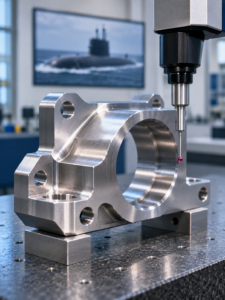
For precision CNC machining, this can involve controlling the full manufacturing process, from contract review through to final inspection and delivery.
An AS9100-certified quality management system provides a recognised framework for organisations operating within aviation, space and defence supply chains.
Building on ISO 9001, AS9100 introduces additional requirements relevant to product conformity, operational risk, traceability and configuration management. In a subcontract machining environment, controlled activities may include:
- Reviewing engineering drawings and customer specifications before production
- Managing approved drawing revisions and manufacturing instructions
- Maintaining material identification and traceability
- Controlling machining processes and inspection operations
- Recording inspection results according to agreed requirements
- Managing nonconforming components and corrective actions
- Retaining appropriate manufacturing and quality records
Depending on the contract, the customer may also require first article inspection, certificates of conformity or other specified documentation.
It is important to distinguish between general defence manufacturing quality requirements and any additional standards governing safety-critical or nuclear-related submarine components.
AS9100 certification does not automatically qualify a machining company to manufacture every type of submarine component. Any additional approvals, security conditions, special processes or programme-specific requirements must be established before work is accepted.
JOSCAR and Supplier Assurance
JOSCAR registration is another consideration for organisations seeking to operate within relevant UK defence supply chains.
JOSCAR provides a supplier information and assessment system used by participating aerospace, defence and security buyers. It helps purchasing organisations access information about suppliers and supports aspects of their supplier assurance processes.
JOSCAR registration is not itself a manufacturing quality certification, nor does it guarantee approval for a particular defence contract.
However, when considered alongside appropriate quality management certification, demonstrated machining capability and customer-specific assessments, it can form part of a supplier’s broader assurance credentials.
Supporting Low-Volume and Specialist Submarine Equipment Manufacturing
Not every component required by the submarine manufacturing supply chain is produced in large quantities.
Specialist equipment manufacturers may need prototypes, development components, small production batches or replacement parts.
Some projects involve recurring demand for a relatively small number of complex components, while others require different parts across multiple assemblies. This creates opportunities for subcontractors specialising in low-volume, high-variety CNC machining.
Such manufacturers are accustomed to managing changing component geometries, multiple materials, varied tolerances and different production requirements. However, smaller batch quantities do not remove the need for manufacturing discipline.
A repeat order may require the same approved drawing revision, material specification, inspection method and controlled manufacturing route.
For defence customers, consistency across separate production batches can be particularly important where components must remain interchangeable or compatible with existing equipment.
A capable subcontractor should therefore combine manufacturing flexibility with appropriate process control and documentation.
Building a Resilient British Submarine Supply Chain
The future of UK submarine manufacturing depends on maintaining access to specialist engineering expertise throughout the country.
Although major submarine construction takes place at established industrial centres, the supporting supply chain includes manufacturers located across Britain.
In its September 2026 Defence Nuclear Enterprise update, the UK government highlighted investment in specialist suppliers, including businesses providing precision engineering capabilities. This reflects the wider requirement for sustainable industrial capacity capable of supporting demanding long-term programmes.
For submarine equipment manufacturers, working with UK-based subcontractors can offer practical advantages. Closer communication may help resolve technical questions, review engineering changes and coordinate manufacturing requirements.
Domestic manufacturing can also support more straightforward site visits, supplier assessments and logistics arrangements, although individual supply risks still need to be considered.
Organisations seeking specialist manufacturing partners can review the UK government’s Submarine Delivery Agency industry partner information to understand the wider industrial structure supporting these programmes.
The objective for equipment manufacturers is not simply to source parts locally, but to identify suppliers capable of meeting the required technical, quality and delivery expectations.
What Should Submarine Equipment Manufacturers Look for in a CNC Subcontractor?
Selecting a precision machining subcontractor involves assessing more than manufacturing capacity or quoted price.
A supplier should be able to demonstrate that its capabilities are appropriate for the component requirements. Important considerations include:
- Machining capability: Suitable CNC milling, turning and multi-axis equipment for the required component geometries.
- Quality management: Documented processes supported by relevant quality management certification.
- Technical understanding: The ability to review drawings, identify manufacturing risks and communicate clearly with engineers.
- Material control: Appropriate arrangements for material procurement, identification and documentation.
- Inspection capability: Suitable measurement methods and records for the specified tolerances.
- Production flexibility: The ability to manage prototypes, small batches and repeat requirements.
- Commercial reliability: Clear quotations, realistic lead times and responsive communication.
- Information security: Appropriate controls for handling sensitive customer drawings and technical data.
For defence applications, these considerations may be supplemented by customer-specific supplier approval requirements. A supplier’s credentials should always be assessed against the actual scope of work.
Precision CNC Machining at Tarvin Precision
Based in Hawarden, North Wales, Tarvin Precision is a privately owned British precision engineering company specialising in low-volume, high-variety manufacturing.
We provide subcontract CNC machining services, including CNC milling, turning and multi-axis machining, for customers requiring accurately manufactured components to engineering drawings.
Our experience includes complex mechanical parts, close-tolerance machining and controlled production for demanding engineering sectors.
Tarvin Precision operates an AS9100D-certified quality management system and holds JOSCAR registration and Cyber Essentials Plus certification.
These credentials support the quality management, supplier assurance and information security considerations relevant to defence procurement.
As a Made in Britain member, we are committed to supporting British manufacturing and strengthening domestic engineering supply chains.
Our privately owned structure, precision machining capabilities and focus on low-volume, high-variety components make us a potential manufacturing partner for specialist naval equipment manufacturers seeking reliable subcontract support.
We understand that defence procurement often involves complex drawings, demanding inspection requirements and the need for dependable communication throughout manufacturing.
Our defence manufacturing capabilities provide further information about our approach to precision engineering, traceability and quality assurance.
Discuss Your Submarine Equipment CNC Machining Requirements
The UK submarine manufacturing supply chain requires specialist businesses capable of producing precision components consistently and to defined engineering standards.
Whether the requirement involves machined housings, mounting brackets, cylindrical components or other specialist mechanical parts, selecting the right subcontractor can support manufacturing quality, delivery performance and long-term supply continuity.
At Tarvin Precision, we welcome enquiries from defence equipment manufacturers and engineering businesses seeking a UK-based precision CNC machining partner.
If you require CNC machined components for a naval defence equipment project, request a quotation from Tarvin Precision to discuss your drawings, material specifications, quantities and quality requirements.