
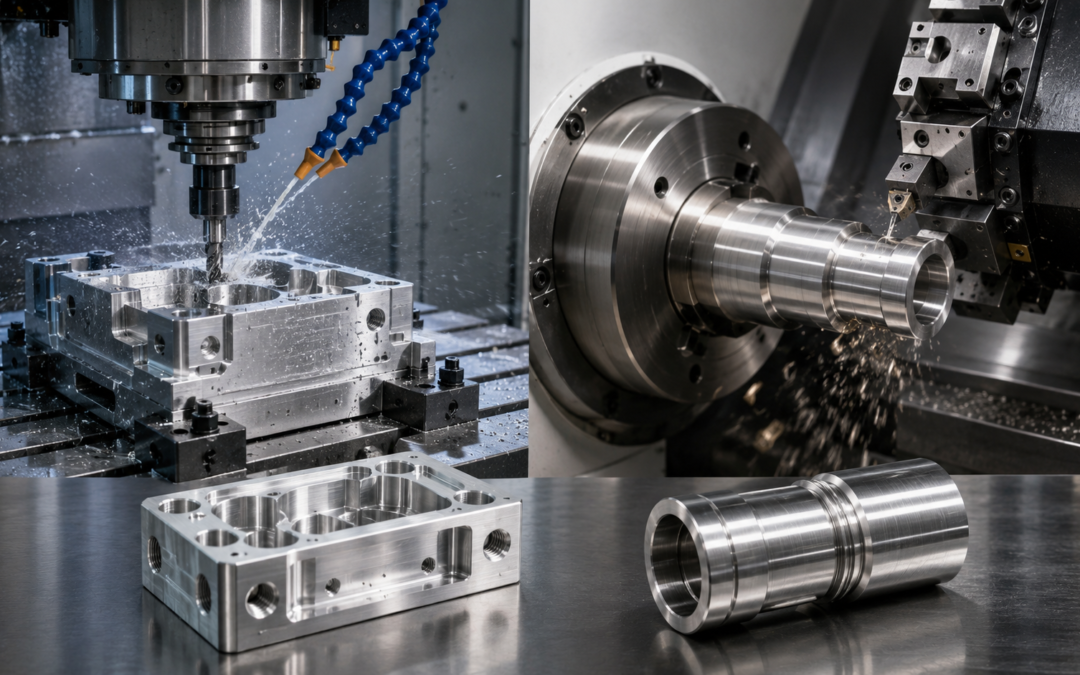
When sourcing precision machined components, one of the first questions many buyers ask is whether a part should be CNC milled or CNC turned. Both processes are widely used in modern manufacturing, and both can produce accurate, repeatable and high-quality components. However, they are not the same. Understanding CNC milling vs CNC turning can help engineers, buyers and project managers choose the right manufacturing route, reduce production risks and avoid unnecessary cost.
The simplest way to think about the difference is this: CNC milling usually uses rotating cutting tools to remove material from a fixed workpiece, while CNC turning usually rotates the workpiece against a cutting tool. This difference affects the shapes that can be produced efficiently, the type of machine required, the achievable features, the inspection approach and sometimes the final cost of the component.
This guide explains how CNC milling and CNC turning work, what each process is best suited for, and how to decide which option is right for your part.
CNC Milling vs CNC Turning: What is the Main Difference?
The main difference between CNC milling and CNC turning is how the material and cutting tool move during machining. In CNC milling, the cutting tool rotates and moves across the workpiece to remove material. In CNC turning, the workpiece rotates while a cutting tool removes material from its surface. This difference makes each process more suitable for different component shapes.
CNC milling is commonly used for prismatic, block-like or complex parts with flat surfaces, pockets, slots, drilled holes and milled profiles. CNC turning is commonly used for round, cylindrical or symmetrical components such as shafts, spacers, bushes, pins, threaded parts and sleeves. A useful way to compare them is by looking at the geometry of the finished part:
- CNC milling is often best for square, rectangular, plate, housing, bracket and enclosure-style parts.
- CNC turning is often best for round, cylindrical, conical and rotational parts.
- Mill-turn machining may be suitable when a component needs both turned and milled features.
- Secondary operations may be required when one process cannot complete every feature efficiently.
For buyers, the decision is rarely about which process is “better”. It is about which process is most appropriate for the component design, tolerance requirements, material, batch size and final application.
What is CNC Milling?
CNC milling is a subtractive machining process where rotating cutting tools remove material from a workpiece. The workpiece is typically clamped to a machine table or fixture, and the tool moves across multiple axes to create the required shape. CNC milling is highly versatile and is used across industries where precision, repeatability and complex geometry are important.
Modern CNC milling machines can produce anything from simple plates and brackets through to complex aerospace, motorsport, scientific and industrial components. Depending on the machine, milling can be carried out using 3-axis, 4-axis or 5-axis machining. More advanced machines allow access to multiple sides of a component in fewer setups, which can improve accuracy and reduce handling time. Typical CNC milling features include:
- Flat faces and stepped surfaces
- Pockets, slots and grooves
- Drilled, tapped and reamed holes
- Profiles, contours and radii
- Bosses, pads and mounting faces
- Complex multi-axis surfaces
- Lightweighted structures and machined housings
CNC milling is particularly valuable when a part has multiple faces, intersecting features or tight relationships between holes and surfaces. It is also a strong choice for components that start as billet, plate, block or casting material and require accurate material removal from several sides.
What is CNC Turning?
CNC turning is a machining process where the workpiece rotates in a chuck, collet or between centres while a fixed or moving cutting tool removes material. It is especially effective for producing round components with accurate diameters, shoulders, bores, grooves, threads and end features.
CNC lathes are widely used for components that are symmetrical around a central axis. These may include simple spacers or complex turned parts with internal features, external threads, fine surface finishes and tight diameter tolerances. Depending on the equipment, CNC turning can also include live tooling, which allows some milling, drilling or cross-hole features to be added while the part remains in the machine. Typical CNC turning features include:
- External diameters
- Internal bores
- Shoulders and steps
- Grooves and undercuts
- Internal and external threads
- Chamfers and radii
- Faces and parting-off features
- Conical or tapered forms
CNC turning is often the most efficient method for producing cylindrical parts because the rotating workpiece allows material to be removed quickly and consistently. For suitable components, it can offer excellent repeatability and efficient production times.
Considerations for Part Shapes and Geometry
The shape of the component is usually the biggest factor when deciding between CNC milling and CNC turning. If the part is mainly round and can be described by diameters along a centreline, CNC turning is often the natural starting point. If the part is mainly rectangular, has flat faces on several sides or needs complex pockets and mounting features, CNC milling is often more suitable.
Some precision machined components are not clearly one or the other. A part may begin as a turned shaft but need flats, slots or cross-drilled holes. Another part may begin as a milled block but need a precise bore, circular boss or turned insert. In these cases, a machining supplier may recommend a combined process or multiple setups. Examples of parts suited to CNC milling include:
- Machined housings and enclosures
- Mounting plates and brackets
- Aerospace structural components
- Scientific instrument parts
- Motorsport components
- Manifolds and valve blocks
- Covers, cases and precision plates
Examples of parts suited to CNC turning include:
- Shafts and pins
- Bushes and sleeves
- Spacers and standoffs
- Threaded inserts
- Collars and rings
- Rollers and plugs
- Precision cylindrical components
The more closely the part geometry matches the strengths of the process, the more efficient machining is likely to be. This can affect cost, lead time, inspection complexity and production reliability.
Tolerances and Accuracy
Both CNC milling and CNC turning can achieve tight tolerances when the machine, tooling, setup, material and inspection process are suitable. The achievable tolerance depends less on the name of the process and more on the specific feature being machined, the stability of the component and the capability of the supplier.
CNC turning is often highly effective for maintaining accurate diameters, concentricity and roundness on cylindrical parts. CNC milling is highly effective for positional accuracy, flatness, hole patterns and complex relationships between milled features. Both processes require careful planning when tolerances are very tight or when materials are difficult to machine. The technical requirements for 5-axis aerospace machining will be very different for a simpler, more straightforward production. Factors that affect tolerance capability include:
- Material stability and stress relief
- Component size and wall thickness
- Tool access and rigidity
- Workholding method
- Number of setups required
- Cutting strategy and tool wear
- Temperature control
- Inspection equipment and reporting requirements
Buyers should avoid applying unnecessarily tight tolerances across an entire drawing. Tighter tolerances usually increase machining time, inspection time and production risk. A good machining supplier can help identify which dimensions are function-critical and which can be opened up without affecting performance.
CNC Milling vs CNC Turning for Surface Finish
Surface finish is another important consideration when comparing CNC milling vs CNC turning. Both processes can produce high-quality finishes, but the resulting surface texture is created in different ways. Milling often leaves toolpath marks based on cutter movement, while turning leaves a circular or helical pattern based on the rotation of the workpiece and tool feed.
For visible, sealing, sliding or bearing surfaces, surface finish may be critical. Turned parts often achieve fine finishes on external diameters and bores, especially when appropriate inserts, speeds and feeds are used. Milled parts can also achieve excellent finishes, but larger flat faces, pockets and contoured surfaces may require specific finishing strategies. Surface finish can be influenced by:
- Cutting tool type and condition
- Feed rate and spindle speed
- Material grade and hardness
- Coolant strategy
- Toolpath strategy
- Machine rigidity
- Finishing passes
- Post-machining treatments
It is important to specify surface finish only where it matters. Over-specifying surface finish on non-critical areas can increase cost without improving component performance. For parts that will be anodised, plated, painted or otherwise finished, machining marks and edge breaks should also be considered during design and manufacture.
Different Types of Materials
CNC milling and CNC turning can both be used with a wide range of engineering materials. The best process is usually determined by part geometry rather than material alone. However, material behaviour still affects how the component is machined, how it holds tolerance and how suitable it is for certain features.
Common CNC machining materials include aluminium, stainless steel, mild steel, alloy steel, brass, bronze, copper, engineering plastics and specialist alloys. Aluminium is widely used for milled housings, brackets and lightweight structures, while steels and stainless steels are common in turned shafts, pins, bushes and threaded parts. Common material considerations for aluminium CNC machining include:
- Strength and hardness
- Machinability
- Corrosion resistance
- Thermal stability
- Weight requirements
- Surface treatment compatibility
- Wear resistance
- Industry or customer specifications
Some materials are more prone to distortion, work hardening or poor chip control. Thin-walled parts, deep bores and complex pockets may need additional planning to avoid movement during machining. This is why early supplier input can be valuable, especially when the material is expensive or the component has demanding tolerances.
Cost Considerations
Cost is one of the biggest reasons to choose the right machining process early. A part that is well suited to CNC turning may become unnecessarily expensive if produced by milling. Likewise, a complex prismatic component may be inefficient or impractical to turn. Matching the process to the geometry helps reduce machining time, setup time and avoidable handling.
CNC turning can be very cost-effective for round components because material removal is often fast and repeatable. CNC milling can be cost-effective for complex multi-face components because it allows accurate machining of pockets, holes, faces and profiles. The lowest-cost option is not always the one with the shortest machine cycle; it may be the route that reduces setups, scrap risk and inspection complexity. Machining cost is influenced by:
- Raw material size and type
- Machine setup time
- Cycle time
- Tooling requirements
- Batch quantity
- Tolerance and surface finish requirements
- Inspection requirements
- Secondary operations
- Finishing and treatment processes
Design decisions can also affect cost. Deep pockets, very small internal radii, long slender turned features, excessive tolerances and hard-to-reach surfaces can all increase machining time. A manufacturability review can often identify small changes that improve cost without compromising function.
CNC Milling vs CNC Turning for Lead Times
Lead time depends on more than the machining process itself. Material availability, machine capacity, inspection requirements, surface finishing, customer approvals and batch size can all influence delivery dates. However, choosing the right process can still make a significant difference.
CNC turning may offer short lead times for simple cylindrical parts, especially where bar stock is readily available. CNC milling may be efficient for complex parts where multiple features can be completed in one or two setups. If a part requires both milling and turning, lead time may increase unless the supplier has suitable mill-turn capability or can manage the process efficiently in-house. Lead time may be affected by:
- Availability of certified material
- Complexity of programming
- Number of setups
- Fixture design
- Machine availability
- Inspection and documentation
- Subcontract finishing
- First article inspection requirements
- Customer review and approval stages
For urgent projects, buyers should provide complete drawings, CAD data, material requirements, quantities and finishing details as early as possible. Clear information reduces back-and-forth and helps the supplier confirm the most efficient production route.
Design for Manufacture
Design for manufacture is the process of making a component easier, more reliable and more cost-effective to produce. When comparing CNC milling vs CNC turning, design for manufacture can help identify whether the part shape supports the chosen process or creates unnecessary machining challenges.
For milled parts, designers should consider tool access, internal corner radii, pocket depth, wall thickness and datum strategy. For turned parts, designers should consider diameter changes, groove positions, bore depths, thread requirements and how the part will be held during machining. Small adjustments can often make a part easier to produce without affecting how it works. Useful design for manufacture considerations include:
- Avoiding unnecessarily deep pockets
- Allowing realistic internal radii
- Reducing excessive length-to-diameter ratios
- Avoiding very thin unsupported walls
- Specifying clear datums
- Applying tight tolerances only where needed
- Considering inspection access
- Matching material choice to function and machinability
A good supplier will not simply quote the drawing in isolation. They should be able to review the component, flag potential manufacturing risks and suggest practical improvements where appropriate. This can be especially useful during prototype development or before committing to repeat production.
When to Use CNC Milling
CNC milling is usually the right choice when the component has flat faces, complex profiles, pockets, multiple hole patterns or features on several sides. It is also suitable when the part begins as a billet, plate or block and requires accurate removal of material to create the final shape.
Milling is widely used for components where alignment between features matters. For example, CNC machined housings may need accurate bearing bores, mounting holes, sealing faces and internal pockets. A bracket may need profiled edges, countersunk holes and tight relationships between mounting surfaces. These features are often naturally suited to CNC milling. CNC milling may be the best choice for:
- Complex prismatic components
- Housings, cases and enclosures
- Brackets, plates and frames
- Components with multiple flat faces
- Parts with pockets, slots and milled profiles
- Components requiring accurate hole patterns
- Parts needing 3-axis, 4-axis or 5-axis machining
CNC milling is also a strong option for prototypes because it allows complex shapes to be produced directly from CAD data without dedicated tooling. This makes it useful for development projects, specialist components and low-volume production.
When to Use CNC Turning
CNC turning is usually the right choice when the component is round, cylindrical or symmetrical around a central axis. It is particularly effective when the part can be machined from bar stock or a round billet and requires accurate diameters, bores, shoulders, grooves or threads.
Turning is often selected for parts where concentricity, roundness and diameter control are important. Components such as shafts, bushes and spacers are well suited to turning because the geometry follows the rotation of the workpiece. With the right tooling and setup, CNC turning can be efficient and highly repeatable. CNC turning may be the best choice for:
- Shafts, pins and axles
- Bushes, sleeves and spacers
- Round inserts and collars
- Threaded components
- Components with accurate bores
- Parts with external and internal diameters
- Cylindrical components produced from bar stock
Some CNC lathes also include driven tooling, allowing selected milled features to be added. This can reduce the need for separate operations and may improve consistency where turned and milled features must align.
Prototypes and Production Batches
Both CNC milling and CNC turning are suitable for prototypes, small batches and repeat production. The best choice depends on the part design and the wider manufacturing requirements. For prototypes, flexibility is often important. For production batches, repeatability, cycle time and inspection efficiency become increasingly important.
CNC milling is often used during development because it can create complex parts from solid material without specialist tooling. CNC turning is often highly efficient for producing repeat batches of round parts, especially where bar-fed production or repeatable workholding can be used. In both cases, good programming and process control are important for consistent results. When planning prototypes or production batches, buyers should consider:
- Whether the design is final or still changing
- How many parts are required
- Whether future repeat orders are expected
- Whether the material is readily available
- How critical the tolerances are
- Whether inspection reports are required
- Whether finishing or assembly is needed
A prototype may be machined differently from a production part if the priority is speed rather than long-term efficiency. However, where possible, it is useful to consider future production requirements early so the prototype design does not create avoidable problems later.
CNC Milling vs CNC Turning: Can One Part Need Both?
Many precision components require both CNC milling and CNC turning. A part may have a cylindrical body with flats, slots, drilled holes or milled pockets. Another part may have a milled outer form with a precision turned bore or circular feature. In these cases, the supplier may recommend a combined machining route.
Mill-turn machines can complete both turning and milling operations in one setup or reduced setups, depending on the component. This can improve accuracy because the part does not need to be transferred between multiple machines as often. However, not every component requires mill-turn machining, and not every mill-turn route is the most cost-effective option. A part may need both processes if it includes:
- Accurate diameters and milled flats
- Turned shafts with cross holes
- Cylindrical parts with keyways or slots
- Milled bodies with precision bores
- Threaded components with side features
- Components requiring multiple operations
The best route depends on the tolerance relationships between features, batch size, machine availability and overall cost. An experienced supplier can advise whether to use turning, milling, mill-turn machining or a planned sequence of separate operations.
How to Choose Between Milling and Turning
Choosing between CNC milling and CNC turning starts with the component geometry, but it should also include tolerance, material, quantity, surface finish, inspection and lead time requirements. Buyers do not need to decide everything before speaking to a supplier, but understanding the basics helps create a better technical conversation.
If the part is mostly round, begin by considering CNC turning. If the part is mostly block-like, begins as plate or needs machined features across several faces, begin by considering CNC milling. If the part contains both round and prismatic features, ask whether a combined route would reduce setups or improve accuracy. A practical decision checklist includes:
- Is the part mainly round or mainly prismatic?
- Does the component need accurate diameters or flat faces?
- Are there features on multiple sides?
- Are bores, threads, slots or pockets involved?
- What tolerances are function-critical?
- What material and finish are required?
- What quantity is needed now and in future?
- Is inspection documentation required?
- Are there any assembly or finishing stages?
The earlier these details are reviewed, the easier it is to identify the most reliable manufacturing route. This can help prevent delays, reduce redesign work and improve the quality of the final component.
What Information Should Buyers Provide?
To receive an accurate quote and practical manufacturing advice, buyers should provide as much technical information as possible. A drawing and CAD model are usually the starting point, but they are not always enough on their own. Material requirements, tolerances, finishing standards and end-use expectations can all affect the recommended process.
When a supplier understands how the component will be used, they can assess risks more effectively. For example, a sealing face, bearing location or alignment feature may need greater attention than a non-critical external surface. Clear communication helps the supplier focus machining and inspection effort where it matters most. Useful information to provide includes:
- 2D engineering drawing
- 3D CAD model
- Material grade and specification
- Quantity required
- Critical tolerances
- Surface finish requirements
- Thread and insert requirements
- Finishing or treatment requirements
- Inspection report requirements
- Application or industry context
- Target delivery date
Providing complete information at the enquiry stage can reduce delays and improve quote accuracy. It also helps the supplier recommend whether CNC milling, CNC turning or a combined process is most suitable.
Common Mistakes When Comparing
One common mistake is assuming that any CNC process can make any part equally efficiently. While both CNC milling and CNC turning are precise and versatile, each has natural strengths. Choosing the wrong method can increase setup time, machining time and cost.
Another mistake is focusing only on the unit price without considering quality, repeatability and risk. A cheaper route may become more expensive if it creates tolerance issues, finishing problems or inspection failures. The best solution is usually the process that produces the part reliably and consistently at the required quality level. Common mistakes include:
- Choosing a process before reviewing the geometry
- Over-specifying tolerances across the whole drawing
- Ignoring workholding and tool access
- Underestimating finishing and inspection time
- Not considering future batch production
- Supplying incomplete drawings or missing CAD data
- Treating prototype and production needs as identical
Avoiding these mistakes can make the sourcing process smoother and help buyers receive more useful advice from machining suppliers.
FAQs
The following questions are often asked by buyers comparing CNC milling vs CNC turning. The answers depend on the specific component, but these general principles can help guide early decision-making before requesting a quote.
Is CNC milling more accurate than CNC turning?
CNC milling is not automatically more accurate than CNC turning. Both can produce tight tolerances when the right machine, setup, tooling and inspection methods are used. Turning is often excellent for diameters and concentric features, while milling is often excellent for flat faces, hole positions and multi-face geometry.
Is CNC turning cheaper than CNC milling?
CNC turning can be cheaper for round components because it is efficient for cylindrical geometry. CNC milling can be more cost-effective for complex prismatic parts. Cost depends on material, setup time, cycle time, tolerance requirements, finishing and batch size.
Can CNC milling make round parts?
CNC milling can produce round features, pockets and profiles, but it may not be the most efficient method for a fully cylindrical part. If the part is mainly round, CNC turning is usually worth considering first.
Can CNC turning make square features?
Standard CNC turning is mainly suited to round features, but CNC lathes with driven tooling can produce some flats, slots and cross holes. More complex square or multi-face features may require CNC milling or mill-turn machining.
Which process is best for precision components?
The best process is the one that matches the component design and quality requirements. Precision components can be produced by CNC milling, CNC turning or a combination of both.
Decision Depends on the Component
Understanding CNC milling vs CNC turning helps buyers make better sourcing decisions for precision machined components. CNC milling is usually best for complex, prismatic, multi-face parts with pockets, slots, profiles and accurate hole patterns. CNC turning is usually best for round, cylindrical or symmetrical components with diameters, bores, grooves and threads.
Many parts clearly suit one process, while others need a combination of both. The right choice depends on geometry, tolerance requirements, material, surface finish, quantity, inspection needs and lead time. By providing clear drawings, CAD data and application details, buyers can help their machining supplier recommend the most efficient and reliable production route.
For manufacturers, engineers and procurement teams, the key is not simply choosing between milling and turning. It is choosing a machining partner who understands both processes and can advise on the best route for quality, consistency and long-term supply.