
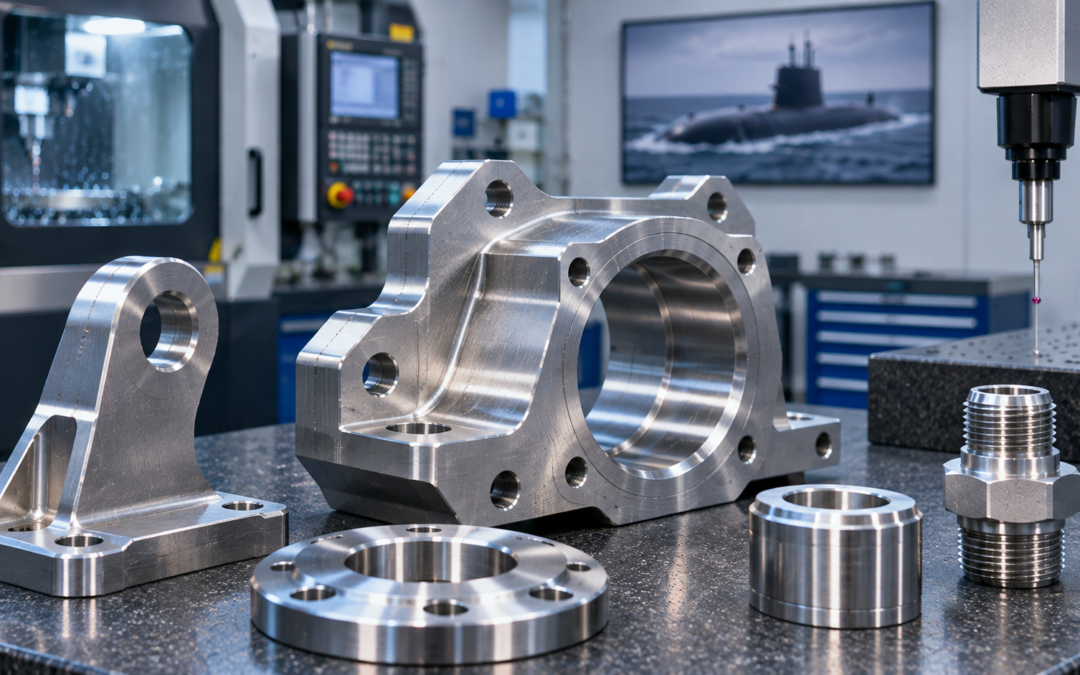
Modern naval defence equipment depends on an extensive network of specialist engineering companies. While major contractors are responsible for delivering complete systems, many of the precision-machined components within those systems are manufactured by specialist subcontractors.
From mechanical housings and mounting brackets to precision shafts, adaptors and complex engineered components, defence equipment CNC machining plays an important role in supporting manufacturers throughout the naval supply chain.
For specialist defence equipment manufacturers, selecting a CNC machining subcontractor involves more than comparing prices or available machine capacity. Dimensional accuracy, manufacturing flexibility, material traceability, information security and reliable communication can all influence whether a supplier is suitable for a particular project.
These considerations become especially important where manufacturers require low-volume, high-variety components produced to demanding engineering specifications.
This article explores how subcontract CNC machining supports specialist naval defence equipment manufacturers, the capabilities procurement teams should look for and why quality-controlled British manufacturing remains important to the defence supply chain.
The Role of Subcontract CNC Machining in Naval Defence Manufacturing
The naval defence industry includes a diverse range of businesses responsible for developing, manufacturing and maintaining specialist equipment.
Beyond the major organisations involved in shipbuilding and submarine construction are companies producing mechanical systems, instrumentation, underwater technology, electronic equipment and supporting engineering assemblies. Many of these manufacturers require precision-machined components but may not maintain every manufacturing process within their own facilities.
Subcontract CNC machining provides access to specialist manufacturing equipment and expertise, allowing customers to concentrate their internal resources on product development, assembly, testing and system integration.
For example, a specialist equipment manufacturer may design a mechanical assembly containing several machined housings, brackets and cylindrical components. Rather than manufacture every item internally, the business can source these components from a qualified machining subcontractor working to its approved engineering drawings.
This approach can provide access to different machining processes, manufacturing flexibility and additional production capacity. However, the effectiveness of subcontract manufacturing depends on selecting suppliers whose capabilities and working practices match the technical and contractual requirements.
Precision CNC Machined Components for Specialist Defence Equipment
Defence equipment manufacturers use a wide variety of mechanical components, each designed for a specific application.
Some provide structural support or accurate positioning, while others form mechanical interfaces, protect equipment or contribute to moving assemblies. Typical component types suitable for subcontract CNC machining can include:
- Precision-machined equipment housings and enclosures
- Structural mounting brackets and support plates
- Cylindrical shafts, bushes, sleeves and spacers
- Machined flanges, adaptors and connecting components
- Instrumentation mounts and locating features
- Manifold blocks and mechanical interfaces
- Complex components combining turned and milled features
The exact manufacturing requirements depend on the intended application, the approved engineering drawing and any relevant customer or programme specifications.
Housings and Protective Enclosures
Machined housings may contain complex internal pockets, precision bores, threaded connections, mounting features and sealing interfaces.
Depending on their function, accurate dimensions and controlled mating surfaces can be important for successful assembly. Some housings require several machining operations to produce features across different faces while maintaining the specified geometric relationships.
Mounting Brackets and Structural Components
Mounting components may need accurately located holes, machined seating surfaces and controlled flatness or perpendicularity.
Where a design incorporates weight-reducing pockets or complex external geometry, CNC milling can offer a suitable manufacturing solution. The important requirement is that the finished component conforms to the approved design, including any relevant geometric tolerances.
Shafts, Sleeves and Mechanical Adaptors
Cylindrical components often involve controlled diameters, shoulders, bores, threads and surface finishes. These may be manufactured using CNC turning, with additional milling operations where needed.
For certain mechanical interfaces, the relationship between mating components can be particularly important, making dimensional tolerances and inspection essential considerations.
Why Low-Volume, High-Variety CNC Machining Matters
Not every specialist defence equipment programme requires large quantities of identical components. Development projects, specialist instruments, replacement parts and smaller equipment assemblies can all involve limited production quantities.
A manufacturer may require ten different precision components rather than several thousand examples of a single part. This creates a different set of manufacturing challenges from those associated with high-volume production.
Low-volume, high-variety CNC machining requires the ability to manage frequent setup changes, different materials, varying component geometries and individual inspection requirements. For equipment manufacturers, this flexibility can be valuable when sourcing components for specialist applications.
Supporting Prototypes and Development Work
During product development, manufacturers may require small quantities of components to evaluate mechanical fit, assembly and manufacturability. These parts might be used for initial testing or to identify potential design changes before a final manufacturing specification is approved.
A machining subcontractor with appropriate engineering experience can provide feedback on manufacturing considerations, including workholding, tool access and features that may increase production complexity. Any design modifications must remain subject to the customer’s approval and configuration control arrangements.
Repeat Manufacturing and Small Production Batches
Low production quantities do not remove the importance of process consistency.
Where a component is ordered again, the supplier may need to reproduce it to the same approved drawing revision, material specification and inspection requirements. Documented manufacturing instructions and controlled production records can help support this consistency.
For defence equipment manufacturers, reliable repeat manufacture can be important when planning maintenance, equipment upgrades or ongoing production.
CNC Milling and Turning for Naval Defence Components
Different component designs require different machining approaches. A specialist subcontractor with access to multiple CNC machining processes can support manufacturers sourcing a variety of mechanical parts.
CNC Milling for Complex Components
CNC milling is well suited to components incorporating flat surfaces, pockets, holes, slots and complex machined profiles. It is commonly used for brackets, housings, structural components and mechanical interfaces.
Where a component requires machining across several faces, 4-axis or 5-axis equipment may reduce the number of setups or improve access to particular features. However, the appropriate machining strategy depends on the geometry and tolerances rather than the complexity of the machine alone.
At Tarvin Precision, our CNC milling services support the manufacture of complex components using controlled machining processes.
CNC Turning for Cylindrical Components
CNC turning is particularly relevant for shafts, bushes, sleeves, collars and adaptors. It can produce accurate rotational features, including external diameters, internal bores, shoulders and threads.
Additional operations may be required where components incorporate features that are not rotationally symmetrical. Our CNC turning capabilities support the production of precision components requiring dimensional control and repeatability.
For defence equipment manufacturers, sourcing turning and milling from a supplier familiar with both processes can simplify the management of mixed-component manufacturing requirements.
Managing Tight Tolerances and Engineering Drawings
Precision CNC machining is ultimately about producing components that conform to the requirements of their engineering drawings.
Although close tolerances are often associated with defence manufacturing, not every feature requires exceptionally tight dimensional control. The correct tolerance depends on the function of the component and how it interacts with neighbouring parts.
A precision bore may need a defined diameter and geometric tolerance, while a mounting face may require controlled flatness. Other dimensions may allow greater variation without affecting the component’s intended function. Understanding these differences is important when planning a manufacturing process.
Overly restrictive tolerances can increase machining time, inspection requirements and manufacturing cost. Conversely, insufficient control of functionally important features can create assembly difficulties or result in nonconforming components.
Geometric dimensioning and tolerancing (GD&T) provides a recognised method of communicating requirements relating to position, orientation, form and runout.
For components incorporating mating shafts and bores, the specified dimensional relationship may also determine whether the assembly uses a clearance, transition or interference fit. Our guide to clearance, transition and interference fits in CNC machined parts explains how these relationships influence manufacturing and assembly.
A technically capable subcontractor should review the complete drawing, identify critical features and plan the machining and inspection operations accordingly.
Material Selection and Manufacturing Control
Naval defence equipment may operate in environments involving moisture, vibration, mechanical loading or significant temperature variation. However, material requirements differ between applications.
A housing installed inside a protected equipment enclosure may have different material considerations from a component exposed directly to a marine environment.
Manufacturers may specify aluminium alloys, stainless steels, engineering steels or more specialised materials according to the intended application. Each material family introduces different machining considerations.
For example, some stainless steels require careful control of cutting conditions, while thin-walled aluminium components may be sensitive to workholding forces and residual stress. The selected machining process must account for these characteristics while maintaining the required dimensional accuracy and surface finish.
For defence-related manufacturing, material identification and traceability can also form part of the contractual requirements. Where specified, material certificates and associated records should support the identification of the material used for a particular production batch.
A subcontract machining supplier should manufacture components using the approved material grade and condition, with any proposed substitutions agreed through the customer’s authorised process.
AS9100 and Quality Assurance for Defence Subcontract Manufacturing
Quality management is one of the most important considerations when selecting a subcontractor for defence-related components.
A technically capable workshop may have suitable machinery, but defence customers can also require evidence of controlled manufacturing processes, appropriate inspection and documented handling of nonconforming products.
An AS9100-certified quality management system provides a recognised framework for organisations operating within aviation, space and defence supply chains. Building on ISO 9001, AS9100 includes additional requirements relevant to operational risk, configuration management, product safety and quality control.
Within CNC machining, a structured quality management system can support activities such as:
- Reviewing customer drawings and contractual requirements
- Controlling drawing revisions and manufacturing instructions
- Managing material identification and traceability
- Planning machining and inspection operations
- Recording inspection results where required
- Managing nonconforming products and corrective action
- Maintaining appropriate production and quality documentation
Depending on the customer and component, additional requirements may include first article inspection, certificates of conformity or specific inspection reporting.
AS9100 certification does not automatically approve a supplier for every defence programme or component classification. Additional customer approvals, special process requirements and programme-specific conditions must still be considered.
For manufacturers selecting a subcontractor, the value lies in combining appropriate certification with demonstrated manufacturing capability and effective day-to-day quality controls.
JOSCAR Registration and Supplier Assurance
Defence procurement can involve detailed assessment of potential suppliers.
In addition to technical capability and manufacturing quality, purchasing organisations may consider business information, compliance arrangements, security and other supplier assurance requirements.
JOSCAR registration supports this process by providing a recognised supplier information and assessment system used by participating aerospace, defence and security organisations.
For a CNC machining company, JOSCAR registration can help demonstrate engagement with the supplier assurance processes relevant to these markets. However, JOSCAR is not a manufacturing quality standard and should not be confused with AS9100 certification.
The two serve different purposes.
AS9100 establishes requirements for the quality management system used to deliver products and services, while JOSCAR assists participating organisations with supplier information and assessment.
Neither replaces a customer’s responsibility to assess the suitability of a supplier for a particular manufacturing requirement.
Cyber Security and Protecting Engineering Information
For defence equipment manufacturers, the security of technical information is another important consideration when selecting subcontractors.
Manufacturing projects can involve sensitive drawings, CAD models, specifications, revision histories and commercial documentation. Unauthorised access or disruption to these systems can create significant problems for both the customer and supplier.
Cyber Essentials Plus is a UK government-backed certification involving independent technical verification of specified cyber security controls. It provides assurance that an organisation has implemented the relevant controls assessed under the scheme.
However, Cyber Essentials Plus does not automatically authorise a company to receive classified information or replace additional security requirements imposed by a defence customer. Machining subcontractors must understand and follow the information handling requirements associated with each contract.
For defence procurement teams, cyber security should therefore be assessed alongside manufacturing quality, traceability and technical capability.
Building Reliable Long-Term Defence Manufacturing Partnerships
A successful subcontract manufacturing relationship depends on more than delivering an individual batch of components.
Specialist defence equipment manufacturers may work with suppliers across several product revisions, repeat orders and different engineering projects. This requires reliable communication and a clear understanding of customer expectations.
At the quotation stage, a machining supplier should review the available technical documentation and identify any features that may affect manufacturing cost, inspection or delivery.
During production, clear communication can help address drawing queries, material issues or changes in requirements. Once components have been delivered, maintaining appropriate manufacturing records can support future repeat orders.
For manufacturers, the most useful suppliers are often those who combine technical competence with consistent service and an understanding of long-term manufacturing requirements.
What Should Procurement Teams Look for in a CNC Machining Subcontractor?
When assessing potential suppliers, useful considerations include:
- Suitable CNC milling and turning capabilities
- Experience with complex, low-volume components
- Appropriate quality management certification
- Material control and traceability arrangements
- Suitable dimensional inspection capability
- Clear communication with engineering and procurement teams
- Appropriate cyber security controls
- Realistic production planning and delivery commitments
- Willingness to support prototypes and repeat manufacturing
The relative importance of these factors depends on the component, contract and programme requirements.
Strengthening the British Defence Manufacturing Supply Chain
Maintaining a capable domestic manufacturing supply chain remains an important consideration for the UK defence industry.
The Ministry of Defence’s 2025 Defence Industrial Strategy identifies British industrial capability, supply chain resilience and greater opportunities for small and medium-sized enterprises as important priorities.
This reflects the role that specialist businesses can play in supporting larger defence manufacturers.
For equipment manufacturers, UK-based subcontract machining can provide practical benefits, including more direct communication, opportunities for supplier visits and potentially simpler logistics arrangements.
However, geographical proximity alone does not establish manufacturing capability. A reliable domestic supplier must still demonstrate suitable technical expertise, quality management, capacity and commercial performance.
For specialist British engineering companies, investing in these capabilities helps strengthen the wider manufacturing network supporting defence programmes.
The government’s Defence Industrial Strategy 2025 provides further context on the importance of developing a resilient and competitive UK defence supply base.
Precision Defence Equipment CNC Machining at Tarvin Precision
Based in Hawarden, North Wales, Tarvin Precision is a privately owned British precision engineering company specialising in low-volume, high-variety CNC machining.
We manufacture precision components to customer drawings, supporting manufacturers who require complex geometries, close tolerances and controlled production processes.
Our capabilities include CNC milling, CNC turning and 5-axis machining, with an emphasis on manufacturing flexibility, quality assurance and repeatability.
Tarvin Precision operates an AS9100D-certified quality management system, holds JOSCAR registration and is certified to Cyber Essentials Plus.
These credentials support the manufacturing quality, supplier assessment and cyber security requirements relevant to defence procurement.
Our integrated manufacturing systems provide control and traceability across production, supporting customer requirements for inspection documentation and repeat manufacturing.
As a Made in Britain member, we are committed to supporting British industry, engineering skills and resilient domestic supply chains.
We recognise that specialist naval defence equipment manufacturers may require small batches, complex machined features, controlled documentation and dependable supplier communication.
Our privately owned structure and focus on low-volume, high-variety work provide a foundation for supporting these manufacturing requirements.
Further information about our credentials and capabilities is available on our defence manufacturing page.
Discuss Your Defence Equipment CNC Machining Requirements
Specialist defence equipment manufacturing depends on accurate components, controlled processes and reliable subcontract supply.
Whether your requirement involves precision housings, structural brackets, cylindrical components or complex machined assemblies, selecting the right manufacturing partner can help support component conformity and dependable delivery.
At Tarvin Precision, we welcome enquiries from naval defence equipment manufacturers, specialist engineering businesses and procurement teams seeking a UK-based CNC machining subcontractor.
If you have engineering drawings or CAD models for precision-machined defence equipment components, request a quotation from Tarvin Precision to discuss your requirements, materials, quantities and quality documentation.