
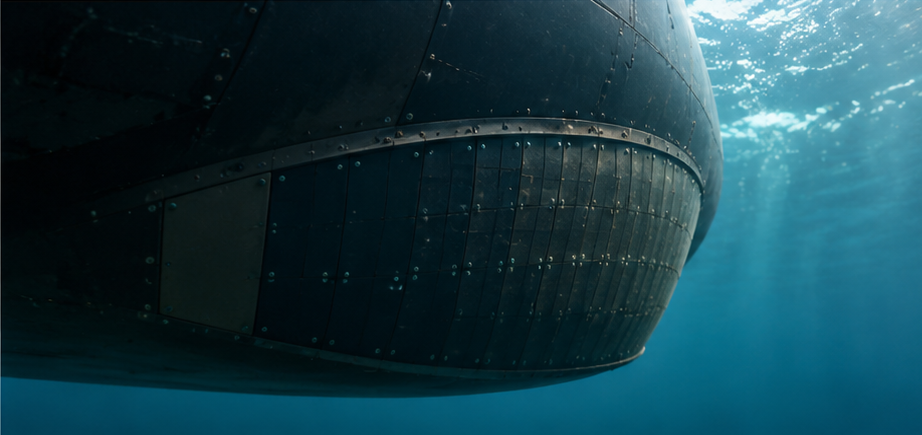
Modern naval sonar systems depend on sophisticated acoustic technology, but their effectiveness also relies on the precision-engineered mechanical components that support, protect and position sensitive equipment.
From underwater sensor housings and mounting brackets to machined enclosures and structural components, CNC machining for sonar systems plays an important role in the wider manufacturing supply chain.
For companies developing naval sonar equipment, underwater monitoring systems and specialist marine technology, sourcing reliable precision-machined components involves more than finding a supplier capable of producing complex shapes. Material selection, dimensional accuracy, repeatability, surface finish and documented quality control can all influence how successfully a component performs within its intended assembly.
This article explores the role of precision CNC machining in sonar equipment manufacturing, the engineering challenges involved and what manufacturers should consider when selecting a UK machining subcontractor.
The Role of Precision Machining in Naval Sonar Systems
Sonar, or Sound Navigation and Ranging, uses underwater sound to detect, locate and characterise objects or features in the marine environment.
These systems have important applications in naval operations, submarine detection, underwater navigation, hydrographic surveying and subsea monitoring. Although acoustic transducers, hydrophones and signal-processing electronics perform the principal sensing functions, they must be integrated into mechanical assemblies capable of meeting demanding operational requirements.
The UK’s Royal Navy relies on advanced sonar systems across its submarine and surface fleet. Sonar 2076, for example, is used on Astute-class submarines and is also planned for the Dreadnought class.
The importance of specialist manufacturing within this sector was demonstrated in April 2025, when Marshall announced a long-term agreement with Thales UK to manufacture and support sonar array modules for the Royal Navy. Such programmes illustrate the wider industrial ecosystem supporting naval acoustic technology, including specialist engineering, mechanical component manufacturing, assembly and testing.
For precision machining companies, the relevant opportunities lie in producing components to customer drawings and specifications that form part of these larger systems.
CNC Machined Components for Sonar Equipment
Sonar equipment manufacturers may require a wide variety of mechanical components, depending on the system design, installation environment and operating conditions. Some components provide structural support, while others protect instrumentation, establish alignment or create mechanical interfaces between assemblies.
Sensor Housings and Protective Enclosures
Machined housings can provide an accurately manufactured mechanical interface around sensitive electronics and instrumentation.
Depending on the application, housing features may include internal bores, mounting flanges, threaded connections, recessed sealing areas and accurately positioned holes. For components exposed to moisture or seawater, the relationship between material selection, protective treatments and sealing design can be particularly important.
CNC milling and turning can produce these features to defined dimensional requirements, allowing the finished component to integrate with surrounding mechanical and electrical assemblies.
Sonar Mounting Brackets and Support Structures
Mounting brackets and structural supports are another potential application for precision CNC machining within sonar equipment.
These components may need to maintain accurate positional relationships between a sensor, its mounting structure and associated equipment. Typical machined features can include:
- Accurately positioned mounting holes and locating features
- Precision bores and machined seating surfaces
- Threaded connections and fastening points
- Recesses, pockets and weight-reducing features
- Controlled mating faces and assembly interfaces
In systems where vibration behaviour or acoustic isolation is important, the mechanical design and mounting arrangement must also meet the equipment manufacturer’s requirements.
The machining supplier’s responsibility is to manufacture the component accurately to the approved specification, rather than independently determine the acoustic performance of the complete assembly.
Adaptors, Spacers and Mechanical Interfaces
Not every component within a sophisticated sonar assembly is geometrically complex.
Spacers, bushes, sleeves, adaptors and connecting components may appear relatively straightforward, but their dimensions and tolerances can be essential to successful assembly.
For example, a precision-machined spacer may establish a specified separation between mechanical interfaces, while an adaptor may connect components manufactured using different mounting arrangements.
Consistent dimensions become especially important where components must remain interchangeable during maintenance, replacement or future production.
Why Dimensional Accuracy Matters in Sonar Equipment Manufacturing
Precision machining is about producing a component that conforms to its engineering drawing, including requirements that extend beyond basic length, width and diameter.
In sonar equipment assemblies, dimensional and geometric controls may affect how components locate, fasten and interact with neighbouring parts. A mounting component might require accurate hole positions relative to a defined datum. A machined housing may need a controlled bore diameter, specific surface finish and accurately located mating face.
Where multiple components form an assembly, these individual characteristics can influence the accumulated dimensional variation.
Geometric dimensioning and tolerancing (GD&T) provides a structured way of specifying characteristics such as position, flatness, perpendicularity and cylindricity.
These requirements are particularly relevant where maintaining alignment and reliable assembly is more important than achieving unnecessarily tight general tolerances. For manufacturers, the challenge is to determine which characteristics are critical to the component’s function and develop an appropriate machining and inspection strategy.
A technically capable CNC subcontractor should be able to review the drawing, identify demanding features and plan a manufacturing route that supports consistent conformity.
Material Selection for Underwater Defence Components
Choosing a suitable material is an important part of designing mechanical components for naval and underwater equipment.
Different applications may involve exposure to seawater, humidity, changes in temperature, vibration or mechanical loading. Common engineering materials that may be considered include aluminium alloys, stainless steels and specialist corrosion-resistant alloys.
Aluminium Alloys
Aluminium offers useful strength-to-weight characteristics and good machinability, making it suitable for many precision housings, brackets and structural components.
Where corrosion protection is required, an appropriate alloy and surface treatment must be selected for the intended operating environment. Not all aluminium grades or protective treatments are suitable for prolonged seawater exposure.
Stainless Steel
Stainless steel is widely used in engineering applications requiring strength, durability and resistance to corrosion.
However, stainless steel grades differ significantly in their suitability for marine conditions. Selecting the correct grade requires consideration of the environment, component function, mechanical properties and relevant customer specifications.
Specialist Materials
Some underwater equipment may require materials with additional properties, such as enhanced corrosion resistance, controlled thermal behaviour or specific mechanical characteristics.
These requirements can introduce machining challenges related to tool selection, cutting conditions, workholding and achievable surface finish. Whatever the material, manufacturing should follow the specified grade, condition and any associated documentation requirements.
CNC Milling and Turning for Sonar Components
The most suitable machining process depends on component geometry and the tolerances specified by the equipment manufacturer.
CNC milling is particularly useful for components containing flat faces, mounting surfaces, pockets, complex profiles and accurately positioned holes. It can be an effective approach for manufacturing structural brackets, enclosures and mechanical interfaces.
CNC turning is generally better suited to cylindrical components such as housings, bushes, sleeves, adaptors and threaded components.
Where a part combines cylindrical and prismatic features, a planned combination of turning and milling may be required.
For low-volume, high-variety manufacturing, production planning also needs to consider setup times, workholding, material removal and inspection. An effective machining strategy balances dimensional conformity with manufacturing efficiency, rather than automatically selecting the most complex process available.
Quality Assurance and Traceability in Naval Defence Machining
For defence equipment manufacturers, dimensional accuracy is only one aspect of assessing a subcontract machining supplier. 
Depending on the programme, suppliers may also need to demonstrate controlled manufacturing processes, documented inspection, material traceability and appropriate management of design changes.
An AS9100-certified quality management system provides a structured framework for managing quality within aviation, space and defence manufacturing supply chains.
The standard builds on ISO 9001 and includes additional requirements relating to matters such as operational risk, product conformity, configuration management and supplier control. For CNC machined components, these principles can support activities including:
- Reviewing customer drawings and technical requirements
- Maintaining control of drawing revisions
- Managing material identification and traceability
- Planning machining and inspection operations
- Recording inspection results where required
- Controlling nonconforming products
- Maintaining appropriate production documentation
Individual programmes may additionally require first article inspection, certificates of conformity or other customer-specific documentation. The requirements should be established during contract review and agreed before manufacturing begins.
JOSCAR registration is also relevant within the UK defence supply chain, providing participating buying organisations with a recognised supplier information and assessment system. Although JOSCAR registration and AS9100 certification serve different purposes, both can contribute to the supplier assurance process.
For a more detailed explanation, our guide to AS9100-certified CNC machining for defence components examines the role of quality management and inspection in defence manufacturing.
Supporting Prototypes and Low-Volume Sonar Equipment Production
Not every underwater defence equipment project requires large production quantities.
Development programmes, specialist instrumentation, equipment modifications and replacement components may involve relatively small batches. This can create challenges for manufacturers who need precision components but cannot justify high-volume manufacturing arrangements.
Low-volume, high-variety CNC machining offers flexibility for producing components in smaller quantities, particularly where designs are specialised or subject to engineering change.
During development, prototypes may be used to establish component fit, verify manufacturability or support equipment testing. Once designs are approved, controlled production documentation becomes important for repeat manufacture and future replacement requirements.
For equipment manufacturers, working with a responsive machining subcontractor can help manage these different stages without losing sight of dimensional control and traceability.
The Importance of a Resilient UK Sonar Manufacturing Supply Chain
The UK has established expertise in underwater acoustic technology, defence engineering and precision manufacturing.
Maintaining access to specialist domestic suppliers can provide practical benefits for organisations developing and manufacturing naval equipment. Closer communication between design engineers and machining subcontractors can assist with drawing reviews, manufacturing queries and proposed engineering changes.
UK-based manufacturing can also help reduce some of the logistical complexity associated with longer international supply chains, although delivery performance and overall supply risk must still be assessed individually.
For specialist sonar equipment manufacturers, the objective is to identify suppliers that combine suitable machining capability with dependable communication, quality controls and commercial responsiveness.
The National Physical Laboratory’s underwater acoustics work also demonstrates the importance of measurement science and technical expertise in supporting the UK’s marine technology and defence industries.
While acoustic measurement and mechanical machining are distinct disciplines, both contribute to the wider engineering infrastructure on which advanced underwater systems depend.
Precision CNC Machining at Tarvin Precision
Based in Deeside, North Wales, Tarvin Precision is a privately owned British precision engineering company specialising in low-volume, high-variety CNC machining.
Our manufacturing capabilities include CNC milling, turning and the production of complex precision components for demanding engineering applications.
We work with customers who require carefully controlled manufacturing to engineering drawings, including components with close tolerances, multiple machined features and specific inspection requirements.
Tarvin Precision operates an AS9100D-certified quality management system, holds JOSCAR registration and is certified to Cyber Essentials Plus.
As a Made in Britain member, we are also committed to supporting British manufacturing capability and resilient domestic supply chains.
Our experience in precision engineering and defence-related manufacturing provides a foundation for working with specialist equipment manufacturers seeking a reliable subcontract machining partner.
Further information about our capabilities and supplier credentials can be found on the defence manufacturing section of our site.
Discuss Your Sonar Equipment CNC Machining Requirements
Whether you are developing underwater instrumentation, sourcing precision mounting components or seeking a machining subcontractor for specialist naval equipment, selecting a manufacturing partner involves balancing technical capability, quality assurance and reliable delivery.
At Tarvin Precision, we welcome enquiries from manufacturers requiring precision CNC machined components for demanding applications.
If you have an engineering drawing, CAD model or component specification requiring subcontract CNC machining, request a quotation from Tarvin Precision to discuss your requirements.