
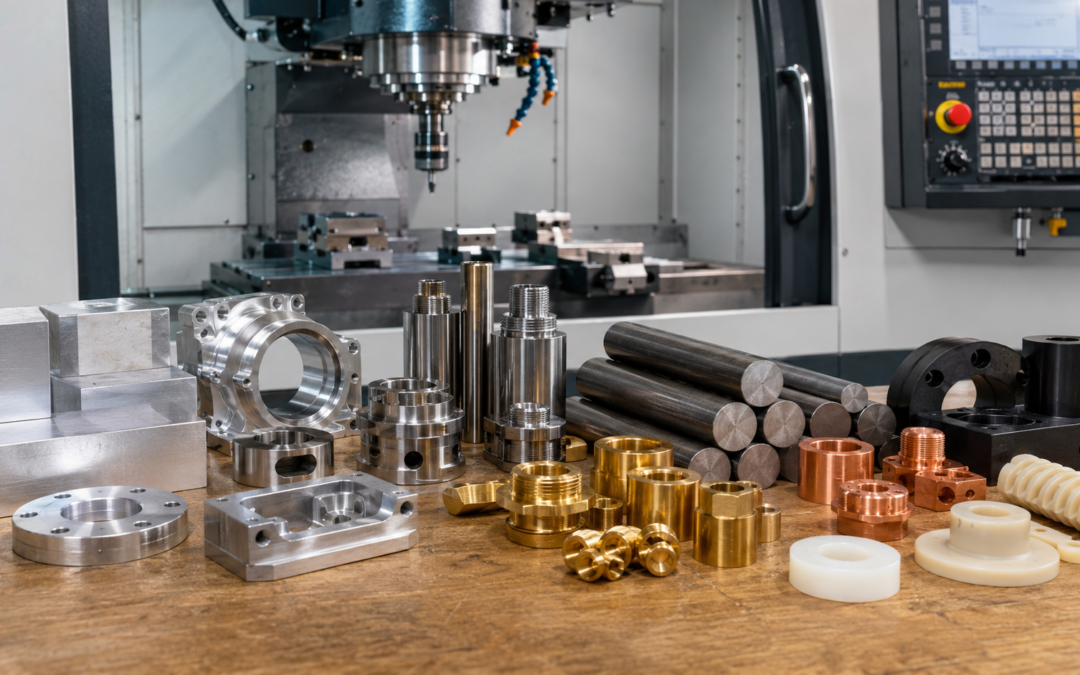
Choosing the right CNC machining materials is one of the most important decisions in any precision engineering project. Material choice affects cost, lead time, machining performance, tolerance capability, surface finish, corrosion resistance, strength, weight and long-term reliability. Even a well-designed component can become difficult to manufacture, inspect or assemble if the material is not suitable for the application.
For buyers, engineers and procurement teams, understanding material options can help reduce risk before an RFQ is submitted. The best material is not always the strongest, lightest or cheapest. It is the material that gives the right balance of performance, machinability, availability and quality control for the intended environment.
This guide explains the main CNC machining materials used for precision components, including aluminium, stainless steel, mild steel, engineering plastics, brass, copper and specialist alloys. It also covers how material selection affects tolerances, finishes, inspection and supplier choice.
CNC Machining Materials and Why Material Selection Matters
CNC machining materials influence almost every part of the manufacturing process. The same component design can behave very differently depending on whether it is machined from aluminium, stainless steel, engineering plastic or a specialist alloy. Factors such as cutting speed, tool wear, heat generation, distortion and burr formation all change with the chosen material.
Material selection should be considered early in the design and sourcing process, not treated as an afterthought. A material that performs well in service must also be practical to machine, finish and inspect. For example, some materials offer excellent strength for precision machined components but are slower to machine. Others are easy to cut but may not hold tight tolerances under changing temperatures or loads. Key considerations when choosing CNC machining materials include:
- Mechanical strength and stiffness
- Weight and density
- Corrosion resistance
- Temperature stability
- Wear resistance
- Machinability
- Surface finish requirements
- Tolerance requirements
- Availability and lead time
- Compatibility with finishing processes
- Cost for prototype, batch or repeat production
A reliable machining supplier can often provide useful input before production starts. Practical advice on material grade, stock form, machining strategy and finishing options can help avoid unnecessary cost or manufacturing complications.
Materials for Precision Engineering Applications
Precision engineering projects often require CNC machining materials that can meet demanding standards for accuracy, repeatability and reliability. Components may be used in aerospace, motorsport, scientific instruments, industrial equipment, medical technology, energy systems or specialist machinery. Each sector has different priorities, but the material must always support the function of the part.
In many cases, the selected material must meet both technical and commercial requirements. A part may need to be lightweight, corrosion resistant, easy to assemble and suitable for inspection. It may also need to be available in small quantities for prototypes, high mix low volume manufacturing, or consistent supply for repeat production. Precision applications commonly demand materials that provide:
- Stable machining behaviour
- Consistent material quality
- Reliable dimensional performance
- Good surface finish potential
- Compatibility with inspection processes
- Traceability where required
- Suitability for anodising, plating, painting or passivation
The right choice depends on the component’s job. A housing may need dimensional stability and good cosmetic finish. A shaft may require strength, concentricity and wear resistance. A fixture may need stiffness and repeatable positioning. A scientific component may require clean finishes, low weight or chemical compatibility.
Aluminium CNC Machining Materials
Aluminium is one of the most widely used CNC machining materials because it offers an excellent balance of machinability, strength, weight and finish. It is particularly common for housings, brackets, plates, enclosures, covers, prototypes, aerospace components, motorsport parts and scientific equipment.
Aluminium machines efficiently compared with many steels and specialist alloys. This can help reduce cycle time, especially for complex milled parts. It is also lightweight, corrosion resistant and suitable for a variety of finishing processes such as anodising, alochrom, painting and bead blasting. Common aluminium grades used in CNC machining include:
- 6082 for general engineering, structural components and machined parts
- 7075 for higher strength applications where weight saving is important
- 2014 for aerospace-style applications requiring good strength
- 5083 for marine, scientific and structural applications requiring corrosion resistance
- 6061 for general-purpose machined components, particularly in global supply chains
Aluminium is often chosen when a component needs to be strong but not heavy. An aluminium milling service is also useful for parts that require a clean visual finish. However, not all aluminium grades behave the same. Some are better for anodising, some offer higher strength, and some provide improved corrosion resistance.
Stainless Steel Options
Stainless steel CNC machining materials are used when components need strength, corrosion resistance and durability. Stainless steel is common in food processing, medical equipment, scientific instruments, marine environments, energy systems, industrial machinery and high-wear applications.
Compared with aluminium, stainless steel is generally slower to machine and can cause greater tool wear. It also requires careful control of heat, cutting strategy and workholding. However, its long-term performance makes it a strong choice for parts exposed to moisture, chemicals, cleaning processes or demanding operating conditions. Common stainless steel grades used for CNC machining include:
- 303 stainless steel for improved machinability
- 304 stainless steel for general corrosion resistance
- 316 stainless steel for better resistance in harsher or marine environments
- 17-4 PH stainless steel for high strength and hardness
- 431 stainless steel for strength, toughness and corrosion resistance
Stainless steel is a good choice when reliability in service matters more than the lowest machining cost. Buyers should be aware that tighter tolerances, deep pockets, fine threads and cosmetic finishes may take longer to achieve in stainless steel than in softer materials.
Mild Steel and Alloy Steel
Mild steel and alloy steel are important CNC machining materials for components that require strength, toughness and cost-effective performance. These materials are widely used in fixtures, shafts, tooling, machine components, brackets, spacers, bushes, plates and industrial parts.
Mild steel is generally more affordable than stainless steel and can be machined efficiently. However, it does not offer the same corrosion resistance unless it is protected with a coating, plating, painting or oiling process. Alloy steels can offer improved strength, hardness or wear performance depending on the grade and heat treatment. Common steel options include:
- EN1A for good machinability
- EN3B for general-purpose mild steel components
- EN8 for improved strength and toughness
- EN24T for high-strength engineering components
- Tool steels for wear-resistant parts, jigs, fixtures and specialist tooling
Steel material selection often depends on whether the part needs to be welded, hardened, ground, plated or used under load. If the component needs a secondary process after machining, this should be considered before the material is confirmed.
Engineering Plastic CNC Machining Materials
Engineering plastics are CNC machining materials used when components need low weight, electrical insulation, chemical resistance, low friction or reduced wear against mating parts. Plastics are common in scientific equipment, medical devices, food machinery, electronics, test fixtures, spacers, guides and lightweight assemblies.
Plastic machining is different from metal machining. Many plastics are more sensitive to heat, clamping pressure and stress relaxation. They may move during or after machining, especially if the design includes thin walls, tight tolerances or large flat surfaces. A good machining strategy for machined plastic parts is essential for achieving reliable dimensions. Common CNC machined plastics include:
- Acetal / POM for stability, low friction and general engineering use
- Nylon for wear resistance and toughness
- PEEK for high-performance temperature and chemical resistance
- PTFE for low friction and chemical resistance
- Polycarbonate for impact resistance and transparency
- Acrylic for optical clarity and display components
- Tufnol and laminates for insulation and wear-resistant applications
Engineering plastics can be excellent choices, but they should not be selected using the same assumptions as metals. Tolerance, load, temperature and inspection requirements need careful review.
Brass and Copper
Brass and copper are CNC machining materials often chosen for electrical, thermal, decorative or corrosion-resistant applications. Brass is known for its machinability and is frequently used for fittings, bushes, connectors, threaded parts, valves, inserts and turned components. Copper is used where electrical or thermal conductivity is important.
Brass is generally easier to machine than copper. It produces good finishes and is suitable for detailed turned parts. Copper can be more challenging because it is softer, stickier and more prone to burrs, depending on the grade. Machining copper successfully requires appropriate tooling, speeds and coolant strategy. Typical applications include:
- Electrical connectors
- Heat transfer components
- Bushes and bearings
- Inserts and fittings
- Valve components
- Sensor housings
- Decorative or visible parts
- Low-friction mating components
Buyers should consider whether conductivity, appearance, wear resistance or corrosion resistance is the main priority. Brass and copper can both be good choices, but they behave differently during machining and finishing.
Specialist Materials for Demanding Industries
Some applications require specialist CNC machining materials that go beyond standard aluminium, steel or plastic options. These materials may be selected for extreme strength, temperature performance, chemical resistance, low weight or demanding certification requirements.
Specialist materials can provide excellent in-service performance, but they are often more expensive and slower to machine. For example, materials for aerospace parts machining may also require longer sourcing times, specialist tooling, specific inspection methods or controlled finishing processes. Early supplier involvement is especially valuable when working with these materials. Examples of specialist CNC machining materials include:
- Titanium for strength-to-weight ratio and corrosion resistance
- Inconel for high-temperature and demanding environments
- Duplex stainless steels for strength and corrosion resistance
- High-performance plastics such as PEEK and PTFE
- Aerospace aluminium alloys for lightweight structural applications
- Tool steels for wear resistance and hardened components
When choosing specialist materials, buyers should check availability, certification, tolerance requirements and finishing needs before committing to a design. A small design adjustment can sometimes make a difficult component significantly easier to machine.
Material Selection for Tolerances and Surface Finish
CNC machining material selection has a direct impact on achievable tolerances and surface finish. Some materials are naturally more stable and easier to finish, while others are more prone to movement, tool marks, burrs or distortion. This is especially important for precision machined components with tight fits, sealing faces, bearing locations or assembly-critical features.
A tolerance that is straightforward in one material may be more difficult in another. For example, aluminium often machines efficiently and can hold good tolerances when designed correctly. Stainless steel may need more careful control due to heat and tool pressure. Plastics may move after machining because of stress relief or temperature sensitivity. Material-related factors that affect tolerances and finishes include:
- Material hardness
- Internal stress
- Thermal expansion
- Tool wear
- Burr formation
- Wall thickness
- Component geometry
- Clamping method
- Heat generated during machining
- Finishing or coating thickness
It is important to apply tight tolerances only where they are functionally necessary. Over-tolerancing can increase cost and lead time without improving performance. A machining supplier can help identify which features need critical control and which can be manufactured with standard tolerances.
CNC Machining Materials and Finishing Options
CNC machining materials often need finishing after manufacture. Finishing can improve corrosion resistance, appearance, wear performance, cleanliness or identification. The chosen material must be compatible with the required finish, and the finishing process should be considered before finalising tolerances.
Some finishes add thickness, while others remove material or alter the surface condition. For example, anodising can affect dimensions on aluminium parts. Plating can build up on external surfaces. Painting may require masking of threaded holes, sealing faces or precision bores. These details should be discussed before machining begins. Common finishing options include:
- Anodising for aluminium
- Hard anodising for improved wear resistance
- Alochrom or chemical conversion coating
- Passivation for stainless steel
- Zinc plating for steel
- Nickel plating for wear and corrosion resistance
- Powder coating or wet painting
- Bead blasting for cosmetic surface texture
- Polishing for visible or functional surfaces
- Deburring and edge breaking
Material and finish should work together. If a component needs a specific colour, coating thickness, corrosion resistance or cosmetic standard, the machining supplier should understand this before programming and production.
Prototypes, Small Batches and Repeat Production
CNC machining materials should be selected with production quantity in mind. A prototype may need to be made quickly to test form and fit, while a repeat production part may need stable availability, consistent quality and reliable cost over time. The best material for a one-off prototype is not always the best material for ongoing manufacture.
For prototypes, buyers may prioritise speed, machinability and availability. For production, they may need traceability, repeatable finishing results, inspection reports and long-term material consistency. In some cases, a prototype is made from an easier or cheaper material before switching to the final production grade. Production planning should consider:
- Stock availability
- Minimum order quantities
- Certification requirements
- Batch-to-batch consistency
- Machining cycle time
- Inspection requirements
- Finishing lead times
- Risk of material movement
- Cost stability
- Repeat order history
Clear communication with rapid prototyping companies helps avoid delays. If the component will move from prototype to production, it is worth discussing future volumes, expected tolerances and material supply at the start.
CNC Machining Materials and Quality Control
Quality control is an important part of working with CNC machining materials, especially for components used in demanding applications. Material traceability, inspection records and certification may be required depending on the industry, customer specification or component function.
Some projects only need dimensional checks against a drawing. Others may require full inspection reports, material certificates, FAIR documentation, batch traceability or controlled non-conformance processes. The level of quality control should match the risk and purpose of the component. Quality considerations may include:
- Material certificates
- Batch traceability
- First article inspection
- Dimensional inspection reports
- Surface finish checks
- Thread inspection
- Coating or finishing certification
- Visual inspection standards
- Customer-specific requirements
- Documented quality procedures
For precision components, quality control starts before machining. It includes material selection, purchasing, cutting, programming, workholding, inspection and final release. Choosing a supplier with strong quality systems can reduce risk throughout the project.
How to Choose the Best CNC Machining Materials for Your Component
Choosing the best CNC machining materials requires a practical understanding of the part’s function, environment and manufacturing requirements. The decision should not be based on material strength alone. It should consider how the part will be made, finished, inspected, assembled and used.
A useful approach is to start with the component’s real operating conditions. Consider whether it needs to carry load, resist corrosion, reduce weight, provide insulation, handle heat, maintain a tight fit or look visually presentable. From there, material options can be compared against cost, availability and machining complexity. Questions to ask before confirming a material include:
- What does the component need to do?
- Will it carry load or experience vibration?
- Does it need to be lightweight?
- Will it be exposed to moisture, chemicals or heat?
- Are tight tolerances required?
- Does it need a specific surface finish?
- Is the material readily available?
- Are certificates or inspection reports required?
- Will the part be anodised, plated, painted or passivated?
- Is the component a prototype or repeat production item?
The earlier these questions are answered, the easier it is to avoid manufacturing problems. Material advice from an experienced CNC machining supplier can be valuable when the application is demanding or the design is still being finalised.
Working With a Supplier
A good machining supplier should understand more than how to cut metal or plastic. They should be able to advise on CNC machining materials, tolerances, finishes, inspection requirements and practical design improvements. This is particularly important when parts are complex, time-sensitive or used in critical applications.
Buyers should look for a supplier that can support the full manufacturing process, from material sourcing through to machining, finishing, inspection and delivery. The right supplier can help identify risks before they become production issues. When discussing a new project, it is useful to provide:
- Drawings and 3D models
- Material grade or performance requirements
- Required tolerances
- Surface finish expectations
- Quantity and delivery requirements
- Finishing specifications
- Inspection or certification needs
- Assembly requirements
- Any known application constraints
Clear information helps the supplier recommend the most suitable manufacturing route. It can also improve quoting accuracy and reduce the chance of delays once the order is placed.
CNC Machining Material Selection
CNC machining materials play a major role in the success of any precision component. The right material can improve performance, reduce risk and support reliable manufacturing. The wrong material can increase cost, extend lead times or create problems with tolerances, finishing and assembly.
Aluminium is often chosen for lightweight precision parts. Stainless steel offers strength and corrosion resistance. Mild steel and alloy steel provide toughness and cost-effective engineering performance. Engineering plastics are useful for insulation, low friction and specialist applications. Brass and copper support conductivity, fittings and detailed turned parts. Specialist alloys provide performance for demanding environments but require careful planning.
For the best result, material selection should be discussed early. By considering function, tolerance, finish, inspection and production quantity, buyers can choose CNC machining materials that support both the design and the manufacturing process.
A knowledgeable CNC machining partner can help review drawings, recommend suitable materials and manufacture precision components that meet the required standards for quality, reliability and repeatability.