
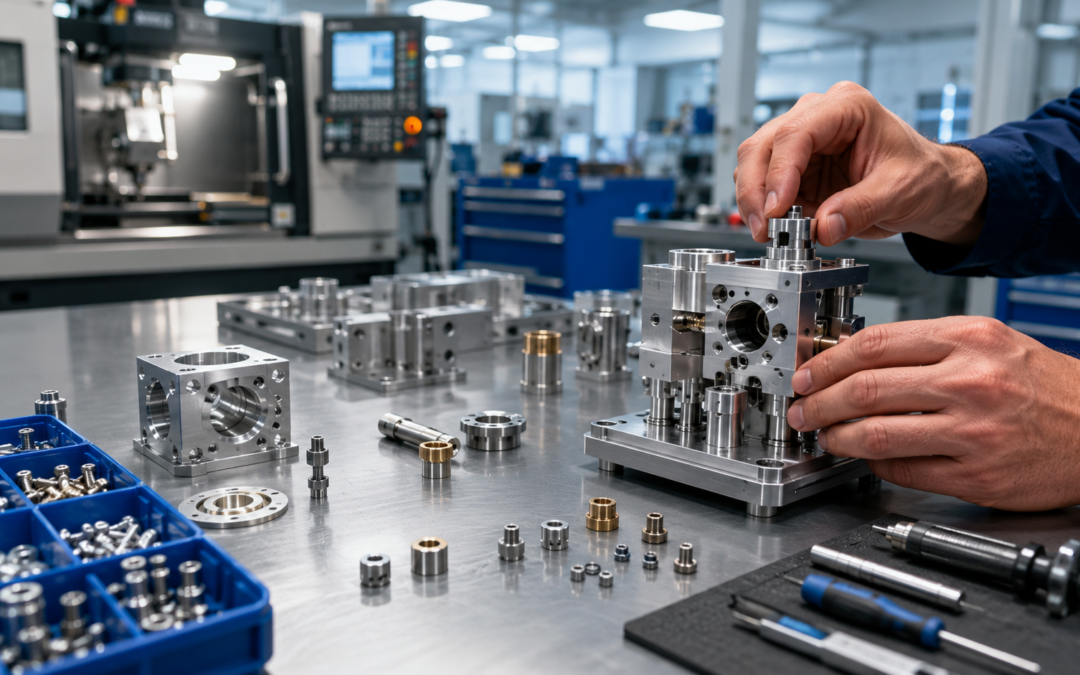
Sub assembly services can help manufacturers reduce internal workload, simplify supplier management and receive machined components in a more complete, production-ready condition. Instead of buying individual precision parts from one supplier, finishes from another, and then carrying out inspection, fitting or assembly in-house, customers can work with a machining partner that supports a wider part of the production process.
For many UK manufacturers, this is becoming increasingly valuable. Engineering teams are often under pressure to reduce lead times, protect quality, control costs and manage capacity without adding unnecessary complexity. When a supplier can manufacture, inspect, finish, assemble and package components as a controlled sub assembly, the customer receives more than a machined part. They receive a joined-up solution that is easier to integrate into their own build schedule.
This guide explains what sub assembly services involve, where they are useful, what buyers should check before placing work, and how machined component assemblies can support sectors such as aerospace, scientific equipment, industrial machinery, specialist manufacturing and high-performance engineering.
What Are Sub Assembly Services?
Sub assembly services involve taking individual components and combining them into a partial assembly before they are delivered to the customer. This may include machined parts, bought-in components, inserts, bushes, fasteners, bearings, seals, pins, brackets or other associated items. The aim is to supply a completed section of a larger product, ready for the customer to install, test or integrate into a final assembly.
A sub assembly is not usually the complete finished product. Instead, it is a prepared section of it. For example, aluminium CNC machined housings may be supplied with threaded inserts fitted, covers attached, seals installed and inspection documents included. A precision bracket may be supplied with dowels, bushes or helicoils fitted. A machined plate may be delivered with associated parts assembled, checked and packed as a matched set. Common examples of sub assembly services include:
- Fitting threaded inserts, bushes, pins or dowels
- Installing bearings, seals or customer-specified hardware
- Combining CNC machined parts into matched assemblies
- Managing surface treatments before assembly
- Completing inspection checks before delivery
- Packaging parts as kits for easier customer use
For buyers, the main advantage is that responsibility for several production stages can sit with one capable supplier. This helps reduce handovers, delays and uncertainty.
Sub Assembly Services for Machined Components
Sub assembly services for machined components are especially useful when parts need to be manufactured accurately and then fitted together with care. Machined parts often have critical features, tight tolerances, specific surface finishes and important positional relationships. If these precision machined components are later assembled incorrectly, damaged during handling or supplied without the correct checks, the value of precision machining can quickly be lost.
A machining-led sub assembly service gives customers access to both manufacturing expertise and assembly understanding. The supplier is not simply bolting parts together. They understand the machining process, the tolerances involved, the risks around distortion or burrs, and the importance of protecting critical faces, bores and threads during handling. This can be particularly helpful for:
- CNC machined housings and covers
- Precision plates and mounting blocks
- Brackets, carriers and support structures
- Machined enclosures and instrument components
- Small mechanical assemblies
- Prototype and low-volume production builds
- Repeat production assemblies with inspection requirements
When machined components are assembled by the same supplier that manufactured them, any fit, tolerance or finish issues can often be identified and resolved earlier. This creates a smoother route from drawing to finished assembly.
Why Manufacturers Outsource Assembly Work
Manufacturers outsource sub assembly work for several practical reasons. In many cases, it is not because they cannot assemble the parts themselves. It is because their internal teams are focused on higher-value final assembly, testing, installation or customer delivery. Moving repeatable sub assembly tasks to a trusted supplier can free up time and reduce bottlenecks.
Outsourcing can also make the supply chain easier to manage. Rather than coordinating multiple purchase orders, deliveries, inspection stages and internal assembly tasks, buyers can receive a more complete unit from one supplier. This reduces administration and helps production teams plan with more confidence. Key reasons component manufacturers use sub assembly services include:
- Reducing internal handling and assembly time
- Simplifying purchasing and supplier management
- Improving consistency across repeat builds
- Reducing the risk of missing parts or mismatched components
- Supporting production when internal capacity is limited
- Receiving assemblies in a cleaner, better controlled condition
- Improving traceability and inspection control
For small and medium-sized manufacturers, this can be especially valuable. It allows them to scale production without immediately increasing internal labour, equipment or floor space.
The Difference Between Component Supply and Sub Assembly Supply
Component supply usually means that a supplier manufactures and delivers individual parts to a drawing. Sub assembly supply goes further. It means the supplier takes responsibility for preparing multiple items so they arrive as a usable assembly, kit or part-built unit. This changes the nature of the supplier relationship.
With component supply, the customer may still need to unpack, inspect, sort, clean, fit, fasten, label and store individual parts. With sub assembly supply, many of those steps can be completed before delivery. The customer receives a more organised output, often with inspection evidence and supporting documentation. The differences may include:
- Individual parts supplied separately versus parts supplied assembled
- Customer manages fitting versus supplier manages fitting
- Separate inspections versus combined assembly checks
- Multiple part numbers delivered individually versus grouped assembly delivery
- More internal handling versus reduced internal handling
- Drawing-only supply versus drawing, assembly and process understanding
This does not mean sub assembly supply is suitable for every project. For some parts, simple component supply is enough. But when there is repeated handling, fitting, cleaning, checking or organising involved, sub assembly services can provide a clear advantage.
CNC Machining and Sub Assembly Services
CNC machining and sub assembly services work well together because many assemblies depend on the accuracy of the machined parts at their core. CNC milling, CNC turning and precision inspection create the foundation for reliable fit and function. Assembly then adds another layer of value by preparing those parts for their next stage of use.
For example, a CNC machined housing may need several secondary operations before it is ready for installation. It may require anodising, painting, threaded inserts, fitted bushes, cleaned ports, deburred edges, protected faces and inspection checks. If each stage is managed separately, delays and errors can occur. If the machining supplier coordinates the process, the route can become more controlled. Typical machining and assembly combinations include:
- CNC milled parts with inserts and fasteners fitted
- CNC turned parts supplied with mating components
- Machined housings supplied with covers, seals or plugs
- Precision plates delivered with pins, dowels or bushes installed
- Aluminium assemblies supplied after anodising or chemical conversion coating
- Stainless steel components assembled into small mechanical units
This is particularly valuable where tolerances, finish and cleanliness matter. The supplier can protect machined features throughout the process instead of treating assembly as a separate afterthought.
Materials Used in Machined Component Assemblies
Material selection has a direct effect on both machining and assembly. Different materials behave differently during cutting, finishing, fitting and fastening. A good sub assembly supplier should understand how the chosen material affects the complete manufacturing route, not just the machining operation.
Aluminium is common in many machined assemblies because it is lightweight, machinable and suitable for surface treatments such as anodising, alochrom or painting. Stainless steel may be used where corrosion resistance, strength or cleanability is important. Engineering plastics can be useful for insulation, weight reduction or specialist functional requirements. Brass, copper and other non-ferrous materials may be selected for conductivity, wear behaviour or application-specific performance. Common materials used in sub assembly services include:
- Aluminium alloys for lightweight machined assemblies
- Stainless steel for strength and corrosion resistance
- Mild steel and alloy steel for robust industrial components
- Engineering plastics for specialist low-friction or insulating parts
- Brass and copper alloys for electrical or wear-related applications
- Customer-specified materials for regulated or critical environments
The right material choice should consider the finished assembly, not just the individual component. Surface treatment, thread strength, torque requirements, weight, compatibility and operating environment can all affect the decision.
Surface Finishing Options
Surface finishing is often an important stage within sub assembly services. Many machined components need protective, cosmetic or functional finishes before they are assembled. If these finishes are not managed carefully, there can be problems with masking, coating build-up, thread fit, sealing faces or final appearance.
A capable supplier should understand which features must be protected and which areas can accept coating. This is especially important for assemblies where components must fit together after finishing. Coating thickness, anodising requirements, paint coverage and conversion coatings can all affect assembly performance. Surface finishing may include:
- Clear or coloured anodising
- Hard anodising
- Chemical conversion coatings
- Passivation for stainless steel
- Painting or powder coating
- Plating
- Specialist customer-specified treatments
- Masking of critical faces, bores and threads
Where possible, surface finishing should be considered early in the design and sourcing process. Drawings should clearly identify finish requirements, masked areas, cosmetic expectations and any post-finish inspection needs. This helps avoid uncertainty and reduces the risk of parts being delayed or rejected.
Quality Control
Quality control is a key part of reliable sub assembly services. It is not enough for individual parts to be correct before assembly. The completed sub assembly must also be checked for fit, function, orientation, cleanliness and documentation requirements. A supplier should be able to show how quality is controlled at each stage. 
Inspection may begin with the machined components, using drawing checks, dimensional inspection, thread gauges, bore checks or coordinate measurement equipment where needed. It may then continue through finishing, goods-in checks for bought-in items, assembly checks and final verification before dispatch. Quality control for sub assemblies may include:
- Dimensional inspection of machined components
- Verification of threads, bores and critical features
- Checks on bought-in parts and customer-supplied items
- Assembly orientation and fit checks
- Torque or fastening checks where specified
- Visual inspection after finishing and assembly
- Final inspection reports or certificates of conformity
For regulated sectors, quality evidence may be just as important as the physical assembly. Buyers should confirm what documents are required before the work starts, especially where traceability, batch control or formal inspection reporting is needed.
Inspection Documentation and Traceability
Inspection documentation and traceability help customers prove that a sub assembly has been manufactured and checked correctly. This is particularly important for aerospace, scientific, defence, medical, energy and high-value industrial applications, where components may need to be supported by clear records.
Traceability can include material certificates, finish certificates, inspection reports, batch records and certificates of conformity. For more demanding projects, customers may require first article inspection reports, ballooned drawings or inspection records produced to a defined format. The level of documentation should match the risk and importance of the assembly. Common documentation requirements include:
- Material certificates
- Surface treatment certificates
- Certificates of conformity
- Dimensional inspection reports
- First article inspection reports
- Batch traceability records
- Customer-specific inspection forms
- Assembly check sheets
Good documentation reduces ambiguity. It gives the customer confidence that the assembly has been produced in line with the drawing, purchase order and agreed process requirements.
Sub Assembly Services for Aerospace and High-Integrity Sectors
Sub assembly services for aerospace and high-integrity sectors require a controlled approach. These industries often involve tighter documentation, stricter traceability and greater attention to process control. Even a small machined assembly may need clear evidence that the correct material, finish, inspection method and assembly procedure have been followed.
Aerospace-related work may involve aluminium alloys, stainless steels, specialist coatings, non-destructive testing, first article inspection and formal quality records. Scientific and technical applications may place more emphasis on cleanliness, dimensional accuracy, stability, repeatability or careful packaging. In each case, the supplier must understand the expectations behind the drawing. Buyers in high-integrity sectors should look for:
- Experience with precision machined components
- Strong inspection capability
- Clear document control
- Understanding of traceability requirements
- Careful handling and packaging processes
- Ability to manage finishing and secondary operations
- Consistent communication throughout the project
The more critical the application, the more important it is to involve the supplier early. Early technical review can identify risks before parts are machined, finished or assembled.
Design Considerations for Machined Sub Assemblies
Design has a major influence on how easily a machined sub assembly can be manufactured, finished and put together. A design that looks straightforward on screen may create unnecessary problems during machining, coating, fitting or inspection. Early supplier input can help avoid these issues.
Buyers and design engineers should consider how the assembly will be built, how parts will be held, whether fasteners can be accessed, whether tolerances are realistic and whether finishes affect mating features. It is also worth considering how parts will be inspected and how the supplier will confirm that the assembly is correct. Useful design considerations include:
- Clear assembly drawings as well as individual part drawings
- Defined critical features and tolerances
- Suitable access for fasteners and tooling
- Realistic tolerance stack-ups
- Coating allowance on mating surfaces
- Clear thread and insert specifications
- Defined orientation and marking requirements
- Packaging requirements for delicate assemblies
A good supplier can often suggest small design changes that make production easier without compromising function. This can reduce cost, improve consistency and shorten lead times.
How Sub Assembly Services Can Reduce Lead Times
Sub assembly services can reduce lead times by removing unnecessary handovers between suppliers and internal departments. When machining, finishing coordination, inspection and assembly are managed together, there is less waiting time between stages. This can make the overall route faster and easier to control.
Lead time is not only about cutting metal. It includes material sourcing, programming, machining, deburring, finishing, inspection, assembly, packaging and delivery. If each stage is treated separately, delays can build up. A supplier that understands the full route can plan more effectively. Sub assembly services can help reduce lead times by:
- Combining manufacturing and assembly planning
- Reducing separate purchase orders and supplier handovers
- Identifying finishing requirements earlier
- Reducing internal customer workload after delivery
- Delivering parts as ready-to-use assemblies or kits
- Avoiding delays caused by missing or mismatched components
This does not mean every sub assembly will be faster by default. Complex assemblies still need careful planning. However, a joined-up process often gives customers better visibility and fewer avoidable delays.
Cost Benefits
The cost benefits of sub assembly services are not always limited to the part price. A sub assembly may appear more expensive than a single machined component when viewed line by line, but it may reduce total cost once handling, inspection, purchasing, storage and internal assembly time are considered.
For example, buying individual parts may require the customer to raise several purchase orders, receive multiple deliveries, check each item, organise internal fitting, manage shortages and resolve quality issues across different suppliers. Buying a completed sub assembly can reduce this hidden workload. Potential cost benefits include:
- Lower internal assembly labour
- Reduced purchasing administration
- Fewer supplier handovers
- Less risk of damaged or misplaced parts
- Reduced rework from fit or orientation errors
- Better use of skilled internal staff
- More predictable production planning
The most useful comparison is total cost, not just component cost. Buyers should consider the full route from drawing release to final installation.
What to Include in an RFQ
A clear RFQ helps suppliers price and plan sub assembly services accurately. If the request only includes individual part drawings, the supplier may not understand the full assembly requirement. This can lead to missing costs, unclear assumptions or delays later in the process.
A good RFQ should explain what the finished sub assembly needs to include, how it will be used, what standards apply and what documentation is required. It should also identify whether any parts are customer-supplied, bought-in or to be sourced by the machining supplier. A strong RFQ should include:
- Individual component drawings
- Assembly drawings
- 3D models where available
- Material specifications
- Surface finish requirements
- Bought-in component details
- Insert, fastener, seal or bearing specifications
- Inspection and documentation requirements
- Annual or batch quantities
- Delivery and packaging requirements
Clear information at the start reduces assumptions. It also allows the supplier to identify technical questions before the project reaches production.
Choosing a Supplier for Sub Assembly Services
Choosing the right supplier for sub assembly services is about more than finding someone who can machine the parts. The supplier must also be organised, quality-focused and capable of managing the extra responsibility that comes with assembly work. This includes communication, planning, inspection and careful handling.
A strong supplier should be able to review drawings, understand tolerance requirements, manage finishing processes, assemble parts consistently and provide the correct documentation. They should also be honest about what they can control in-house and which processes need to be subcontracted or coordinated externally. When selecting a supplier, consider:
- CNC machining capability and experience
- Assembly experience with machined components
- Quality management and inspection equipment
- Ability to manage finishing and secondary operations
- Communication during technical review
- Capacity for repeat production
- Understanding of traceability and documentation
- Careful packaging and delivery processes
The best supplier is often one that asks good questions before quoting. Those questions can prevent problems later and show that the supplier understands the complete requirement.
Services for Prototypes, Small Batches and Repeat Production
Sub assembly services can support prototypes, small batches and repeat production, but each type of work has different priorities. Prototype assemblies often need flexibility, technical feedback and quick learning. Small batches may require careful setup control and practical cost management. Repeat production needs consistency, documentation and reliable scheduling.
For prototypes, the supplier may help identify design improvements or assembly risks. For small batches, the focus may be on reducing customer workload without creating unnecessary process complexity. For repeat production, the aim is usually to create a stable, repeatable route that delivers consistent assemblies over time. Sub assembly services can support:
- One-off prototype builds
- Development and pre-production batches
- Low-volume specialist assemblies
- Repeat production schedules
- Spares and replacement assembly supply
- Build-to-order component kits
This flexibility is useful for manufacturers that do not always need high-volume production but still require professional control, accuracy and reliability.
Packaging, Labelling and Delivery
Packaging is an important part of sub assembly services because a completed assembly may be more vulnerable than individual components. Finished faces, coatings, fitted inserts, seals, threads and delicate features need to be protected during transport and storage. Poor packaging can undo the value of careful machining and assembly.
Labelling also matters. Customers may need assemblies supplied by part number, serial number, batch, project, order or build stage. Clear packaging and labelling make it easier for stores, inspection and production teams to use the parts without delay. Packaging and delivery considerations include:
- Protective wrapping for finished surfaces
- Separation of delicate or coated parts
- Labelling by part number or assembly number
- Kitting of related components
- Inclusion of inspection documents
- Batch or serial traceability
- Clear delivery notes and certificates
- Packaging suitable for customer storage or production use
Good packaging is not just about preventing damage. It also helps the customer use the assembly efficiently once it arrives.
Common Problems Sub Assembly Help to Prevent
Sub assembly services can help prevent several common production problems. Many of these issues happen not because individual parts are wrong, but because the process between suppliers, stores and assembly teams is fragmented. A more controlled supply route can reduce these risks.
For example, a customer may receive correct machined parts but later discover that inserts are missing, coating has affected a thread, a mating part does not fit after finishing, or components have been stored separately and delayed production. Sub assembly supply helps bring these checks forward. Common problems reduced by sub assembly services include:
- Missing fasteners, inserts or bought-in parts
- Incorrect orientation during internal assembly
- Damage from repeated handling
- Fit issues discovered too late
- Delays between machining, finishing and assembly
- Documentation gaps
- Confusion between similar parts
- Production time lost on low-value fitting tasks
By moving these responsibilities into a controlled supplier process, manufacturers can reduce friction and improve build reliability.
When Sub Assembly Services Are the Right Choice
Sub assembly services are the right choice when the customer wants to reduce internal workload, improve consistency or receive parts in a more complete state. They are particularly useful when machined components need finishing, fitting, inspection and packaging before they can be used.
They may also be suitable when assemblies are repeated over time, when internal production teams are busy, or when there is a need for tighter supplier accountability. If one supplier can manufacture and prepare the assembly correctly, the customer can reduce the number of separate steps they need to manage. Sub assembly services are often worth considering when:
- Several machined parts are used together
- Components need inserts, bushes, pins or seals fitted
- Parts require finishing before assembly
- Inspection documentation is important
- Internal assembly capacity is limited
- Production delays are caused by part organisation
- The customer wants a more complete supply solution
The decision should be based on risk, value and total process efficiency. Where sub assembly work removes avoidable handling, delays or uncertainty, it can be a practical and cost-effective option.
Comprehensive Component Sourcing
Sub assembly services give manufacturers a more complete way to source precision machined components. Instead of receiving separate parts and managing every finishing, fitting and inspection stage internally, customers can work with a supplier that delivers controlled machined component assemblies ready for the next stage of production.
For UK manufacturers, this can help reduce internal workload, improve consistency, support capacity planning and simplify the supply chain. It is especially useful where components require CNC machining, surface finishing, inserts, bushes, seals, documentation or careful packaging.
The best results come from early communication, clear drawings, accurate specifications and a supplier that understands both machining and assembly. When these elements are in place, sub assembly services can provide a reliable bridge between component manufacture and final product build.