
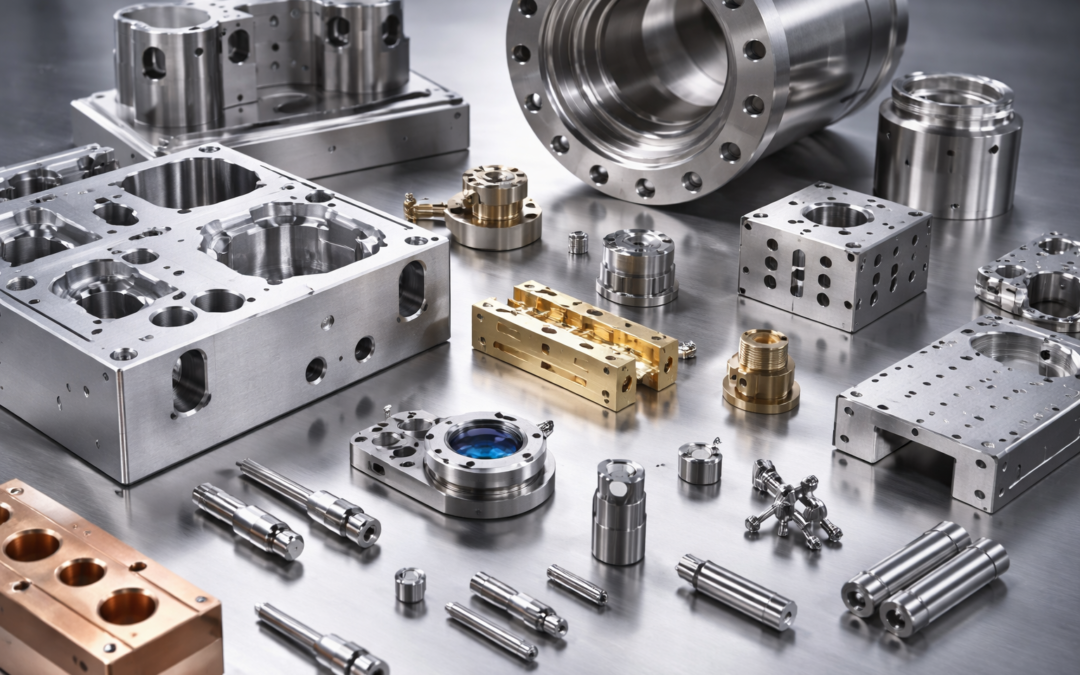
Scientific instrument machining plays a critical role in the performance, repeatability, and lifespan of modern analytical, laboratory, and research equipment. Whether a component is used inside a mass spectrometer, optical device, medical research system, vacuum chamber, or sensing platform, the quality of the machining has a direct effect on how reliably the final instrument performs.
In many scientific applications, there is very little margin for error. Components may need to fit together with micron-level accuracy, maintain stability across changing temperatures, resist corrosion, or support highly sensitive measurement processes. That is why scientific instrument machining is about far more than simply producing a part to drawing. It involves understanding tolerances, materials, surface finish, cleanliness, inspection, and the practical realities of assembling precision equipment.
This guide explains what scientific instrument machining involves, the types of parts commonly required, the materials and processes used, and what buyers and engineers should look for when choosing a machining partner. For companies working in research, diagnostics, optics, or instrumentation, getting these details right can make a meaningful difference to product quality and long-term reliability.
What Is Scientific Instrument Machining?
Scientific instrument machining refers to the manufacture of precision engineered parts used in instruments designed for measurement, analysis, testing, observation, and controlled experimentation. These parts often appear in highly technical equipment where performance depends on exact alignment, dimensional consistency, and dependable material behaviour.
Unlike more general industrial machining, scientific instrument machining often involves small to medium batch sizes, tight tolerances, and complex geometries. Components may be visible external housings, but just as often they are internal features that support optical pathways, fluid handling, electronic integration, or vacuum performance. Even a relatively simple bracket or mounting plate can become a critical part when it holds a sensor or governs the position of a calibrated element. Typical requirements in this area include:
- Tight dimensional tolerances
- Fine surface finishes
- Clean, burr-free edges
- Stable, repeatable batch quality
- Good material traceability
- Careful handling to avoid contamination or damage
Because scientific equipment is often developed through a mix of prototyping and controlled production, machining suppliers in this sector also need to be flexible. Drawings may evolve, assemblies may be refined, and early-stage design decisions can have a major effect on manufacturability.
Why Precision Machining Matters for Scientific Instruments
Precision machining for scientific instruments matters because the performance of the instrument depends on the quality of the components inside it. In sectors such as spectroscopy, diagnostics, microscopy, semiconductor research, and environmental analysis, poor tolerances or surface issues can introduce misalignment, instability, leakage, vibration, or unreliable readings.
A scientific instrument is usually part of a larger chain of trust. Researchers, technicians, manufacturers, and end users rely on the data it produces. If a machined part allows movement where there should be rigidity, introduces contamination into a clean system, or fails to hold alignment over time, the entire instrument can be compromised.
This is why precision matters at several levels:
- Dimensional accuracy supports exact assembly and alignment
- Surface finish affects sealing, cleanliness, and friction
- Material consistency supports thermal and mechanical stability
- Repeatability ensures every unit behaves the same way
- Good inspection reduces risk before parts reach assembly
In practice, the value of careful machining is often seen in the absence of problems. Equipment builds more smoothly, calibration becomes more consistent, and instruments remain reliable in service. For design and procurement teams, that reliability is often worth far more than a small saving on unit cost.
Common Components in Scientific CNC Machining
Scientific instrument machining covers a wide range of precision parts, from simple support features to complex multi-operation components. The exact mix depends on the instrument type, but certain categories appear again and again across laboratory and analytical equipment.
Many machined components are structural or positional, designed to hold critical elements in exactly the right place. Other scientific CNC machining components are functional, such as fluidic parts, vacuum-compatible pieces, optical mounts, or precision enclosures. Some may need cosmetic quality as well as functional accuracy, especially for customer-facing or benchtop instruments. Common examples include:
- Mounting plates and base plates
- Sensor housings
- Optical mounts and brackets
- Vacuum chamber components
- Manifolds and fluid handling blocks
- Precision spacers and bushes
- Enclosures and front panels
- Connector interfaces and adaptor parts
- Heat sinks and thermal management features
- Calibration fixtures and jigs
These parts may be machined from aluminium, stainless steel, brass, titanium, engineering plastics, or specialist alloys depending on the demands of the application. The challenge is not only making each feature to size, but making sure the complete part performs properly in its final environment.
Materials Used in Scientific Components
Material selection is a major part of successful scientific instrument machining. The right material must support the instrument’s functional requirements while also being suitable for machining, finishing, assembly, and long-term use. In many cases, designers need to balance weight, stiffness, corrosion resistance, thermal properties, electrical behaviour, and cost.
Aluminium is widely used for many scientific instrument components because it offers a strong combination of machinability, low weight, and dimensional stability. It is often chosen for housings, brackets, support plates, and structural features where high precision is needed without excessive mass. Stainless steel, by contrast, is often selected where corrosion resistance, strength, or cleanability are more important. Other materials are used for more specialised reasons:
- Aluminium for lightweight, precise structural parts
- Stainless steel for durability, corrosion resistance, and hygiene
- Brass for electrical and connector-related components
- Copper for thermal or conductivity-focused parts
- Titanium for strength-to-weight and specialist environments
- PEEK, PTFE, and other polymers for insulation or chemical resistance
- Tool steels for wear-resistant fixtures or specialised components
For scientific instruments, the behaviour of the material after machining can be just as important as the machining process itself. Thermal expansion, surface response, and compatibility with coatings or cleaning processes all need to be considered early in the design stage.
CNC Machining for Science & Medical
CNC machining for scientific instruments is usually the preferred route because it provides the consistency, complexity, and repeatability required in technical applications. CNC milling and CNC turning allow parts to be produced with close control over dimensions and geometry, while also supporting efficient transition from prototype to production. 
Many scientific instrument parts require multiple operations, including drilled and tapped holes, machined pockets, precision faces, and complex contours. CNC machining allows these features to be programmed and reproduced accurately over repeated batches, reducing manual variability and improving overall quality. The main CNC processes used in this area include:
- CNC milling for prismatic parts, plates, housings, and detailed features
- CNC turning for cylindrical parts, shafts, rings, and precision sleeves
- 3-axis machining for simpler geometries and efficient production
- 4-axis and 5-axis machining for more complex access and reduced setups
- Drilling, boring, and reaming for accurate hole production
- Thread milling and tapping for secure assembly features
The benefit of CNC machining is not only the machine capability itself. It also includes the programming discipline, workholding strategy, tool selection, and inspection process that sit behind it. In scientific instrument machining, those details often make the difference between a part that is merely acceptable and one that genuinely supports high-performance equipment.
Tolerances and Surface Finish in Scientific Instrument Machining
Tolerances and surface finish are two of the most important factors in scientific instrument machining because they directly affect fit, function, and reliability. A well-machined part does not just match basic dimensions. It must also meet the geometric and surface requirements that allow the instrument to work as intended.
Instruments that rely on optics, fluidics, vacuum systems, or sensitive sensors often need very stable interfaces between parts. Flatness, parallelism, concentricity, and positional accuracy may all matter. Surface finish is equally important, especially where parts need to seal, remain clean, avoid particle generation, or support smooth assembly. Areas commonly controlled in this kind of work include:
- Tight linear tolerances on critical dimensions
- Flatness on mounting faces and base surfaces
- Positional accuracy for holes and alignment features
- Concentricity for rotating or cylindrical components
- Fine surface finish on sealing and contact areas
- Deburring and edge control to reduce contamination risk
It is also important to apply tight tolerances only where they are genuinely needed. Over-specifying every feature can increase cost and lead time without improving instrument performance. A good machining partner can often help identify which dimensions are truly critical and which can be relaxed for more efficient manufacture.
Cleanliness and Quality Control for Laboratory Equipment Parts
Cleanliness is often overlooked in general machining discussions, but it can be a major issue in scientific instrument machining. Laboratory and analytical systems may be highly sensitive to particles, residues, oils, or burrs. Even where a part is dimensionally correct, inadequate cleaning or finishing can create downstream problems during assembly or operation.
That is why quality control in this sector needs to go beyond simple pass or fail measurement. Inspection for scientific and medical CNC machining should confirm that the part is not only within tolerance, but also properly finished, free from damaging defects, and suitable for the environment in which it will operate. Good quality control practices for laboratory equipment parts often include:
- First-off inspection before batch production
- In-process checks on critical dimensions
- Final inspection using calibrated equipment
- Visual checks for burrs, marks, and cosmetic issues
- Cleaning procedures suited to the application
- Material certification where required
- Clear identification and traceability
For customers in regulated or technically demanding sectors, documented quality processes can be especially important. At Tarvin Precision, for example, the value of controlled machining and inspection is often most visible in the consistency of the finished component and the confidence it gives to the customer’s assembly team.
Prototype and Low Volume Scientific Instrument Machining
Prototype and low volume scientific instrument machining is common because many instruments are developed through iterative design. Engineering teams often need early samples to test fit, function, thermal behaviour, or assembly methods before locking a design for wider production.
This stage of the process is especially important in scientific and technical industries because prototypes are rarely just visual models. They are functional parts that may be used in test rigs, validation units, demonstration systems, or pre-production builds. The machining quality still matters, even when quantities are small. A strong prototype machining approach should offer:
- Fast response to drawing revisions
- Feedback on manufacturability
- Consistent machining between prototype and production
- Clear communication on tolerances and critical features
- Practical advice on material and finish selection
- Reliable inspection of key dimensions
Low volume work also benefits from a supplier who understands that part performance is the priority. In some cases, the fastest route is not the best route if it introduces avoidable risk. Scientific instrument machining often works best when prototype support combines technical accuracy with sensible engineering input.
Design for Manufacture in Scientific Instrument Machining
Design for manufacture is especially valuable in scientific instrument machining because many parts begin as highly functional designs created around instrument performance rather than machining efficiency. That is understandable, but small design adjustments can often improve manufacturability without affecting the function of the part.
For instance, internal corner radii, thread depths, wall thickness, and feature accessibility can all influence machining time and cost. Likewise, the way tolerances are applied can either simplify inspection or make it unnecessarily difficult. A collaborative supplier can help identify these issues early, before they affect lead times or unit price. Useful design for manufacture considerations include:
- Avoiding unnecessarily deep pockets
- Using realistic internal radii for tooling access
- Applying tight tolerances only to critical features
- Standardising hole sizes and threads where possible
- Considering part orientation and workholding
- Choosing materials that suit both function and machining
- Reviewing whether multiple parts could be combined or simplified
This kind of support is often most helpful when the relationship is practical rather than purely transactional. For technical buyers and engineers, a supplier who can flag issues early may help reduce both cost and project risk.
Choosing a Scientific Instrument Machining Supplier
Choosing a scientific instrument machining supplier is about more than machine capacity. The best supplier for this kind of work needs to understand precision, consistency, communication, and the end use of the parts being produced. Scientific equipment often contains features that are critical but not immediately obvious from a basic drawing review.
A capable supplier should be comfortable with close tolerances, careful inspection, and small details that affect final assembly. Scientific and medical component manufacturers should also be able to manage prototype work, ongoing revisions, and production repeatability without letting standards slip between batches. When assessing a supplier, buyers often look for:
- Experience with precision machined components
- Strong inspection and quality control processes
- Ability to work with technical drawings and revisions
- Reliable communication on lead times and issues
- Good material knowledge
- Clean, consistent finishing standards
- Capacity for both prototypes and repeat work
For companies in the UK scientific and advanced manufacturing sectors, it can also be helpful to work with a supplier that understands the expectations of high-specification industries more broadly. Tarvin Precision is one example of a machine shop operating in this kind of quality-focused environment, where consistency and attention to detail matter as much as throughput.
Scientific Instrument Machining and Long-Term Product Performance
The long-term performance of scientific equipment is closely tied to the quality of the machined components inside it. A part that fits correctly on day one but drifts, corrodes, wears, or creates maintenance issues over time can become an expensive problem. This is particularly important for instruments used in demanding research, continuous laboratory operation, or precision production settings.
Well-machined components contribute to product performance in ways that are not always obvious at first glance. They support stable calibration, smoother assembly, reduced servicing, and more predictable behaviour across multiple units. Over time, these advantages can have a real effect on product reputation and total cost of ownership. Long-term gains from good scientific instrument machining often include:
- Better assembly repeatability
- Reduced need for rework
- Improved instrument stability
- Lower risk of premature part failure
- More consistent product quality across batches
- Greater confidence in field performance
For OEMs and technical manufacturers, this is why machining should be seen as part of the wider engineering outcome rather than just a purchasing line item. The right component quality supports the whole product.
Why Scientific Instrument Machining Deserves Careful Attention
Scientific instrument machining is a specialist area of precision engineering where details matter. The requirements may include tight tolerances, fine surface finishes, careful material selection, and strong quality control, all supporting equipment that must perform reliably in technical and sensitive applications.
From prototype development through to repeat production, the machining approach used for scientific instrument components can influence assembly, calibration, cleanliness, and long-term instrument performance. Whether the part is a housing, mount, manifold, support feature, or internal precision component, the standard of manufacture has a direct effect on the final result.
For buyers, engineers, and product developers, the key is to work with a machining partner that understands both the drawing and the application behind it. In scientific and laboratory sectors, that understanding is often what turns a correctly machined part into a genuinely successful one.