
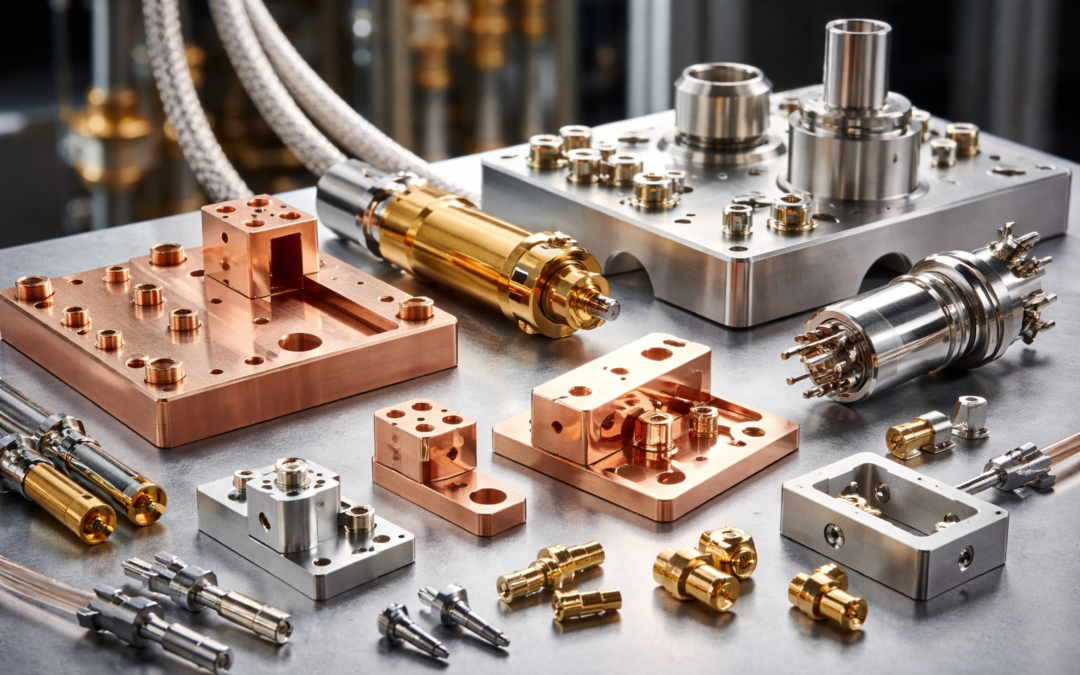
Cryogenic components are a critical part of the wider quantum computing ecosystem. While quantum computing hardware is often discussed in terms of qubits, control systems, and software stacks, the physical platform matters just as much. In many leading architectures, especially superconducting and spin-based systems, performance depends on hardware operating in ultra-low-temperature environments, often inside dilution refrigerators and carefully engineered cryogenic assemblies. These requirements makes precision machining far more important than many people first assume. Superconducting quantum chips are tested and operated in dilution refrigerators, while newer scaling approaches are focused on better cryogenic infrastructure, tighter packaging, and lower-heat interconnect strategies.
For manufacturers, this is where conventional CNC capability starts to overlap with advanced scientific hardware. A component that looks simple on a drawing may still need to perform under thermal contraction, vacuum conditions, vibration sensitivity, and demanding cleanliness requirements. In practice, that means cryogenic components for quantum systems are not just “cold parts.” They are precision-engineered features within a larger thermal, electrical, and mechanical chain. Companies such as Tarvin Precision are relevant in this space not because quantum hardware needs marketing language, but because it needs dependable machining discipline, material awareness, and repeatable quality.
Why Cryogenic Components Matter in Quantum Computing Hardware
Quantum systems that rely on superconducting qubits or cryogenic spin qubits need an environment that protects fragile quantum states from heat, noise, and unwanted interference. In a typical dilution refrigerator setup, the system is staged from room temperature down through intermediate levels such as roughly 50 K and 4 K, before reaching the colder stages around the still, cold plate, and mixing chamber where the experiment sits. The hardware around the chip therefore has to do several jobs at once: hold alignment, manage thermal flow, support cabling and connectors, reduce radiation load, and remain stable as the assembly cools down. That has major implications for machining:
- Flatness and positional accuracy can affect assembly quality.
- Material choice can affect contraction, conductivity, and mass.
- Surface finish can influence contact quality and cleanliness.
- Thread quality and fit can affect reliability after repeated cool-down cycles.
- Burr control matters because loose particles and poor edges are unwelcome in vacuum and high-spec assemblies.
In other words, cryogenic components are often performance-enabling parts, not just support hardware.
Cryogenic Components Commonly Found in Quantum Systems
When people picture quantum computers, they often think only of the processor chip. In reality, there is a wide surrounding hardware layer made up of structural, thermal, shielding, and interconnect elements. Dilution refrigerator systems are described by Bluefors as multi-stage assemblies with metallic flanges, radiation shields, vacuum enclosures, heat links, gas-handling interfaces, and experimental space infrastructure. Control and readout lines then add attenuators, filters, amplifiers, and related microwave hardware throughout the temperature stages. Typical machined cryogenic components in quantum hardware can include:
- Mounting plates and baseplates
- Thermal anchor blocks and heat links
- Radiation shield parts and covers
- Vacuum can interfaces and support hardware
- Connector housings and feedthrough support parts
- Waveguide, coaxial, or microwave packaging features
- Chip carriers, sample holders, and brackets
- Precision spacers, standoffs, and alignment parts
- Custom fixtures for testing and characterization
- Enclosures for cryo-electronics or packaging subassemblies
Some of these parts are simple geometrically. Others are highly detailed with pockets, tapped holes, sealing faces, and tight datums. What they share is that the machining cannot be treated as generic if the finished part is going into a quantum test or operating environment.
Materials: What Matters at Low Temperature
Material selection sits at the centre of successful cryogenic design. NIST maintains cryogenic material property references for common engineering materials including aluminium alloys, OFHC copper, beryllium copper, stainless steels, silicon, sapphire, G-10, and titanium alloys, precisely because low-temperature behaviour matters so much in cryogenic hardware. At those temperatures, thermal conductivity, linear expansion, specific heat, stiffness, and related properties can differ greatly from room-temperature expectations. In precision machining for cryogenic components, common choices often include:
- OFHC copper for thermal conductivity where heat sinking and thermalization matter
- Aluminium alloys where low mass, machinability, and structural function are priorities
- Stainless steels where strength, fasteners, and lower thermal conductivity are useful
- Titanium alloys for strength-to-weight and specialist applications
- Engineering insulators and composite materials where thermal isolation is needed
From a machining perspective, the ideal material on paper is not always the easiest material on the machine. OFHC copper, for example, may be highly attractive thermally but can present challenges around burrs, smearing, and surface integrity. An aluminium milling service may provide efficient machining, but not every alloy behaves the same in cryogenic service. Stainless steels may give structural confidence, yet they bring their own tooling and finishing demands.
That is why good manufacturing input should happen early. Material selection for cryogenic components is rarely just a design-office exercise; it benefits from feedback on machinability, achievable tolerances, inspection strategy, and assembly risk.
Precision Machining Challenges for Cryogenic Components
Low-temperature service amplifies ordinary manufacturing mistakes. A tolerance stack that seems acceptable at ambient conditions may become a fit problem after cool-down. A minor burr can become an assembly nuisance. A poor contact face can reduce thermal transfer. A lightly considered screw pattern can distort a thin plate or shield section. As quantum hardware scales, these issues become more visible because there are more interfaces, more cables, more package density, and more need for repeatability across builds. IBM highlights scalable cryogenic infrastructure, flex wiring, and cryogenic CMOS as part of the push toward larger, more reliable systems, while published research on superconducting and spin-based architectures points to packaging density, wiring complexity, and heat load as real barriers to scale. Key machining challenges usually include:
- Holding tight positional tolerances across multiple features
- Managing distortion in thin or lightweight parts
- Minimising burrs in soft or difficult materials
- Maintaining clean, repeatable threaded features
- Protecting critical faces used for thermal contact
- Achieving consistency between prototype and production batches
- Preventing cosmetic damage that may hide functional defects
For suppliers entering this sector, that is why a “can machine to drawing” mindset is not enough. The better approach is to understand what the drawing is trying to achieve in service.
Cryogenic Components and Thermal Contraction
One of the most important issues in cryogenic components is differential contraction. Different materials shrink by different amounts as temperature drops, and NIST’s cryogenic material references exist precisely because designers need reliable data on expansion and related low-temperature properties. In quantum hardware, this matters anywhere two materials meet, anywhere a clamped joint is used, and anywhere a precision alignment needs to survive cool-down without excess stress or loss of contact. That makes practical design-for-machining points especially useful:
- Keep an eye on mixed-material assemblies.
- Consider how bolt loads may change after cooling.
- Avoid unnecessary stress raisers near highly loaded features.
- Think about thermal paths, not just static geometry.
- Use sensible datum structures so critical fits can be inspected properly.
- Review whether pockets, ribs, or thin walls could distort during machining or service.
This is where experienced machining input adds value early. A supplier used to high-spec work will often spot where a nice CAD model may be vulnerable in the real assembly. Tarvin Precision, for example, would be better positioned in this type of discussion because the issue is not simply whether a part can be cut, but whether it can be cut repeatably with the stability the final application needs.
Surface Finish, Cleanliness and Contact Quality
In quantum hardware, the quality of a machined surface can matter beyond appearance. Cryogenic systems use thermal links, shield interfaces, connector mounts, and hardware that must behave predictably inside vacuum and low-temperature environments. Bluefors notes the importance of vacuum cans, radiation shields, thermalized lines, staged attenuators, and filters that help manage radiation and noise. Their IR filters, for example, are designed to protect sensitive quantum devices below 1 K from high-energy photons that can cause heating or decoherence. That tells you something broader: the environment is highly sensitive, so seemingly small mechanical details deserve proper control. For machining, that usually means paying attention to:
- Surface finish on mating and contact faces
- Deburring of edges, threads, and internal features
- Cleanliness after machining and handling
- Scratch prevention on cosmetic and functional faces
- Consistency of counterbores, spot faces, and seating surfaces
- Avoidance of trapped swarf in blind features
Every one of those points sounds ordinary, but in cryogenic components ordinary discipline becomes advanced capability. A poor finish or hidden burr may not always fail immediately, yet it can create avoidable friction during build, test, or maintenance.
Components for Dilution Refrigerators and Microwave Infrastructure
A great deal of quantum hardware machining happens not at the qubit itself, but in the surrounding cryogenic platform. Dilution refrigerators have multiple temperature stages, copper heat links, vacuum enclosures, radiation shields, and interfaces that help pre-cool, isolate, and support experiments. Quantum measurement infrastructure also relies on carefully managed control and readout lines, where attenuators reduce thermal radiation, filters suppress noise, and amplifiers help recover weak signals. Bluefors explicitly describes this chain as essential to high-performance superconducting qubit operation.
That broad system creates demand for cryogenic components such as:
- Flange-mounted support parts
- Cable management and clamp hardware
- Thermalization blocks for line anchoring
- Mounts for attenuators, filters, and readout modules
- Brackets and carriers for sample-stage assemblies
- Shield penetrations and routing features
- Precision covers and housings around sensitive subassemblies
This is also where collaboration between designer, assembler, and machinist matters most. A component may need to clear cables, allow tool access, preserve shielding geometry, and maintain contact on a thermal face all at once. Good machining support helps balance those competing needs without forcing a redesign later.
Scaling from Prototype to Production
Quantum computing is moving from laboratory proof-of-concept toward industrialisation. IBM’s current hardware roadmap and system architecture emphasise modular cryogenic infrastructure, and Nature reports now show superconducting qubits being manufactured on 300 mm CMOS pilot lines and cryogenic control strategies aimed at easing wiring bottlenecks and system scale-up. That does not mean every quantum hardware programme is in mass production today, but it does mean suppliers should be ready for a path from one-off development parts to controlled repeat batches. For cryogenic components, scaling well usually requires:
- Stable machining processes, not one-off heroics
- Clear revision control and documentation
- Repeatable inspection on critical features
- Good handling methods for soft or high-value materials
- Sensible fixture strategy for low-distortion machining
- Feedback loops between prototype learning and production release
This is an area where precision subcontract machining can quietly make a big difference. A shop that can take a development drawing, discuss risk points, produce clean first-off parts, and then hold the same standards through later batches is far more useful than one that treats every order as unrelated.
How to Choose a Machining Partner for Cryogenic Components
Choosing the right supplier for cryogenic components is less about buzzwords and more about engineering fit. Quantum hardware teams usually need a machining partner that understands tolerance, traceability, inspection, finish, and communication. They may not need the supplier to be a quantum physicist, but they do need them to appreciate why one face is more critical than another, why burr-free edges matter, and why consistency matters from build to build. A strong machining partner should be able to demonstrate:
- Experience with tight-tolerance precision parts
- Confidence with copper, aluminium, stainless steels, and specialist alloys
- Thoughtful fixturing and process planning
- Good metrology and inspection reporting
- Clean deburring and careful handling
- Willingness to review drawings and flag manufacturability issues
- Reliability on repeat work, not just prototypes
That is the kind of space where Tarvin Precision can be mentioned naturally. In advanced sectors, customers are often looking for competent, technically grounded manufacturing support rather than a dramatic sales pitch. For cryogenic and quantum-adjacent hardware, that grounded approach tends to be exactly what is needed.
Cryogenic Components for Quantum Hardware
As quantum systems become more ambitious, the supporting mechanical hardware becomes more important, not less. The processor may get the attention, but the surrounding cryogenic components help create the stable thermal, structural, and electromagnetic environment that allows the processor to work at all. From thermal anchor blocks and shield parts to chip carriers, support plates, and precision microwave packaging, machining quality has a direct effect on buildability and long-term performance.
For that reason, precision machining for quantum computing hardware should be approached as part of the system engineering effort. Material behaviour at low temperature, thermal contraction, finish quality, cleanliness, vacuum compatibility, and repeatability all matter. The businesses that will add most value in this field are the ones that understand that advanced hardware is rarely about a single part in isolation. It is about making every part behave correctly inside a demanding whole. If you are producing or sourcing cryogenic components, that is the mindset worth keeping from the first drawing review to the final inspection.