
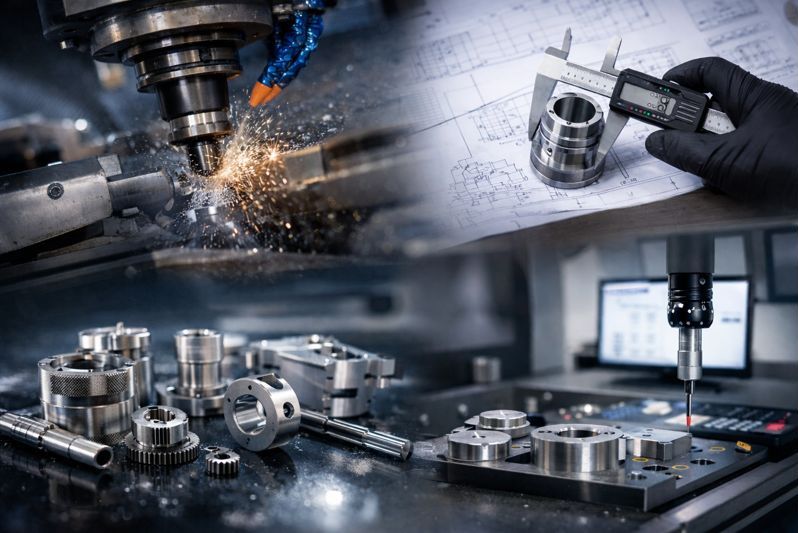
Component manufacturers sit at the quiet centre of almost every product you can name – from industrial sensors and medical devices to aerospace subsystems and energy infrastructure. When they perform well, your production line runs smoothly, your field returns stay low, and your engineering team can focus on improving the product rather than firefighting supply issues. When they perform poorly, the knock-on effects are immediate: late builds, quality escapes, unexpected cost, and a steady erosion of confidence across engineering, procurement, and operations.
This guide is written for people who buy, design, or manage the supply of engineered parts – especially where tolerances, traceability, and repeatability matter. Here you will find practical ways to evaluate suppliers, write better drawings, de-risk launches, and set relationships up for long-term success.
What Component Manufacturers Do
The phrase component manufacturers can mean very different things depending on your industry. For some teams, it refers to high-volume producers of standardised parts. For others, it means precision CNC machining partners building low-to-mid volume components with tight tolerances and documentation. Getting specific about what you need – right at the start – prevents mismatched quotes, unreliable lead times, and quality plans that don’t fit your risk profile.
A helpful way to think about component manufacturers is by the value they provide across four layers: process capability (can they physically make it?), quality capability (can they prove it?), delivery capability (can they repeat it on time?), and collaboration (can they help you reduce cost and risk over time?).
Component Manufacturers vs. Contract Manufacturers vs. Assemblers
It’s common for procurement documents, RFQs, and even internal conversations to blur these categories, which creates friction later – especially when quality documentation, accountability for sub-suppliers, or “who owns the build” isn’t clearly defined. Getting the labels right up front helps you set expectations and makes quotes more comparable, because you’re not accidentally comparing a “parts only” price to a “parts + build + test” price.
Component Manufacturers
Component manufacturers typically make discrete parts or subcomponents rather than finished products. This can include CNC machined parts, pressed and stamped items, molded plastics, fabricated sheet metal, or processed materials such as cut-to-size stock and treated components. Their value is rooted in process capability and repeatability – they’re geared around producing parts to drawing, controlling variation, and providing the right inspection and traceability for those items. In many cases, a strong component manufacturer will also support DFM feedback, propose tolerance or datum improvements, and help you understand what drives cost and lead time on a per-feature basis.
Contract Manufacturers
Contract manufacturers usually provide a broader scope that goes beyond making individual parts. They commonly manage kitting, sub-assembly, final assembly, test, packaging, and logistics, and they may also take responsibility for purchasing and coordinating multiple upstream suppliers. In other words, you’re paying for system-level delivery, not just part-level production. Depending on the sector, a contract manufacturer might also support design transfer, process validation, and documentation packs aligned to regulated requirements. The key difference is accountability: contract manufacturers are often expected to “own the build” end-to-end, which can reduce your internal workload but requires very clear alignment on specifications, change control, test criteria, and acceptance standards.
Assemblers
Assemblers may not manufacture many parts themselves, but they add value through integration and finishing operations that turn parts into functional units. This can include wiring and harnessing, bonding and sealing, calibration, alignment, torque/fastening control, functional checks, and final test. Assemblers are especially useful when the build requires specialised fixtures, repeatable workmanship, or controlled handling (for example, delicate optical, electronic, or cleanliness-sensitive assemblies). The best assemblers are strong on build documentation – work instructions, process checks, build records – and on catching tolerance or fit issues early, before they become expensive rework later.
Many modern suppliers span multiple categories, so it’s worth confirming the exact scope rather than relying on the label. If you need finished subassemblies, ask early whether the supplier manages upstream suppliers, accepts customer-supplied parts, and can provide build records, test results where applicable, and serialised traceability (including how they handle part revisions and substitutions).
Matching Types of Component Manufacturers to Your Needs
Choosing between “a supplier who can do everything” and “a specialist for each process” is not just a cost decision, it’s a risk decision. Consolidating can simplify purchasing and logistics, while specialists can offer superior capability and more consistent yield within a narrow scope.
A useful selection approach is to start from your dominant risk: is your risk mainly dimensional/functional, regulatory/documentation, scale/volume, or schedule/availability? The best-fit component manufacturers are those whose strengths align with your largest risk.
Before comparing suppliers, it helps to map common categories you’ll encounter:
- Precision component manufacturers (machining-focused): CNC milling/turning, multi-axis work, tight tolerances, inspection-heavy industries.
- High-volume component manufacturers: automated lines, low unit cost at scale, often less flexible on design changes.
- Custom component manufacturers: engineered-to-order parts, prototypes through small batch production, strong DFM input.
- Process specialists: grinding, EDM, laser cutting, heat treatment, plating, anodising, passivation, coating, molding.
- Integrated suppliers: machining + surface treatment + assembly + test (sometimes including supply-chain management).
In practice, many teams use a hybrid model: a small number of core component manufacturers for the highest-risk items, plus approved specialists for secondary processes (finishing, heat treatment, marking, calibration).
UK Component Manufacturers and The Value of Proximity
Global sourcing can be excellent when volumes are high and designs are stable. But for complex, tolerance-sensitive parts, especially in development or early production, proximity still has real advantages: faster feedback loops, easier site visits, quicker corrective actions, and less exposure to border disruption or logistics variability.
UK component manufacturers are often chosen for programmes where design iterations are frequent, documentation standards are strict, or where schedule risk outweighs labour-cost differences. In sectors like aerospace, medical, and advanced instrumentation, the ability to pick up the phone, discuss inspection strategy, and rapidly refine a drawing is sometimes worth more than a small unit-cost delta.
As an example (without turning this into a sales pitch), Tarvin Precision is the kind of UK machining-led partner some teams prefer during development because design-for-manufacture conversations can happen quickly and practically, especially when tolerances, finishes, and assembly intent need to be translated into a robust manufacturing plan.
Capabilities That Separate Great Component Manufacturers from Average Ones
Most supplier evaluations focus on “can you make this part?” The better question is “can you make this part repeatedly, with controlled variation, and prove it with documentation that matches our risk?” That distinction is where programmes either stabilise, or drift into recurring NCRs and concessions.When you’re comparing component manufacturers, look for evidence in these areas:
Process capability and control
A strong supplier can explain how the process is controlled, not just that it exists. For machining, this might include stable workholding strategy, tool-life management, probing routines, thermal control, and chip evacuation planning. For molding, it’s process windows, gating strategy, shrink prediction, and tool maintenance plans. For fabrication, it’s weld procedures, fixturing, and distortion control.
Ask for examples of how they handle variation: Do they run capability studies? Do they track key dimensions over time? Do they identify special characteristics and treat them differently?
Engineering Support and DFM (Design for Manufacture)
The best component manufacturers reduce your total cost by preventing problems before they reach the shop floor. This doesn’t require “designing your product for you,” but it does mean providing specific feedback:
- alternative datums that inspect more reliably
- tolerance reductions that don’t change function
- material substitutions that improve stability or lead time
- feature tweaks that cut cycle time or scrap risk
- simplified surface finish callouts where appropriate
DFM isn’t about “making it cheaper at any cost.” It’s about making it more manufacturable and therefore more repeatable.
Measurement and Inspection Maturity
Inspection capability isn’t just owning a CMM. It’s having a measurement plan that matches the drawing intent, calibrated equipment, trained inspectors, controlled environmental conditions where needed, and the discipline to segregate nonconforming product.
If your component manufacturers supply into regulated or safety-critical sectors, you should expect to see a clear approach to first article inspection, sampling plans, gauge R&R where relevant, and structured corrective action when issues arise.
Precision Component Manufacturers: Machining Realities You Should Design Around
Precision machining is one of the most common routes for complex, tight-tolerance components, especially in low-to-mid volumes. But “precision” is not a magic label—it’s the result of controlled setups, stable materials, and sensible drawing intent.
To get the best outcomes from precision component manufacturers, keep three realities in mind:
- Datums drive everything: Poor datum selection forces awkward setups and unreliable inspection.
- Tolerance stacking is a design choice: Many “hard parts to make” are simply “hard parts to measure and repeat” because the drawing doesn’t reflect functional requirements clearly.
- Material behaviour matters: Aluminium moves, stainless can work harden, thin walls distort, plastics absorb moisture- your tolerances must reflect the physical world.
A lot of procurement pain comes from designs that are technically possible but not economically stable. You can often keep function identical while making manufacturing far more reliable.
Custom Component Manufacturers: Prototypes, NPI, and Early Production
Custom component manufacturers are especially valuable during NPI (new product introduction), when design changes are frequent and learning cycles are short. The goal at this stage isn’t only to get parts-it’s to generate confidence that the part can be made repeatedly without heroics.
Early-stage best practice is to treat supplier feedback as data, not opinions. If two different manufacturers flag the same risk (for example, a tolerance on a thin-wall bore or an ambiguous datum scheme), it’s usually worth revisiting.
There’s also a planning angle: prototypes that are made “any way possible” don’t always translate cleanly to production. If your first builds require excessive manual rework or inspection gymnastics, you’re effectively borrowing cost and risk from the future.
This is where a pragmatic partner – sometimes a machining-led supplier like Tarvin Precision, sometimes a specialist in your key process – can be useful as a sounding board for manufacturability choices. The most helpful suppliers will explain trade-offs clearly: what changes reduce risk, what changes reduce cost, and what changes mainly improve lead time.
Quality Systems in Component Manufacturing
Certifications (ISO 9001, AS9100, ISO 13485, IATF 16949) can matter a lot, but they’re not a guarantee of performance. The real value is in how the system shows up day-to-day: document control, training records, corrective actions that actually prevent recurrence, and consistent inspection practice. A pragmatic way to assess quality maturity is to ask component manufacturers how they handle three moments:
- First article: What is included? How do they verify the drawing? How do they record results?
- A change: What happens if a tool is replaced, a program changes, or a sub-supplier changes?
- A nonconformance: How do they contain product, communicate quickly, identify root cause, and implement prevention?
If you work in aerospace or defence, you’ll also care about traceability, material certification, and controlled special processes. In medical and high-reliability electronics, cleanliness, handling, and process validation may be equally critical. Align your audit questions with the risks your product can’t tolerate.
Tolerances, GD&T and How Component Manufacturers Interpret Your Drawing
Drawings are contracts, but they’re also translations of functional intent into manufacturing and inspection steps. If the translation is unclear, the result is usually one of two extremes: conservative manufacturing that raises cost, or optimistic interpretation that creates quality escapes.
To work effectively with component manufacturers, aim for drawings that are:
- Function-led: tight where it matters, relaxed where it doesn’t
- Datum-consistent: datums reflect how the part locates in the assembly
- Inspectable: dimensions can be measured reliably with the tools available
- Unambiguous: finishes, edges, threads, and special notes are clear and standardised
Before you release a drawing, it’s worth doing an “inspection thought experiment.” Can you explain, step-by-step, how the critical features will be measured, how the part will be fixtured, and what the acceptance criteria are? If not, you’ll likely pay for that uncertainty later.
Materials and Finishing: Where Quality Issues Often Hide
A part can be dimensionally perfect and still fail in service because of material choice, finishing specification, or surface condition. Many recurring production problems trace back to incomplete definitions around material grade, heat treatment condition, coating thickness, masking requirements, or post-process dimensional change.
This is why experienced component manufacturers will ask clarifying questions about finishes and secondary processes. They know that anodising builds and can shift dimensions, heat treatment can distort, plating can affect threads, and deburring rules can change edge breaks that were assumed but never specified.
When specifying materials and finishes, try to be explicit about:
Material Standards and Condition
Include the exact heat/temper state and clearly list any acceptable equivalent grades/standards. This avoids unplanned substitutions that can change strength, corrosion performance, machinability, or stability.
Surface Finish Requirements
State where the finish truly matters on the part and why (for example, sealing faces, bearing fits, sliding contact, or cosmetic surfaces). Avoid blanket finish callouts that add cost and inspection burden without improving function.
Coating or Treatment Standards
Name the standard/process you require and include the thickness range when it affects fits, threads, conductivity, or fatigue life. Also specify any post-treatment steps such as sealing, baking, or restrictions on marking.
Masking and Critical Areas
Call out exactly which features must be masked – threads, datum bores, press fits, sealing lands, and electrical contact zones – and define the boundaries clearly. This prevents coatings building up where they can cause assembly issues or performance drift.
Post-process Inspection Requirements
Specify what must be verified after finishing or heat treatment, including any coating thickness checks, hardness/adhesion checks, or visual criteria. If distortion is a risk, state how it should be measured and what rework is permitted.
A small clarification at RFQ stage can prevent weeks of rework later.
How Component Manufacturer Prices Work
It’s easy to treat quotes as opaque, but most pricing from component manufacturers is driven by a few predictable factors. If you understand them, you can often reduce cost without compromising function.
For machined parts, typical cost drivers include:
- number of setups and complexity of workholding
- cycle time (especially on expensive multi-axis machines)
- tooling needs and tool wear (hard materials, deep pockets, small cutters)
- inspection time (tight tolerances, many critical features)
- scrap risk (thin walls, distortion-prone geometries)
- finishing and special processes (plus transport and handling)
If a quote looks high, ask a targeted question: “Which feature or tolerance is driving the cost?” Good component manufacturers can point to the specific drawing elements that increase time or risk.
Lead Time, Capacity and Resilience
On-time delivery is often treated as a scheduling issue, but it’s really an operational capability. Suppliers who deliver reliably tend to have:
- realistic capacity planning
- stable sub-supplier relationships
- disciplined change control
- clear prioritisation rules
- fast internal escalation when problems appear
If you’re launching a product, it’s also worth discussing how the supplier handles ramp: what batch sizes make sense, how they manage raw material availability, and what lead time looks like if demand doubles.
For high-risk components, consider dual-sourcing, either by qualifying two component manufacturers or by qualifying one manufacturer plus a backup process route. Dual-sourcing costs time up front, but it can be a major resilience gain.
Communication That Works: How to Collaborate with Component Manufacturers
Supplier relationships go wrong most often due to unclear expectations and slow feedback. The strongest outcomes usually come from a simple shared rhythm:
- clear critical-to-quality features and acceptance criteria
- agreed documentation package (FAI, CoC, material certs, inspection reports)
- defined response times for queries and NCRs
- a structured change process (including sub-supplier changes)
- periodic reviews for performance, forecast, and improvement actions
It also helps to unify engineering and procurement language. If purchasing is optimising for cost while engineering is optimising for risk, the supplier ends up caught between two different definitions of success.
Choosing A Component Manufacturer: A Practical Evaluation Checklist
A checklist doesn’t replace judgement, but it prevents obvious misses. Use the following as a structured way to compare suppliers, especially when qualifying new component manufacturers for critical work.
Start by gathering consistent evidence (not just claims) across these areas:
- Capability fit: machine/process capability matches your drawings, materials, and tolerances
- Quality maturity: inspection plan, calibration, traceability, corrective action discipline
- Documentation: ability to supply the records your sector requires (FAI, certs, reports)
- Change control: how they manage revisions, program updates, tool changes, and sub-suppliers
- Delivery performance: historical OTD, lead time stability, capacity planning approach
- Engineering support: DFM feedback quality, speed of response, clarity of communication
- Risk management: how they contain issues, communicate, and prevent recurrence
- Commercial alignment: transparent quoting assumptions, MOQ/batch logic, sensible payment terms
- Security and compliance: NDA handling, IP protection, export control awareness (if relevant)
- Culture: do they take ownership, and do you trust them with critical work?
If you score suppliers, weight the categories according to your product’s risk. A cosmetic bracket and a flight-critical actuator component should not be evaluated the same way.
Specifying Work to Component Manufacturers: RFQ Packages That Get Better Outcomes
Many quote delays come from missing information rather than lack of interest. A strong RFQ package reduces back-and-forth and makes quotes more comparable.
Before sending an RFQ to component manufacturers, include a paragraph-level “context note” that explains what matters most for this part: function, critical features, intended volume, and any known constraints. That small context helps suppliers choose the right manufacturing strategy.
Then ensure your package covers:
- latest drawings and models (with revision control)
- material specs and allowable equivalents
- finishing specs, masking notes, and post-process inspection needs
- quality/documentation requirements (FAI format, certs, reports)
- annual volume estimates and expected batch sizes
- target dates (prototype, pilot, production) and any ramp assumptions
- packaging, cleanliness, or handling requirements
- acceptance criteria for deviations (if any) and concession process
The goal is not to overwhelm suppliers with paperwork. It’s to remove ambiguity that would otherwise surface later as cost, delay, or disputes.
Long-term Partnerships With Component Manufacturers
Once production stabilises, the conversation should move from “can you make it?” to “how do we make it better?” That’s where long-term value appears: cost-down projects, yield improvements, lead time reductions, and smarter inspection strategies.
A simple continuous improvement loop can look like this:
- review recurring NCR themes quarterly
- identify the top 1–2 cost or lead-time drivers
- run small, controlled changes (one variable at a time)
- measure outcomes and lock in the improvement via documentation and training
Suppliers who embrace this approach often become strategic partners rather than transactional vendors. It also tends to create more predictable pricing and delivery over time, because both sides are reducing variability.
Component Manufacturers Make Your Whole System Stronger
Selecting component manufacturers is not just a procurement task – it’s a design, quality, and operations decision wrapped into one. The best suppliers don’t simply “hit the numbers on the drawing.” They help you define what those numbers should be, manufacture them repeatably, and provide evidence you can trust.
If you want better results quickly, focus on three moves: improve drawing clarity (especially datums and tolerances), align documentation requirements to real risk, and choose suppliers based on proven process control, not just nominal capability. Do that, and you’ll find that good component manufacturers don’t just supply parts – they reduce friction across your entire product lifecycle.