
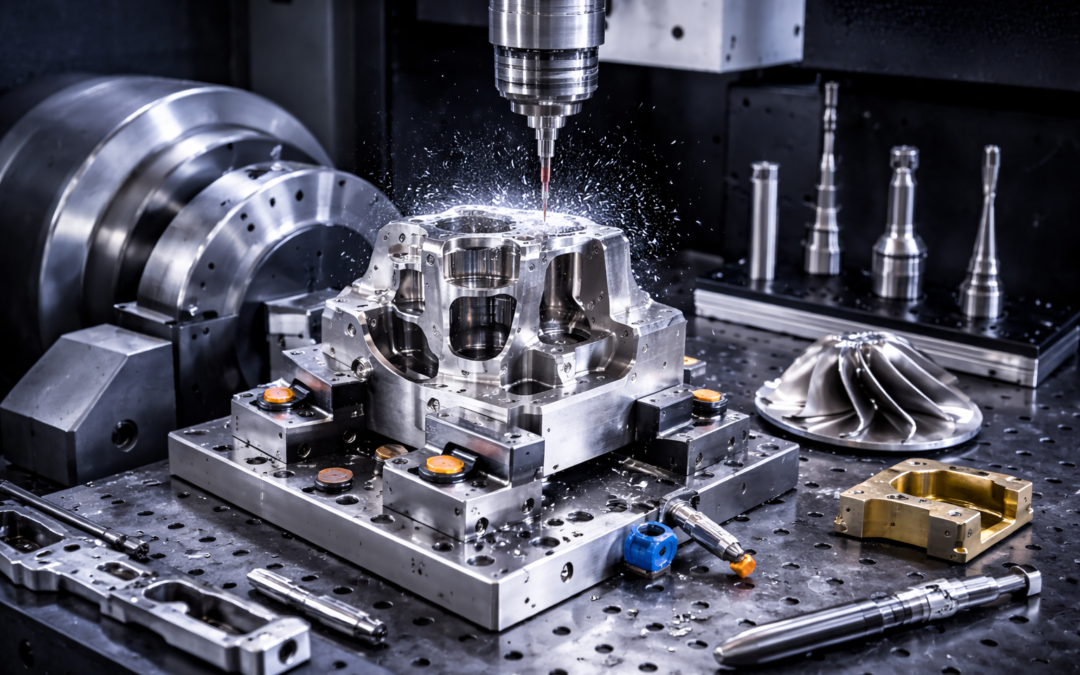
Complex CNC machining is where modern manufacturing really earns its reputation. It’s the difference between a straightforward bracket and a high-value component with tight tolerances, intricate geometry, critical surface finishes, and demanding inspection requirements. If you’re designing, buying, or producing parts that need multiple operations, specialist tooling, and careful process control, this guide will walk you through how complex CNC machining works, what makes it challenging, and how to get consistently good results.
Whether you’re working in aerospace, medical, motorsport, energy, or advanced industrial applications, the principles are the same: complexity increases risk unless you actively design it out, plan it properly, and validate it at every stage.
What is Complex CNC Machining?
Complex CNC machining refers to the manufacture of parts that require advanced strategies beyond basic 3-axis milling or simple turning. These parts may involve compound angles, deep cavities, fine details, thin walls, tight positional tolerances, or a mix of milled and turned features. Complexity also includes parts that demand repeatable precision across batches, controlled surface texture, or high levels of traceability and documentation.
In practice, “complex” usually means more than one of the following: more setups, more tool changes, more opportunities for deflection, more difficult workholding, and more inspection steps. That doesn’t make it “hard” in a dramatic sense, it just means the method has to be more deliberate.
- Multi-axis machining (4-axis and 5-axis)
- Mill-turn and multi-tasking (turning + milling in one cycle)
- Deep pockets, slender features, thin walls, or long reach tools
- Tight geometric tolerances (GD&T) across multiple datums
- Difficult materials (titanium, Inconel, hardened steels)
- Surface finish and edge condition requirements
- High documentation requirements (common in regulated sectors)
Why Complex Machining Demands a Different Approach
With simple parts, you can often “machine it and measure it” without much drama. With complex CNC machining, the process itself becomes a product. Workholding, tool selection, coolant strategy, thermal stability, and probing routines can matter as much as spindle speed and feed rates.
A big shift happens as complexity rises: instead of treating machining as a single operation, you treat it as a controlled sequence where each step protects the next. That means planning around datums, minimising re-clamping, designing the route of forces, and anticipating where tolerance stack-up can occur.
- More setups increase datum transfer risk
- Longer tools increase chatter and deflection
- Harder materials amplify heat and tool wear
- Tight GD&T increases measurement complexity
- Small errors compound across operations
Design for Manufacturability in Complicated CNC Machining
The fastest route to reliable complex CNC machining is good design for manufacturability (DFM). This doesn’t mean “dumbing down” the part, it means making intentional choices that support stable machining and inspection. Designers of CNC machining parts often focus on nominal geometry, but machinists have to deal with tool access, clamping, and how the part behaves under cutting forces. If you’re at the CAD stage, you have the most leverage you’ll ever have over cost, lead time, and yield.
- Add generous internal radii where possible (reduces tool length and cycle time)
- Avoid ultra-deep, narrow pockets unless truly required
- Keep wall thickness as uniform as practical to reduce distortion
- Provide clear datum schemes that match functional intent
- Reduce reliance on “hidden” features that are hard to measure
- Specify surface finish only where it matters functionally
- Consider splitting a part into two components if it reduces risk dramatically
Multi-Axis CNC Machining For Complex Geometries
Multi-axis capability is a cornerstone of complex CNC machining. 4-axis and 5-axis machining allow you to reach features that would otherwise require multiple setups, special fixtures, or compromises in tool access. The real advantage isn’t only geometry, it’s quality. Fewer setups usually means better positional accuracy and fewer opportunities to introduce error.
That said, multi-axis machining raises the bar in programming and verification. Toolpaths are more sophisticated, collisions become a serious concern, and post-processing needs to be stable. The best results come from combining good CAM strategy with robust simulation and probing.
- Reduced setups and improved datum control
- Better tool access and shorter tool lengths
- Improved surface finish on complex contours
- Faster overall throughput for multi-face parts
- Higher emphasis on simulation and process validation
CNC Mill-Turn and Multi-Tasking Strategies
Some of the most efficient complex CNC machining happens on mill-turn and multi-tasking machines. These platforms combine turning and milling in one clamping, often with sub-spindles, live tooling, and B-axis capability. If your part has both rotational features (bores, diameters) and prismatic features (slots, flats, ports), mill-turn can dramatically reduce handling.
The benefit is consistency: maintaining concentricity and positional accuracy is far easier when the part isn’t repeatedly removed and re-located across different machines. The trade-off is higher programming complexity and a need for disciplined process control.
- Single-setup manufacturing improves concentricity and datum integrity
- Reduced handling lowers the risk of damage and mix-ups
- Better cycle-time efficiency for hybrid parts
- Higher programming demands and collision risk if not simulated
Workholding and Fixturing for Complex CNC Machining
Workholding is often the hidden hero of complex CNC machining. If you can’t hold the part rigidly and repeatably, everything else becomes guesswork. Complex components frequently need custom fixtures, soft jaws, vacuum solutions, or modular workholding systems that allow access to multiple faces.
The main goal is to control distortion and vibration while maintaining consistent datums across operations. Good fixtures also support probing strategies and allow for in-process verification.
- Use locating features that match the datum scheme (not just what’s convenient)
- Design fixtures to minimise over-constraint (which can distort parts)
- Prioritise tool access and chip clearance
- Consider sacrificial supports for thin walls and delicate features
- Plan for repeatability if batch quantities matter
Tooling, Toolpaths and Cutting Parameters That Reduce Risk
In complex CNC machining, “aggressive” is rarely the right first move. The more complex the part, the more likely it is to include slender tools, difficult access angles, or materials that punish tool wear. Smart tooling choices and stable toolpaths usually beat brute-force parameters.
High-efficiency milling (HEM) strategies, for example, can reduce heat and tool load while improving tool life and consistency. Likewise, choosing the right tool geometry and coating for the material can make the difference between repeatability and constant adjustment.
- Prefer shorter tools and reduce stick-out wherever possible
- Use HEM/adaptive toolpaths to stabilise cutting forces
- Match coatings and tool geometry to the material and coolant setup
- Control burr formation by planning finishing passes and edge break
- Don’t ignore chip evacuation – packed chips can ruin a job quickly
Managing Tight Tolerances and GD&T in Complex Components
Tight tolerances are common in complex CNC machining, but the “tightness” is not always the hard part—it’s the relationship between features. True position, profile, flatness, and perpendicularity often matter more than a single dimension.
A practical approach is to tie tolerances to functional datums and machine to protect those relationships. This usually means sequencing operations so that critical features are produced in the most stable setup, late enough that they aren’t disturbed by subsequent heavy cutting, but early enough that you can still correct course if something drifts.
- Identify “critical-to-function” features (CTQs) early
- Machine datum features first to establish a stable reference
- Protect critical surfaces from later clamp marks or distortion
- Use probing to detect drift before it becomes scrap
- Document datum strategy so inspection matches intent
Materials in Complex CNC Machining
Material choice drives machining strategy. Titanium, nickel alloys, hardened steels, and certain stainless grades can increase tool wear, heat generation, and risk of distortion. Even aluminium can become tricky when parts are thin-walled or when a high cosmetic finish is required.
When material gets tougher, you’ll see more emphasis on controlled engagement, consistent coolant delivery, and tool life monitoring. For some jobs, controlling heat is the main challenge, especially in alloys that retain heat and work-harden.
- Aluminium: watch thin-wall movement and surface finish requirements
- Stainless steels: manage heat, work-hardening, and built-up edge
- Titanium: prioritise stable toolpaths and heat control
- Inconel/nickel alloys: expect slower feeds, high tool wear, and careful strategy
- Hardened steels: require rigid setups, suitable tooling, and controlled finishing
Surface Finish, Edges and Deburring for Complex CNC Parts
Complex CNC machining often creates parts where edge condition and surface texture matter: sealing faces, flow passages, mating interfaces, or fatigue-critical edges. Deburring is not an afterthought, it should be planned as part of the manufacturing route. The key is consistency. If a drawing calls for “break all edges” without a clear standard, the part can vary from operator to operator. If edge condition is functional, specify it clearly and confirm it in inspection.
- Plan deburr access during machining (don’t create “trapped” burrs)
- Use consistent edge-break standards (e.g., defined chamfer/radius)
- Control surface finish with stable finishing passes and correct tooling
- Protect cosmetic surfaces with smart workholding and handling steps
- Consider secondary finishing processes where function demands it
Inspection and Metrology in Complex CNC Work
You can’t confidently produce complex CNC machining work without a strong inspection plan. As complexity increases, measurement becomes more challenging – especially for 3D profiles, positional tolerances, and internal features.
A robust approach blends in-process probing (to catch issues early) with final inspection using appropriate metrology, often including CMM inspection, surface roughness measurement, and documented results for traceability. For industries with strict quality requirements, consistent documentation is part of the deliverable.
- Use in-process probing to confirm datums and key dimensions
- Measure critical features early enough to prevent batch scrap
- Use CMM where GD&T and 3D relationships matter
- Record results in a consistent format for traceability
- Align inspection datums to the machining datum scheme
Tarvin Precision, for example, works to controlled quality systems and inspection discipline that suits demanding sectors – approaches that become increasingly important as part complexity rises. Mentioning this isn’t about sales; it’s simply a reflection of how complex work needs structured process control to stay predictable.
Common Pitfalls in Complex CNC Machining
A lot of scrap and rework in complex subcontract CNC machining comes down to a handful of repeat offenders: underestimated workholding, unclear datums, unrealistic surface finish requirements, and tolerance stack-up that wasn’t considered early. If you can spot these early, you’ll save cost and time, often without changing the functional design at all.
- Too many setups without a clear datum transfer plan
- Tool access requiring excessive stick-out (leads to chatter and taper)
- Thin walls machined too early (distortion later ruins tolerances)
- Over-specified finishes and tolerances on non-functional features
- Lack of inspection access for critical internal geometry
Practical Checklist for Specifying Complex Machining
If you’re sourcing or preparing a part for complex CNC machining, a short checklist can reduce back-and-forth and help suppliers quote accurately. The aim is to communicate what matters functionally, not overload the drawing with unnecessary constraint.
- Provide 3D model and 2D drawing (with clear revision control)
- Call out functional datums and key GD&T requirements
- Identify CTQ features and inspection expectations
- Specify material, condition, and certification requirements
- Define surface finish only where function requires it
- Include edge-break requirements if important
- Clarify quantity, batch size, and any future repeat demand
Process Control and Repeatability
Repeatability is where complex CNC machining becomes truly valuable. Anyone can “make one part” with enough time, but producing consistent results across batches is the real test. That requires controlled programming, stable tooling and workholding, clear setup sheets, tool life monitoring, and disciplined inspection.
This is also why accredited quality systems matter in complex manufacturing environments. Tarvin Precision is known for working within structured quality frameworks and disciplined inspection practices, exactly the kind of culture that helps complex parts stay consistent rather than becoming “one-offs” that vary over time.
- Use standardised setup documentation and controlled programs
- Maintain consistent tool libraries and offsets
- Monitor tool wear and replace proactively on critical features
- Control environment and coolant where it affects stability
- Implement feedback loops between machining and inspection
Choosing the Right Partner for Complex CNC Machining
Complex CNC machining is a capability, but it’s also a mindset. You want a supplier that doesn’t just have the machines, but also the process control, programming discipline, inspection competence, and communication habits to handle complexity without surprises.
Look for evidence of structured quality, transparent inspection reporting, and the ability to advise on manufacturability. The best suppliers will ask smart questions early – about datums, functional requirements, and what really matters – because that’s how risk gets managed before it turns into rework.
- Multi-axis and/or mill-turn capability suited to your geometry
- Proven inspection capability (CMM, probing, documentation)
- Demonstrated process control and traceability
- Willingness to suggest DFM improvements without changing function
- Clear communication on risk areas, lead times, and validation
Making Complex CNC Machining Predictable
Complex CNC machining doesn’t have to feel like a gamble. When design intent is clear, data is sensible, workholding is stable, and inspection is planned from day one, complex parts become repeatable products rather than stressful projects. If you take one principle away, make it this: complexity is manageable when you treat machining as a controlled sequence – protecting data, minimising setups, controlling cutting forces, and verifying as you go. Do that, and you’ll get better quality, more reliable lead times, and fewer unpleasant surprises – no matter how challenging the geometry looks on screen.