
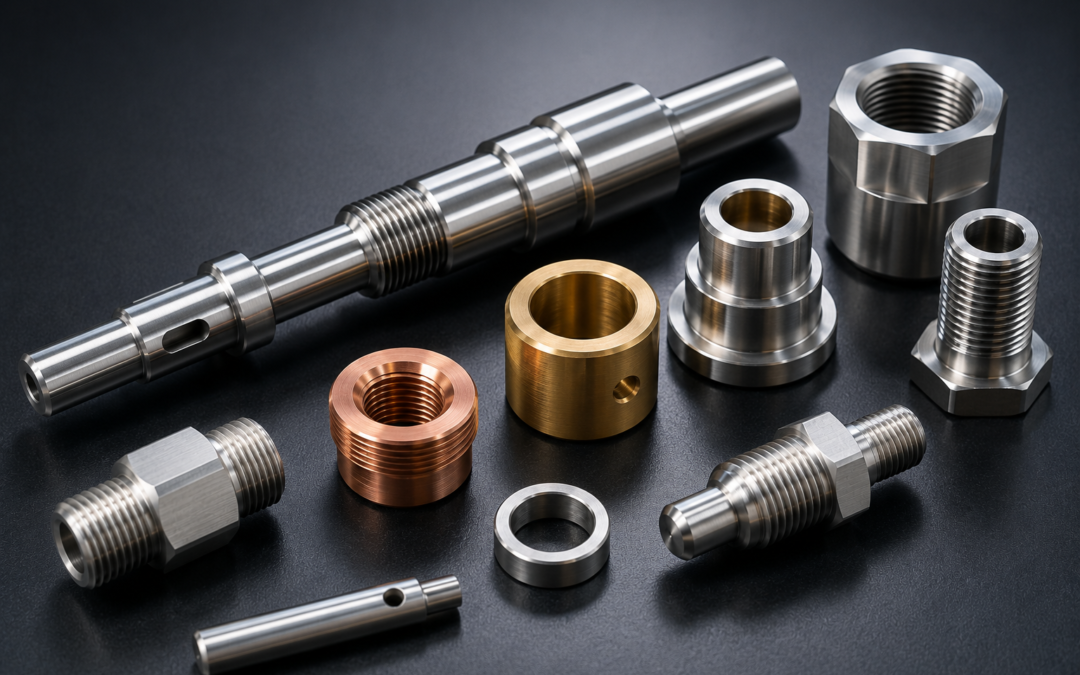
CNC turned parts are used across a wide range of mechanical assemblies, from simple spacers and threaded inserts to precision shafts, bushes and complex rotational components. For buyers, the challenge is rarely just finding a machine shop that can produce the shape. The real value comes from choosing a supplier that understands fit, function, material behaviour, inspection requirements and repeatability.
This guide explains what to consider when sourcing CNC turned parts, especially shafts, bushes, spacers and threaded components. It is designed for engineering buyers, procurement teams and production managers who need reliable parts, sensible lead times and clear communication from their machining supplier.
What Are CNC Turned Parts?
CNC turned parts are components produced on a lathe or turning centre, where material rotates while cutting tools remove material to create the required diameter, profile, groove, thread or feature. Turning is especially suitable for round, cylindrical or rotational parts, although modern CNC turning centres can also produce milled flats, cross holes, keyways and other secondary features. Typical CNC turned components include:
- Shafts
- Bushes and sleeves
- Spacers and standoffs
- Pins and dowels
- Threaded inserts
- Collars and rings
- Adaptors and connectors
- Fastener-style components
- Hydraulic and pneumatic fittings
For buyers, CNC turning is often the preferred process when the component’s main geometry is based around diameters, shoulders, bores, threads or grooves. It can be highly efficient for both one-off prototypes and repeat production runs, provided the drawing, material and tolerance requirements are clearly defined.
CNC Turned Bushes and Sleeves
Turned bushes and sleeves are often used to reduce wear, support movement, provide spacing or act as a replaceable interface between two parts. They can be simple cylindrical components, but they are frequently critical to the performance of an assembly.
The main considerations for CNC turned bushes are internal diameter, external diameter, wall thickness, material choice and surface finish. If the bush is designed to rotate, slide or carry load, then the relationship between bore size, shaft size and material properties becomes especially important. Buyers should consider:
- Whether the bush is fixed or moving
- Whether lubrication is required
- Whether the bore needs a specific finish
- Whether the outside diameter is a press fit
- Whether the part needs grooves, holes or flanges
- Whether the material must resist wear, heat or corrosion
Common materials for bushes include aluminium bronze, phosphor bronze, stainless steel, engineering plastics and mild steel, depending on the application. In some cases, the material is more important than the machining itself, because the wrong material can wear quickly or damage the mating component.
Machined Spacers: Simple Parts with Important Details
Machined spacers are often viewed as straightforward parts, but they still require careful specification. A spacer controls distance, alignment or clearance within an assembly, so errors in length, parallelism or bore size can cause issues during fitting.
CNC turned spacers are commonly used in machinery, electronics, fixtures, automotive assemblies, aerospace equipment and general engineering applications. They may be plain, threaded, counterbored, flanged or produced with specific surface finishes. Buyers should define:
- Length tolerance
- Bore diameter
- Outside diameter
- Parallelism of end faces
- Chamfer requirements
- Thread type, if required
- Material and finish
- Batch quantity and repeat demand
For low-cost parts like spacers, cost control usually comes from clear drawings, suitable tolerances and efficient batch planning. If a spacer does not require a very tight tolerance, stating a practical tolerance when CNC turning can help reduce production cost and inspection time.
Threaded Components and Turned Fastener-Style Parts
Threaded components are a major category of CNC turned parts. These may include inserts, adaptors, studs, threaded bushes, connectors, special bolts, adjusters and custom fastener-style components. Unlike standard off-the-shelf fasteners, CNC turned threaded parts are often designed for a specific assembly or application.
Thread quality is essential. Poorly produced threads can cause assembly delays, weak engagement, leakage, cross-threading or premature failure. Buyers should always provide clear thread specifications rather than relying on assumptions. A complete thread specification should include:
- Thread form, such as metric, UNC, UNF or BSP
- Internal or external thread details
- Thread pitch
- Thread length
- Class of fit, if applicable
- Lead-in chamfer requirements
- Undercuts or relief grooves
- Gauging requirements
- Surface finish or coating after threading
If the part will be plated, anodised or coated after machining, this should be discussed early. Finishing processes can affect thread fit, especially on smaller or tighter tolerance features.
CNC Turned Shafts: Key Buyer Considerations
CNC turned shafts are among the most common precision turned parts. They may be used to transmit motion, locate bearings, support rotating assemblies or act as alignment features within mechanical systems. Because shafts often interact with bearings, seals, gears or couplings, small dimensional errors can create larger assembly problems. 
When sourcing turned shafts, buyers should pay close attention to concentricity, straightness, surface finish and diameter tolerances. A shaft may look simple on a drawing, but its performance depends on how accurately the critical features relate to each other. Important details to specify include:
- Overall length and diameter tolerances
- Bearing fit requirements
- Surface finish on running areas
- Concentricity between stepped diameters
- Thread details, if applicable
- Chamfers, radii and lead-in features
- Material grade and heat treatment requirements
- Any plating, coating or finishing process
A good machining supplier will review the shaft drawing and highlight any areas that could affect cost, lead time or manufacturability. For example, an unnecessarily tight tolerance on a non-critical diameter may increase inspection time without improving performance.
Materials for Precision CNC Turned Parts
Material selection has a direct effect on component performance, machining cost and lead time. Some materials machine quickly and provide excellent surface finish, while others are tougher, more abrasive or more difficult to hold to tight tolerances.
Common materials for CNC turned parts include aluminium, stainless steel, mild steel, brass, bronze, copper alloys, engineering plastics and specialist alloys. The right choice for CNC components depends on strength, weight, corrosion resistance, wear resistance, temperature exposure and compatibility with mating components. Typical material choices include:
- Aluminium for lightweight components and good machinability
- Stainless steel for corrosion resistance and strength
- Mild steel for general-purpose mechanical parts
- Brass for fittings, inserts and components requiring good machinability
- Bronze for bushes, bearings and wear applications
- Engineering plastics for lightweight, low-friction or insulating parts
- Tool steel or alloy steel for high-wear or high-strength applications
Buyers should also consider material availability. A design that depends on an unusual grade may increase lead time or minimum order value. Where possible, discuss material options with the supplier before finalising the drawing.
CNC Turning Tolerances and Surface Finish
Tolerances define how much variation is allowed from the drawing dimensions. In CNC turning, tolerances are often most important on diameters, bores, shoulders, threads and faces that affect fit or function. Surface finish is also important where parts slide, seal, rotate or locate against another component.
A common mistake is applying tight tolerances across the whole drawing. This can increase cost without improving the part. Instead, buyers should identify the critical features and apply tighter tolerances only where they are needed. Key areas to review include:
- Bearing fits
- Sliding fits
- Press fits
- Sealing faces
- Threaded areas
- Datum features
- Mating faces
- Concentric diameters
- Bores and counterbores
A practical drawing separates critical dimensions from general dimensions. This helps the machining supplier plan the most efficient process and focus inspection on the features that matter most.
Design for Manufacture: Reducing Cost and Risk
Design for manufacture is one of the best ways to reduce cost, improve lead times and avoid quality issues. A small change to a groove, radius, bore depth or tolerance can make a CNC turned part easier to machine without affecting its function.
Buyers do not need to redesign parts themselves, but they should be open to supplier feedback. A capable CNC turning supplier can often identify opportunities to simplify machining, reduce setups or avoid unnecessary secondary operations. Useful design checks include:
- Avoiding unnecessarily deep, narrow grooves
- Using standard thread sizes where possible
- Keeping tolerances realistic for the function
- Allowing suitable radii instead of sharp internal corners
- Avoiding excessive length-to-diameter ratios where possible
- Considering how the part will be held during machining
- Reducing unnecessary cosmetic requirements
- Combining features only where it improves the part
The best results usually come when buyers involve the machining supplier early, especially for new components, prototypes or parts moving from design into production.
Prototype and Small Batch CNC Turned Parts
CNC turned parts are often required in prototype or small batch quantities before full production begins. This stage is important because it allows design teams to confirm fit, function and assembly before committing to larger volumes.
Prototype turned parts may not always be produced using the same method as full production, but the supplier should still consider future repeatability. If the part is likely to move into batch production, it is worth discussing how the process could scale. Buyers should share:
- Expected prototype quantity
- Likely production quantity
- Any future repeat order expectations
- Critical test requirements
- Preferred material
- Required inspection level
- Target delivery date
- Any known design uncertainties
A supplier that understands both prototyping and batch production can help avoid redesigns later. This is especially useful when parts are used in assemblies that may need repeated refinement.
Repeat Production and Batch Consistency
For repeat production, consistency becomes just as important as the first-off part. Buyers need confidence that every batch of CNC turned components will match the approved specification and perform reliably in the same assembly.
Repeat work benefits from controlled processes, retained setup knowledge, stable inspection methods and clear revision control. When parts are ordered regularly, even small improvements in machining efficiency can reduce cost over time. Buyers should consider whether the supplier can support:
- Repeat batch manufacture
- Scheduled call-offs
- Revision control
- Material traceability
- Consistent inspection reporting
- First article inspection, where required
- Packaging and labelling requirements
- Reliable communication on lead times
For production buyers, a dependable supplier is not simply the cheapest option. The best supplier is often the one that reduces interruptions, prevents avoidable queries and delivers parts that fit first time.
Inspection and Quality Control for CNC Turned Components
Inspection is a vital part of CNC turned part supply. The right level of inspection depends on the component’s function, industry, tolerance level and risk. A simple spacer may only require basic dimensional checks, while a critical shaft or aerospace component may require detailed inspection reporting.
Buyers should be clear about the quality documentation they need before placing the order. This avoids delays at delivery and ensures the supplier quotes for the correct level of control. Common quality requirements include:
- Dimensional inspection
- First-off inspection
- Batch inspection records
- Material certificates
- Certificates of conformity
- Thread gauging
- Surface finish checks
- Traceability records
- First article inspection reports
For regulated industries, documentation can be as important as the part itself. If material traceability, certification or special inspection is required, it should be included at the enquiry stage.
Choosing a CNC Turned Parts Supplier in the UK
Choosing the right UK supplier for CNC turned parts can improve quality, communication and lead time reliability. Local supply can also make it easier to discuss drawings, resolve technical questions and manage urgent requirements.
A strong supplier should be able to review drawings properly, ask relevant questions and advise where tolerances, material choices or features may create unnecessary cost. Experienced component manufacturers should also understand that buyers need clear communication, not just machining capability. When assessing a CNC turned parts supplier, consider:
- Experience with similar components
- CNC turning capacity and capability
- Ability to machine the required materials
- Quality control processes
- Inspection equipment
- Responsiveness at enquiry stage
- Support with prototypes and repeat batches
- Understanding of your industry requirements
- Ability to provide documentation when needed
The quoting stage often reveals a lot. A supplier that spots potential issues early is usually more valuable than one that simply returns a price without reviewing the drawing properly.
CNC Turned Parts: A Buyer’s Guide to Shafts, Bushes, Spacers and Threaded Components Checklist
Before placing an order for CNC turned parts, buyers should check that the drawing and enquiry provide enough information for an accurate quote and reliable manufacture. Clear information reduces delays, avoids assumptions and helps the supplier recommend the most efficient machining route. A useful enquiry checklist includes:
- Component drawing with revision number
- 3D model, if available
- Material grade
- Quantity required
- Critical tolerances
- Surface finish requirements
- Thread specifications
- Heat treatment or finishing requirements
- Inspection and documentation needs
- Delivery requirement
- Intended application, where useful
- Expected repeat demand
Providing this information at the start helps prevent re-quotes, delays and misunderstandings. It also allows the supplier to identify whether any feature could be simplified without affecting performance.
Decisions When Buying CNC Turned Parts
CNC turned parts may range from simple spacers to highly controlled shafts, bushes and threaded components, but the buying process should always focus on function, repeatability and clear specification. The best results come from matching the part’s requirements with a supplier that understands both machining and practical assembly needs.
For buyers, the most important step is to define what really matters. Critical fits, materials, threads, finishes and documentation should be clear from the beginning. Non-critical areas should be specified sensibly to avoid unnecessary cost.
Whether you need prototype CNC turned parts, small batch turned components or repeat production of shafts, bushes, spacers and threaded parts, a well-prepared enquiry and an experienced machining partner can make the whole process smoother, faster and more reliable.