
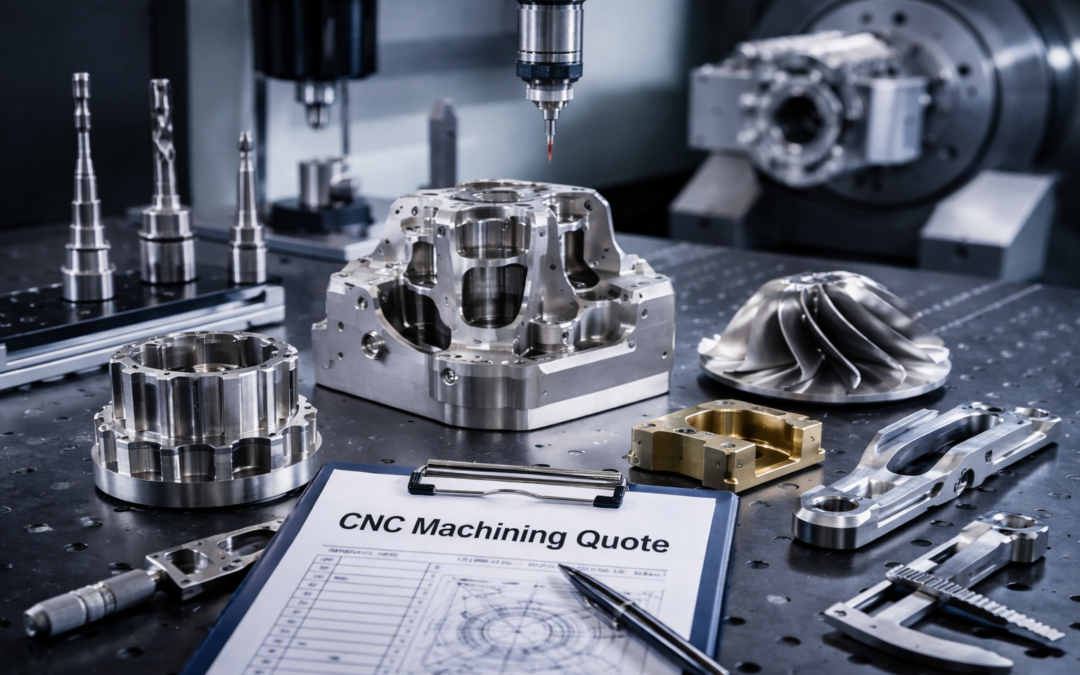
CNC machining quote obtaining should feel straightforward: send the part details, get a price, place the order. In reality, quotes can swing wildly depending on what you provide, how the part is designed, and what assumptions the supplier has to make. This guide breaks down what actually drives cost, what information quoting teams need, and how to get an accurate quote quickly, without endless back-and-forth.
Whether you’re sourcing one prototype or planning a long production run, a better quoting process starts with understanding how machinists interpret your RFQ (request for quotation) and where uncertainty creeps in.
What A CNC Machining Quote Typically Includes
A cnc machining quote is more than a single price. It’s usually a bundle of assumptions and line items that cover how the shop intends to manufacture, inspect, and deliver your parts. Knowing what’s “inside” the number helps you compare quotes properly, especially when two suppliers aren’t quoting the same scope. A typical quote may include:
- Unit price and total price (based on quantity)
- Material grade and form (bar, plate, billet, casting, customer-supplied)
- Machining process assumptions (3-axis, 5-axis, turning, mill-turn)
- Lead time and delivery terms
- Setup/tooling costs (sometimes amortised into unit price)
- Finishing processes (anodise, plating, passivation, paint, bead blast, etc.)
- Inspection approach (standard vs. CMM / full dimensional report)
- Packaging requirements
- Certification requirements (material certs, CoC, traceability)
Why CNC Machining Prices Vary So Much Between Suppliers
If you’ve ever requested the same cnc machining quote from three shops and received three very different prices, you’re not alone. The difference is rarely just “margin.” Most of the variation comes from risk and interpretation – how each supplier thinks they’ll make your CNC components, and how much uncertainty they’re pricing in. Common reasons quotes vary:
- Different assumptions about tolerances, datums, and critical features
- Different fixturing approach (simple vice vs. custom soft jaws vs. fixture plate)
- Different machine selection (3-axis vs. 5-axis vs. mill-turn)
- Different cycle time estimates and toolpath strategies
- Different views on inspection (spot check vs. documented measurement)
- Different availability of material and in-house finishing capacity
- Different overhead structures and utilisation (what machines are currently loaded)
How To Get An Accurate CNC Machining Quote Faster
The fastest way to improve quote quality is to reduce assumptions. When a machinist has to guess, they either ask questions (slowing things down) or include contingency (raising the price). A strong RFQ package makes the part clear, measurable, and manufacturable. To speed up quoting, include:
- A 3D model (STEP preferred) and a fully dimensioned drawing (PDF)
- Quantity and expected repeat demand (prototype only vs. ongoing)
- Material grade/spec and any permitted alternatives
- Surface finish requirements (Ra, cosmetic faces, directionality if relevant)
- Tolerances clearly defined (general tolerance + specific callouts)
- Thread specs and any gauging requirements
- Finishing/coating specs (including standards and colour if applicable)
- Inspection/reporting expectations (FAI, CMM report, sampling plan)
- Target lead time and delivery address
Quote Checklist: What To Send With Your RFQ
Even experienced teams sometimes miss one or two details that change the manufacturing plan. A simple checklist prevents the “quote, revise, quote again” loop. Use this RFQ checklist:
- 3D CAD model (STEP/IGES) and drawing (PDF)
- Revision level (Rev A/B/C) and date
- Quantity (now) and forecast (later)
- Material spec (e.g., 6082-T6, 7075-T651, 316L, Ti-6Al-4V)
- Stock form constraints (plate vs. bar) if relevant
- General tolerance standard (e.g., ISO 2768) if used
- Any critical-to-function dimensions clearly marked
- Surface finish callouts and cosmetic requirements
- Threads, inserts, helicoils, press fits—specified fully
- Deburr/edge break expectations (e.g., “break all edges 0.2–0.5 mm”)
- Coating/finish requirements + standard
- Inspection needs (CoC, material certs, FAI, CMM report)
- Packaging requirements (individual bagging, protective caps, etc.)
Understanding the Biggest Cost Drivers in a Quote
A cnc machining quote is heavily influenced by a few predictable factors. If you understand these drivers, you can often reduce cost without changing the part’s function. The biggest cost drivers are typically:
- Cycle time: More machining minutes = higher cost.
- Setups: More orientations/operations = more labour and risk.
- Tolerances: Tight tolerances increase machining time and inspection effort.
- Material: Hard-to-machine alloys, large billets, or high scrap rates add cost.
- Tooling: Special cutters, long-reach tooling, and wear-prone materials increase cost.
- Fixturing complexity: Custom fixtures and soft jaws add time (especially for small batches).
- Finishing and inspection: Coatings, masking, and full reports can be significant.
Tolerances and the Machining Quote
Tolerances are one of the most misunderstood parts of the quoting process. Many drawings end up with blanket tight tolerances “just to be safe,” which can make a cnc machining quote jump without improving real-world performance. A practical approach is to be intentional: apply tight tolerances only where they affect fit, function, sealing, alignment, or performance. Everywhere else, allow normal machining variation. To manage tolerance cost, consider:
- Use general tolerances for non-critical features and reserve tight callouts for functional surfaces.
- Avoid stacking tight tolerances across multiple dimensions if a datum scheme would control the function better.
- Specify what matters (e.g., position, flatness, perpendicularity) rather than over-dimensioning.
- Be clear on measurement method if it matters (e.g., functional gauge vs. CMM).
Material Selection and Availability: The Hidden Lever in a Machining Quote
Material affects price in two ways: the raw cost and the machining effort. Some alloys chew tools, demand slower feeds, or require careful stress management. Others are readily available, stable, and quick to cut, often lowering both lead time and unit price. When evaluating material for cost and lead time, think about:
- Availability in your region (common stock sizes move faster)
- Machinability (tool wear and cycle time)
- Stability (thin walls and long parts can move after roughing)
- Certification needs (traceability and paperwork can affect sourcing)
If you’re unsure, ask your supplier for approved alternates. A good quoting team will often propose options that meet performance while improving cost or lead time.
Surface Finish, Coatings and Their Impact on Prices
Finishing requirements can change the whole manufacturing route. For example, anodising may require masking and racking strategy; plating may change dimensional outcomes; bead blasting changes appearance but can affect sharp edges and fine details. To prevent surprises, specify finishing clearly and early:
- Define functional vs. cosmetic surfaces
- Call out any “do not mark” or protected faces
- Specify whether post-finish machining is allowed
- Note any dimensional constraints after finishing (important for coatings with thickness)
Common finishing details to include:
- Anodise type/colour and standard
- Passivation standard for stainless
- Plating type, thickness range, and embrittlement relief if required
- Paint system and colour reference (RAL, Pantone, etc.)
- Surface roughness (Ra) where it matters
DFM for a CNC Machining Quote: Designing Parts That Quote Better
Design for Manufacturability (DFM) is the quickest path to improving a cnc machining quote without compromising performance. Small geometry changes can remove entire setups, eliminate long-reach tooling, or allow faster toolpaths. A DFM review typically focuses on “what makes this hard to machine?” – and how to reduce that difficulty. Common DFM improvements include:
- Increase internal corner radii to suit standard end mills
- Avoid ultra-deep pockets or narrow slots that require long, fragile tooling
- Reduce unnecessary tight tolerances
- Standardise hole sizes and thread types
- Add datum features that simplify workholding and inspection
- Avoid thin walls that chatter or deform
At Tarvin Precision, DFM is often treated as part of the quoting conversation: if a feature is likely to drive cost or risk, it’s flagged early so you can decide whether it’s truly necessary or whether a small design change can simplify manufacturing. This tends to reduce revisions later—especially when parts are moving from prototype to production.
Prototypes vs Production: How Quantity Changes Your Quote
Quantity isn’t just “unit price times number of parts.” The whole cost structure shifts depending on whether you’re buying one-off prototypes or repeat production. For prototypes, the quote often reflects:
- Higher setup cost per unit
- More programming time per part
- More conservative machining approach (risk reduction)
- More inspection attention (first-off verification)
For production, you may see:
- Setup/programming amortised across the batch
- Improved fixturing and repeatability
- Faster cycle times after process optimisation
- Better unit price from material buying efficiencies
When requesting a cnc machining quote, it helps to say whether this is a one-time need or a part you expect to reorder. Even a rough forecast can change how the supplier structures the price.
Lead Time and Turnaround: What Affects CNC Machining Quote Timelines
Lead time is influenced by more than how busy a shop is. Some parts simply take longer due to material sourcing, finishing queues, or inspection requirements. Typical lead-time factors include:
- Material availability and certification paperwork
- Number of operations and setups
- Need for special tooling or fixturing
- External processing (anodise, plating, heat treatment)
- Inspection/reporting depth (FAI packs can add time)
- Packaging requirements for delicate components
If you have a hard deadline, say so in the RFQ. Many shops can offer options (standard vs. expedite) when they understand the constraint.
What “Good” Looks Like: Comparing CNC Machining Quotes Properly
A lower price doesn’t always mean a better quote, especially if the scope is different. The goal is to compare like-for-like: same material, same tolerances, same finish, same inspection, same lead time. When comparing quotes, check:
- Material grade and condition (e.g., T6 vs. T651)
- Included finishing and whether masking is covered
- Inspection level (spot check vs. CMM report)
- Certifications included (CoC, material certs, traceability)
- Assumptions listed (tolerance interpretation, deburr standard, etc.)
- Incoterms/shipping and packaging
If a quote seems unusually low, look for what’s missing rather than assuming it’s a bargain.
A Simple CNC Machining Quote Process That Reduces Back-and-Forth
Most quoting friction comes from uncertainty: missing data, unclear tolerances, or “tribal knowledge” that isn’t written down. A clean process makes it easier for both sides to move quickly. A practical quoting workflow looks like this:
- Start with a clear RFQ pack (model + drawing + requirements)
- Supplier reviews for manufacturability and flags assumptions
- Quick DFM feedback loop (if changes would meaningfully reduce cost/risk)
- Quote issued with scope clearly stated
- Purchase order placed with revision control locked
Tarvin Precision typically supports this style of quote process by encouraging early DFM discussion when it will materially change price, lead time, or manufacturability. That keeps the conversation practical: not “redesign everything,” but “here are the two or three changes that will make this easier, faster, or more robust.”
FAQ: CNC Machining Quote Questions You’ll Get Asked (and How to Answer Them)
Shops often ask similar questions because the answers change the manufacturing plan. If you include these details upfront, you’ll usually get a faster, cleaner cnc machining quote. Here are common questions to prepare for:
- What quantity do you need now, and will you reorder?
- Which surfaces are cosmetic, and which are functional?
- Are all tolerances critical, or are some defaults?
- Is a specific inspection report required (FAI/CMM), or is CoC enough?
- Is finishing mandatory, and is colour/thickness controlled?
- Are there any assembly constraints (press fits, mating parts, sealing faces)?
- Can material substitutes be considered if lead time is tight?
Final RFQ Tips to Improve Your CNC Machining Quote Every Time
A strong cnc machining quote is the result of clear requirements, realistic tolerances, and good DFM thinking. If you take only a few actions after reading this guide, make them these: provide both model and drawing, define what’s critical, and invite DFM feedback before the quote is finalised. To wrap up, here’s a quick best-practice list:
- Provide a STEP model + dimensioned drawing + revision
- Mark critical features and avoid blanket tight tolerances
- Specify material, finish, and inspection expectations clearly
- State quantity now and likely repeat demand
- Ask for DFM feedback when cost or lead time is a concern