
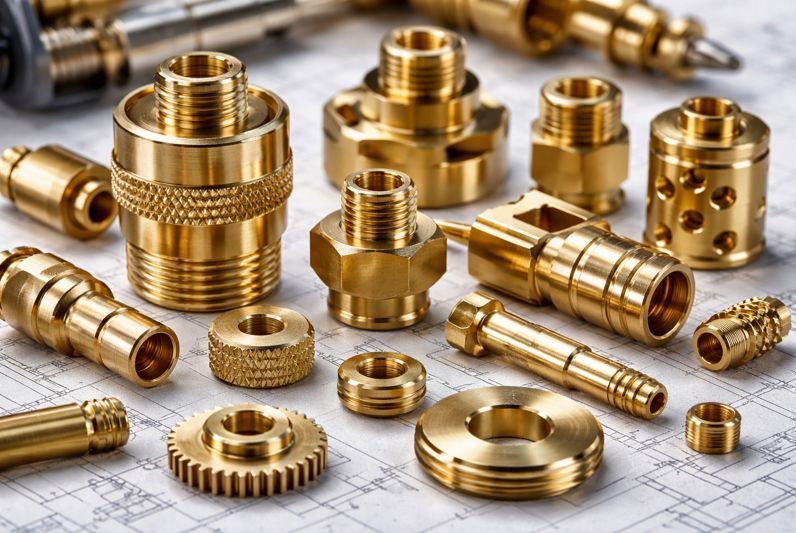
CNC brass parts are everywhere once you start looking: electrical terminals, valves, pneumatic fittings, knobs, threaded inserts, instrument components, decorative hardware, and countless “small but critical” pieces that keep assemblies working. Brass machines well, looks good, resists corrosion in many environments, and offers reliable electrical and thermal conductivity. That combination makes CNC brass parts a go-to choice for both prototypes and production.
But “brass” isn’t one material, and “CNC” doesn’t magically guarantee perfect results. Alloy selection, feature design, thread strategy, tolerances, surface finish, and inspection methods all influence whether machined brass components come out right first time – or become a recurring headache. This guide walks through the key decisions so you can specify custom CNC brass parts with confidence and avoid the common pitfalls.
CNC Brass Parts and Precision Brass Machining Basics
At its simplest, precision brass machining means removing material from brass stock – bar, plate, or near-net blanks – using CNC lathes, mills, or mill-turn centres. Because brass tends to shear cleanly and break chips readily (depending on alloy), it’s often faster and more forgiving than many steels or stainless grades. That said, the “easy machining” reputation can hide details that matter, like burr formation on small edges, thread fit after plating, or the effects of dezincification in certain environments.
Most CNC brass parts are made via one of three common routes:
Turning CNC Brass Parts on a Lathe
Turning is the default choice for many CNC brass parts because it’s fast, stable, and naturally suited to round geometry. If your component is primarily cylindrical – think bushings, spacers, nozzles, valve stems, hose fittings, threaded adaptors, or standoffs – a CNC lathe will usually produce it with excellent concentricity and surface finish. Turning also tends to deliver very consistent diameters and shoulder locations, which is ideal when parts must seal, locate, or run true. From a cost perspective, lathe work is often the most efficient route for brass when the features can be produced in one or two setups, and it typically scales well from prototypes to volume.
Milling Custom CNC Brass Parts for Flats, Pockets, and Complex Shapes
Milling comes into its own when CNC brass parts need non-round features: flats for spanners, pockets for weight reduction, slots, keyways, engraved details, bolt patterns, and complex prismatic forms. It’s also the go-to method for parts that start as plate or block rather than bar. While brass mills cleanly, the design details matter – deep narrow pockets can force long tools and slower machining, and sharp internal corners may need relief radii to avoid extra operations. Good milling strategy can still be very efficient, especially when the part can be fixtured securely and the critical features are accessible from one or two orientations.
Mill-Turn CNC Brass Parts to Reduce Setups and Improve Alignment
Mill-turn machining combines turning and milling in a single machine cycle, which is often the best option for brass parts that are mostly round but also need cross-holes, flats, milled slots, or accurately positioned side features. The big advantage is reducing setups: instead of turning the part, removing it, and then re-fixturing for milling (with the risk of small misalignments), a mill-turn centre can produce multiple feature types while maintaining a common datum. That can improve true position between features, reduce handling marks on cosmetic surfaces, and shorten lead time—especially on parts where alignment between turned diameters and milled details is function-critical.
Choosing the right route isn’t just about geometry; it can determine cost, lead time, and how reliably tight features repeat across a batch.
CNC Brass Parts Materials: Best Brass Alloys for Machining
Selecting the right alloy is the foundation of successful CNC brass parts. The “best” brass alloy depends on machining speed, required strength, corrosion behaviour, appearance, and whether the part must comply with specific regulations (for example, lead content in potable-water applications).
Common brass alloys for machined brass components include:
- C360 (free-machining brass): the classic choice for high-speed CNC turning and milling; excellent machinability and great for complex features and threads
- C260 (cartridge brass): better formability and toughness; often used where cold-working or a more ductile behaviour is needed
- Naval brass / C464: improved corrosion resistance in marine environments; generally tougher to machine than C360 brass
- CZ121 / CW614N (common in the UK/EU): a widely used machining brass comparable to free-machining grades
Material choice affects more than machining time. It can influence surface finish, burr tendency, thread quality, and long-term performance – especially in aggressive water, marine, or ammonia-rich environments.
Practical material selection tips:
- If you need very high throughput and excellent threads, a free-machining grade like C360/CW614N is usually the easiest route.
- If your application sees seawater exposure, consider naval brass (and confirm suitability with your corrosion requirements).
- If regulations restrict lead content, verify the exact grade and compliance requirements early, as it may affect machinability and tool choice.
Custom CNC Brass Parts Design Guidelines for Manufacturability
Good design for manufacturability (DFM) is the quickest way to make custom CNC brass parts more consistent and less expensive – without reducing performance. Brass is forgiving, but it still rewards smart geometry. Start by thinking in “machining operations.” Every time a part needs repositioning, a different tool family, or special workholding, you increase cycle time and risk of variation. Strong DFM aligns critical features to be made in fewer setups and with robust tooling.
Key DFM considerations for CNC brass parts include:
- Maintain sensible wall thicknesses to reduce chatter and deformation during clamping
- Avoid ultra-deep, narrow pockets that force long tools and slow feeds
- Prefer standard drill sizes and common thread forms where possible
- Use clear datums so inspection and assembly alignment are unambiguous
When Tarvin Precision reviews brass parts for manufacturability, the biggest wins typically come from small edits: adding radii, adjusting thread callouts, or reorienting critical features so they can be produced in a single stable setup.
CNC Machined Brass Components: Turning vs Milling vs Mill-Turn
The manufacturing method strongly shapes cost and capability for CNC brass parts. Even when two processes can technically make the same geometry, one may be dramatically more efficient.
Turning tends to dominate for brass because so many brass parts are rotational: connectors, standoffs, nozzles, bushings, valves, and instrument fittings. Milling becomes essential when you need flats, keyways, slots, cross-holes, pockets, or complex prismatic forms. Mill-turn machines handle both in one cycle and often improve concentricity between turned and milled features. Typical decision factors include:
- Quantity: mill-turn shines when it removes a second setup across a batch
- Tolerances: fewer setups often means better true position between features
- Geometry: side features on turned parts can be milled in-cycle
- Finish: reduced handling can protect cosmetic surfaces
CNC Brass Parts Tolerances: What’s Realistic and What Drives Cost
Tolerances are where many drawings unintentionally become “expensive by default.” Brass can hold tight tolerances, but you should only specify what matters to function. Over-tolerancing increases inspection burden, tool wear, and process controls, and it can reduce yield. A useful way to think about CNC brass parts tolerances is to separate them into:
- General tolerances (what the process can normally hold)
- Critical tolerances (only where fit/function requires it)
- Geometric tolerances (position, concentricity, runout, flatness) that preserve relationships between features
As a broad rule, the tighter the tolerance, the more the process shifts from “production machining” to “precision machining with controls.” That usually means more careful thermal management, additional finishing passes, and more measurement steps.
Practical ways to reduce tolerance-driven cost include:
- Apply tight tolerances only to the features that interface with mating parts
- Use GD&T to control function without over-constraining every dimension
- Define inspection datums clearly so measurement is repeatable
- Consider whether a press fit or clearance fit is actually needed, and specify the correct fit class
CNC Brass Threading: Internal Threads, External Threads and Thread Quality
Threads are one of the most common features in CNC brass parts, and they’re also a major source of confusion – especially after plating or when thread fit matters (seal, torque, or repeated assembly). Brass threads can be produced with single-point threading, thread milling, or tapping (internal). Each method has trade-offs in speed, tool life, and suitability for blind holes or thin-walled features.
Thread-related recommendations:
- Use standard thread forms (Metric, UNC/UNF, BSPP/BSPT where applicable) unless there’s a clear reason not to
- Avoid extremely short thread engagement lengths if torque or sealing matters
- Specify whether threads must be gauged, and to what standard (e.g., go/no-go)
- If plating is applied, allow for the change in thread fit and call out “before” or “after” plating requirements clearly
A common real-world problem is specifying a tight thread class and then adding a heavy coating that pushes the thread out of tolerance. Flag the finish early so machining allowances can be planned.
Surface Finish for CNC Brass Parts: Ra Values, Cosmetics, and Function
Surface finish isn’t only cosmetic. It can affect sealing performance, electrical contact, friction, and cleanliness. Brass generally finishes well, but you’ll still see variation depending on tool sharpness, feed/speed strategy, and whether the part is turned or milled.
If you need a functional finish, specify it with a measurable requirement (like an Ra value) on the relevant surfaces. If you need a cosmetic finish, define what “cosmetic” means – scratch limits, uniformity, grain direction, or no tool marks visible at a set distance. Typical finish considerations for machined brass components:
- Sealing faces may need a controlled finish to prevent leaks
- Sliding interfaces may require a smoother surface to reduce wear
- Decorative parts may need consistent toolpath direction and careful handling
Finishing Options for CNC Brass Parts: Plating, Passivation and Protective Coatings
Many CNC brass parts receive a finish to improve corrosion resistance, appearance, or solderability. The important point is that finishing changes dimensions – sometimes subtly, sometimes enough to affect fits and threads.
Common finishing routes include nickel plating (often for appearance and corrosion resistance), tin plating (useful for electrical/solder applications), and clear protective coatings to reduce tarnish. Some parts are also polished or bead blasted to achieve a consistent look. Before you choose a finish, make sure you understand:
- Whether the coating thickness is controlled and how it varies across geometry
- Whether threads and small bores will “build up” and tighten fit
- Whether post-plate masking is required on critical surfaces
- Whether the finish changes electrical contact resistance or solderability
If the finish is critical to function, it should be part of the drawing requirements, not an afterthought in purchasing notes.
Deburring and Edge Control in Machined Brass Components
Burrs are normal in machining, and brass is no exception, especially around cross-holes, slots, and intersecting bores. If your assembly requires clean edges (for seals, O-rings, or handling safety), call out deburring and edge-break expectations clearly.
A simple “break sharp edges” note can be ambiguous. If edges are function-critical, be more specific about edge chamfer size or maximum burr height. That helps the machinist choose appropriate deburring methods without over-processing cosmetic surfaces.
Quality and Inspection for CNC Brass Parts
Inspection strategy should match risk. A batch of simple turned spacers doesn’t need the same metrology plan as a precision valve body with multiple intersecting bores and sealing features. The key is to define which features are critical and how they’re verified. A good inspection approach for CNC brass parts often includes:
- First-off inspection report for setup validation
- In-process checks on key dimensions (especially diameter and thread gauges)
- Final inspection focusing on critical-to-function features
- Surface finish or coating thickness verification where required
For regulated industries or tight traceability needs, you may require material certificates, process records, and documented inspection results. Tarvin Precision, for example, typically aligns inspection depth with the part’s functional risk rather than applying a blanket “inspect everything” approach that drives cost without improving outcomes.
Cost and Lead Time for CNC Brass Parts
When people search for CNC brass parts pricing, they often assume cost is mainly about material. In reality, the major drivers are usually machining time, number of setups, tool complexity, tolerance/inspection requirements, and finishing steps. Key cost drivers for custom CNC brass parts include:
- Setup complexity (multiple operations, reworkholding, special fixturing)
- Cycle time (deep pockets, long tools, fine finishes, slow threading methods)
- Tight tolerances and GD&T that require careful control and extra inspection
- Secondary processes (plating, polishing, cleaning, marking, assembly)
- Material grade availability and certification requirements
Lead time is similarly influenced by process steps. A part that’s “simple to machine” can still get delayed if it needs an external finish house, special inspection, or non-standard material.
Common Applications for CNC Brass Parts in Industry
CNC brass parts show up across industries because brass balances machinability with performance. You’ll see it in:
- Electrical and electronics: terminals, contacts, grounding components
- Fluid and gas: connectors, valve components, seats, nozzles
- Instrumentation: housings, precision fittings, calibration hardware
- Consumer and decorative: knobs, trim parts, branded hardware
- Automotive and general engineering: inserts, standoffs, adapters
The application should always influence alloy and finish choices. What works for a decorative part indoors may be wrong for a water-exposed component, even if the geometry is identical.
Specifying CNC Brass Parts on Drawings: A Quick Checklist
Clear drawings prevent rework and reduce RFIs (requests for information). When specifying CNC brass parts, aim to make functional intent unmistakable. It is recommended to include:
- Brass alloy/grade and any compliance requirements
- Surface finish requirements (functional vs cosmetic areas)
- Thread standards, fit class, and gauging requirement
- Critical tolerances and GD&T tied to clear datums
- Deburring/edge-break expectations, especially on sealing surfaces
- Any finishing/coating requirements and whether dimensions apply before/after finish
FAQ: CNC Brass Parts
Below are some of the most common questions we hear about CNC brass parts – material choice, machining methods, tolerances, threads, finishes, and how to keep cost and lead time under control. If you’re specifying a new component or troubleshooting an existing one, these answers should help you make faster, more confident decisions.
Are CNC brass parts good for outdoor or marine environments?
Brass can perform well outdoors, but environment matters. Some brasses are vulnerable to dezincification in certain waters or marine conditions. If corrosion resistance is critical, consider naval brass or alternative copper alloys and validate against your specific environment.
What’s the best brass for CNC machining?
Free-machining brass grades (like C360/CW614N equivalents) are commonly chosen because they machine quickly and produce excellent threads and surface finish. If you have regulatory or corrosion constraints, another grade may be more appropriate.
Do plated CNC brass parts need different tolerances?
Often, yes. Plating adds thickness and can change thread fit and tight bores. If plating is used, define whether tolerances apply before or after plating, and account for buildup in critical features.
How do I reduce the cost of custom CNC brass parts?
Focus on DFM: reduce setups, avoid overly tight tolerances where they don’t matter, use standard threads and drill sizes, and clarify finish/edge requirements to prevent unnecessary rework or over-processing.
Reliability and Repeatability of CNC Brass Parts
Well-specified CNC brass parts are one of the most reliable ways to get precise, repeatable components quickly. The biggest improvements usually come from early decisions: choosing the right brass alloy, designing features that suit turning or mill-turn manufacturing, applying tolerances only where function demands them, and accounting for finishing effects on threads and fits.
If you’re preparing a new drawing or revising an existing part, a short manufacturability review with a machine shop can uncover quick wins – often shaving cost and lead time while improving consistency. And if you’re working with a supplier like Tarvin Precision, you’ll typically get the most value when functional requirements are clear but the process details are left flexible enough for the machinist to choose the most efficient route.