
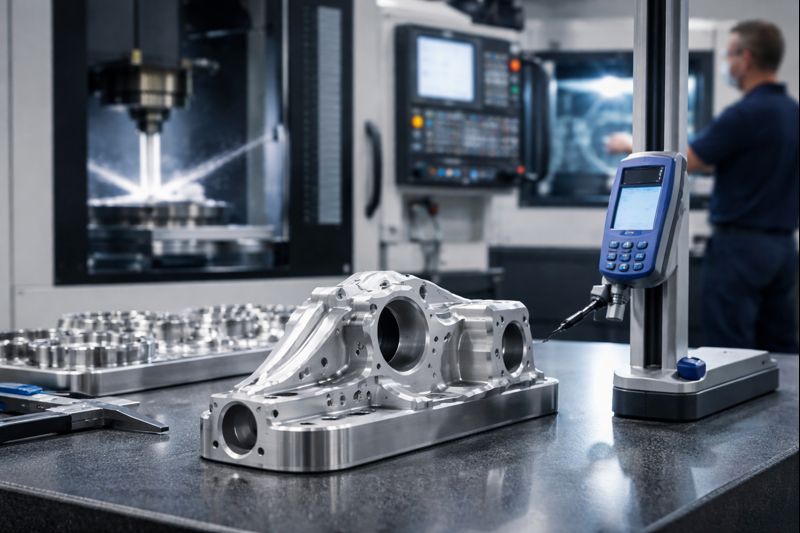
AS9100 machine shop selection isn’t just a procurement decision, it’s a risk decision. In aerospace and defence supply chains, one late delivery, one uncontrolled process change, or one incomplete set of records can trigger line-stops, rework, customer escapes, or uncomfortable supplier reviews. The right CNC machining partner reduces that risk with robust planning, disciplined quality controls, and the ability to communicate clearly when reality hits (material lead-times, drawing ambiguity, tolerance stack-ups, tool wear, inspection strategy, and everything in between).
This guide walks you through how to evaluate an AS9100 machine shop properly – beyond the certificate on the wall – and how to shortlist a CNC machining partner you can trust for repeatable results. Along the way, we’ll reference what “good” looks like in practice, and (gently) show how Tarvin Precision approaches aerospace-quality CNC machining and assembly in the UK.
What is an AS9100 Machine Shop?
AS9100 is the globally recognised quality management standard for aerospace. An AS9100 machine shop has a quality system audited against aerospace requirements, typically including tighter controls on risk, configuration, traceability, nonconformance, corrective action, supplier management, and documented processes.
That said, AS9100 certification isn’t a magic wand. Two shops can both be certified and deliver very different experiences. One may run a mature, disciplined system where every job is planned, verified, measured, and documented. Another might meet the AS9100 machining standard “on paper” but struggle with on-time delivery, unclear documentation, or inconsistent inspection decisions.
To get value from an AS9100 machine shop, you need to evaluate how they operate, not just what they claim.
- AS9100 indicates a structured quality system, controlled documentation, internal audits, corrective actions, and management oversight.
- AS9100 does not automatically guarantee technical capability for your specific tolerances, materials, finishes, or delivery expectations.
- AS9100 does not replace engineering judgement: you still need to check competence, capacity, communication, and inspection methodology.
If you’re buying aerospace parts, the best outcome is a partner who treats quality as a production tool, not just a box-ticking exercise.
Start With Your Reality: What Are You Actually Trying to Buy?
Before you search for an AS9100 machine shop, get clear on what “success” looks like for your parts and programme. The easiest supplier relationships formed with precision engineering companies are the ones where both sides understand what matters most – not just unit price, but the risks that could cause rework, delays, or paperwork issues at goods-in. Defining your requirements in plain language upfront makes quotes more accurate, comparisons fairer, and production far smoother once the job is live.
Materials, Temper, and Flow-Down Requirements
Start by locking down the exact material specification, including temper/condition, approved equivalents, and any customer flow-downs that must be met. In aerospace and defence, this often includes full batch/heat traceability, material certification, and specific compliance clauses that affect what can be purchased and how it must be recorded. If these expectations aren’t stated early, suppliers may quote based on assumptions that later create delays when the “right” material or documentation isn’t available.
Critical Tolerances and Functional Features
Identify the features that truly drive performance and risk – the ones that will determine machining strategy, workholding, tooling, and inspection time. True position, profile tolerances, coaxiality, tight bores, thin walls, surface finish, and edge-condition notes can dramatically change how a part is made and verified. Calling these out helps the machine shop plan for stability and repeatability, rather than discovering complexity mid-process.
Inspection and Reporting Expectations
Be explicit about what inspection output you need and how it should be presented. Some parts only require a basic dimensional report, while others need CMM reporting, a defined sampling approach, or a full First Article Inspection pack. The inspection plan affects lead-time, cost, and even the manufacturing route, so it’s best agreed before the first setup rather than negotiated after machining is complete.
Quantity Profile: Prototype to Repeat Production
Clarify whether you’re buying a one-off prototype, a small pilot batch, or parts intended for repeat orders over months or years. Prototype work may prioritise speed and engineering support, while repeat production values process stability, documented setups, and predictable inspection routines. A good AS9100 machine shop will often plan differently depending on whether the job is “prove it once” or “make it the same every time.”
Lead-Time Expectations and Delivery Cadence
Define what “on time” means in real terms: do you need one delivery date, staged shipments, or a rolling schedule? Also share any non-negotiables such as line-stop risk, build windows, or downstream assembly commitments. A capable supplier will use this to schedule realistically and flag pinch points early – rather than overpromising and slipping quietly later.
Assembly, Kitting, Marking, and Packaging Needs
If parts need to arrive ready for assembly, don’t leave the extras as an afterthought. Requirements like sub-assembly, kitting, bag-and-tag, protective packaging, cleanliness expectations, part marking, or inclusion of paperwork packs can affect time, handling, and verification steps. Stating these requirements early prevents last-minute surprises and ensures the delivery arrives usable, not just “delivered.”
If you’re unsure where the biggest risk is, a capable AS9100 machine shop should help you identify it early – before the first chip is cut – by asking the right questions, documenting assumptions and aligning inspection and documentation with your programme needs.
Step-by-step: how to shortlist the right AS9100 machine shop
A good shortlist process is simple: confirm compliance, confirm capability, confirm culture. You’re looking for a shop that can prove they are controlled (quality), competent (engineering + machining), and dependable (delivery + communication). The steps below help you evaluate suppliers in a way that goes beyond marketing claims and focuses on evidence.
Step 1: Verify Certification Properly
Start by validating the basics. Ask for the current AS9100 certificate and check the scope carefully – some certificates cover specific activities, sites, or services, so you want to be sure machining (and assembly, if required) is actually included. Confirm the issuing certification body and the expiry date, and if you work from aerospace supplier databases or customer-approved lists, cross-check the supplier there too. This step doesn’t tell you everything, but it eliminates avoidable risk early.
Step 2: Check Relevant Experience, Not Generic Experience
“Aerospace” can mean anything from simple brackets to complex, tight-tolerance mechanisms. Instead of accepting broad claims, ask what types of components they regularly produce and where the complexity sits – tolerances, finishes, thin walls, challenging data structures, or repeatability requirements. Then drill into materials: a subcontract CNC machining shop that truly understands your programme should be able to talk confidently about the materials they machine often (such as aluminium, stainless, tool steels, titanium, Inconel, or engineering plastics) and how those materials influence tooling, inspection, and lead-times.
Step 3: Assess Inspection Capability and Philosophy
Inspection isn’t just equipment, it’s decision-making. Confirm they have the right metrology tools for your critical features (for example CMM access where needed, suitable gauges, surface finish measurement capability, and appropriate calibration control). Just as important is whether they understand how to inspect functionally: datum structure, feature relationships, measurement uncertainty, and how to report results clearly. A mature AS9100 machine shop will explain how they choose an inspection method, not just what tools they own.
Step 4: Evaluate Delivery Performance and Capacity Fit
A capable shop that can’t deliver reliably will still create programme risk. Explore whether they are built for quick-turn prototypes, stable repeat production, or a mix of both – and ask how they protect quality when priorities shift or demand spikes. This is where you learn if their planning and scheduling are realistic, whether they communicate early when constraints appear, and how they manage workload without rushing parts through inspection or skipping controls.
Step 5: Test Responsiveness With a Real RFQ
The quoting process is often the most honest preview of the working relationship. Send a real RFQ and watch what happens: do they ask sensible questions, identify ambiguities, and document assumptions clearly? Do they highlight risks like tolerance sensitivity, material availability, or inspection requirements that may affect lead-time and cost? A professional, structured AS9100 machining proposal usually reflects a shop that will run the job professionally too.
If you want a UK-based partner that’s comfortable with aerospace expectations, Tarvin Precision is built around controlled processes and clear communication – the kind that makes supplier management easier, not harder.
What To Ask During The First Call
Most supplier calls drift into machine lists and vague reassurances. A better approach is to steer the conversation toward how the shop prevents problems in aerospace component manufacture – because prevention is what protects your schedule, quality, and paperwork pack. A mature AS9100 machine shop should welcome detailed questions; they reduce ambiguity, surface risk early, and reveal whether the supplier runs controlled processes or relies on last-minute fixes.
Quality and Process Control
Use this section to test how well the shop controls information, manages risk, and maintains discipline when requirements change. You’re looking for clear processes, documented decision-making, and evidence that they treat nonconformance seriously rather than as an inconvenience.
How do you manage drawing revisions and prevent build-to-obsolete?
What triggers a risk review (new material, new tolerance, new process route), and how is it recorded?
How do you control, verify, and calibrate measurement equipment used on customer parts?
How do you handle nonconforming product, concessions, and corrective action to prevent repeat issues?
CNC Machining and Engineering
Here you’re assessing technical judgement and repeatability – especially around tight tolerances, critical features, and “looks simple but isn’t” requirements like edge condition and surface finish. Strong answers will reference practical methods, not just capability claims.
How do you decide the inspection strategy for tight-tolerance features and datum structures?
How do you manage tooling wear on critical bores, thin walls, or fine finishes to maintain consistency?
What’s your approach to deburr and edge condition control so it’s applied consistently across batches?
How do you capture setup knowledge so repeat orders don’t rely on individual operator memory?
Delivery and Communication
This section reveals whether the supplier can be relied on when schedules tighten or information is incomplete. The best shops communicate early, document assumptions, and have a clear method for prioritising work without compromising quality.
What is your typical lead-time range for prototypes versus repeat production, and what usually drives changes?
How do you report job status and manage priorities when capacity is under pressure?
What happens if you find an ambiguity in the drawing mid-process – who gets contacted and how is the decision documented?
How do you handle material lead-time risk or subcontract process delays without surprises at the end?
If the answers are specific, consistent, and supported by examples, you’re likely talking to an AS9100 machining partner who understands aerospace expectations in practice, not just in principle.
Look Beyond “Capability”: Focus on Repeatability
Lots of shops can make a part once. Aerospace buyers need a partner who can make it again months later, to the same standard, and prove it with objective records. That repeatability doesn’t come from having the “right machines” alone – it comes from planning, controlled processes, and feedback loops that stop variation creeping in over time. AS9100 supports this, but only when the shop uses the system as a day-to-day operating method, not a compliance exercise.
Clear Routers and Travellers With Defined Operations and Inspection Points
A repeatable AS9100 machine shop will run each job through a structured route card (router/traveller) that defines what happens at each stage, who is responsible, and where inspection fits into the process. This creates consistency between shifts and between batches, and it prevents “tribal knowledge” becoming the deciding factor in how a part is made. When operations and inspection points are clearly defined, it’s far easier to maintain quality while also protecting lead-time.
Controlled Work Instructions for Critical Features
Some features need more than a drawing note – they need a controlled method. Work instructions help standardise how critical characteristics are produced and verified, especially where small differences in approach can create big differences in outcome (think datum-sensitive features, surface finish requirements, or edge-condition controls). In a mature shop, these instructions are reviewed, version-controlled, and available at the point of use so operators are always working to the current approved method.
Documented Setup Notes and Stable Tooling Strategies
Repeat work gets easier and more reliable when the shop captures what was learned the first time. Documented setup notes, proven workholding approaches, tool selections, offsets, and sequence logic reduce variability and shorten future lead-times. Stable tooling strategies also help maintain consistency on features that are sensitive to wear or heat, such as tight bores, thin walls, and critical surface finishes. The aim is to make a repeat order feel like a controlled continuation, not a fresh start.
Practical, Consistent Inspection Reporting
Inspection reporting should be consistent, readable, and aligned with what matters functionally – not a scattergun set of checks that changes depending on who’s measuring. A repeatable AS9100 machine shop will apply the same logic from batch to batch: clear characteristic reporting, consistent measurement methods, and a sensible approach to sampling where appropriate. This builds confidence for goods-in inspection, simplifies audits, and reduces delays caused by unclear or incomplete data.
Corrective Action That Improves the System
Issues happen, what matters is what changes afterwards. Strong shops treat corrective action as a mechanism to strengthen the process, not just close a form. That means identifying root causes, implementing actions that prevent recurrence, and checking effectiveness over time. When corrective actions genuinely improve planning, machining, inspection, or training, you see fewer repeat problems and far more predictable delivery performance.
This is exactly where a partner like Tarvin Precision adds value: not by promising perfection, but by building the discipline that makes outcomes predictable – the kind of predictability aerospace and defence programmes depend on.
First Article Inspection: Don’t Treat It Like an Afterthought
For many aerospace and defence programmes, First Article Inspection (FAI) is the point where suppliers either gain trust or lose it. A strong FAI isn’t just a dimensional report, it’s proof that the build process is understood, controlled, and traceable. Even if your customer doesn’t require a formal AS9102-style pack, you’ll still benefit from aligning expectations early with a supplier who can produce structured first-off documentation.
Ballooned Drawings and Characteristic Accountability
Agree upfront whether you expect a ballooned drawing and how characteristics will be referenced in the report. This matters because it creates clear accountability for every requirement on the drawing, including notes that are easy to overlook (edge breaks, surface finish, marking, protective handling). A well-structured approach makes reviews faster, prevents missed characteristics, and gives you a clean audit trail showing that the supplier has methodically verified the part against the latest revision.
Material Certificates and Traceability Records
FAI isn’t complete without the paperwork that proves the part is what it claims to be. Align on what material certification is required, how heat/batch traceability will be recorded, and how that traceability links to the job, the components, and the delivered documentation pack. In aerospace and defence, gaps here can cause immediate rejection at goods-in, even if the part measures perfectly, so it’s worth making requirements explicit before production starts.
Inspection Method for Each Critical Feature
Discuss how each critical characteristic will be measured and reported, not just whether the shop “has inspection.” Some features are best suited to CMM measurement, while others may require dedicated gauges, micrometers, bore measurement tools, or surface finish verification. A capable supplier will explain the chosen method in relation to datums, feature relationships, and required accuracy – and will apply the same method consistently so your FAI results are dependable and repeatable.
Process Verification Requirements
Many FAIs fail on the “non-dimensional” requirements because they are treated as afterthoughts. Align on any process verification that must be evidenced, such as part marking, assembly torque values, fit checks, functional checks, cleanliness requirements, or packaging/handling controls. If these expectations are captured early, the supplier can plan verification steps into the route rather than scrambling to recreate evidence at the end.
If a shop gets vague at the FAI stage, it often shows up later as missing paperwork, inspection gaps, and delays at goods-in, which is why clear alignment here pays for itself fast.
Traceability and Documentation: What “Good” Looks Like in Practice
An AS9100 machine shop should be comfortable operating in a world of traceability: material heat/batch control, internal job references, inspection records, calibration status, and strict revision control. In aerospace and defence, documentation isn’t “extra”, it’s part of the product. Done well, paperwork shouldn’t slow anything down; it should prevent rework, stop disputes, and make acceptance at goods-in straightforward.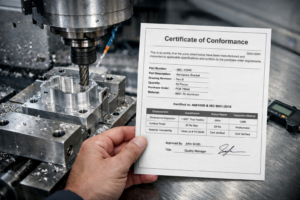
Certificate of Conformance
A good Certificate of Conformance (CoC) is clear, complete, and easy to match to the delivery. It should reference the correct part number, drawing revision, quantity, purchase order, and any applicable specifications or customer requirements. The CoC is essentially the supplier’s formal statement that the product meets requirements, so errors or vague wording here can create unnecessary back-and-forth even when the physical parts are correct.
Material Certificates With Heat or Batch Traceability
Material certification needs to do more than exist, it needs to trace properly. “Good” looks like certificates that clearly identify the material grade/specification and link directly to the heat/batch that was actually used on your parts. You also want to see how the shop maintains that link internally, so there’s no doubt which cert belongs to which job and which delivered components. This is particularly important in aerospace assemblies where traceability may need to be demonstrated months or years later.
Inspection Report or Dimensional Report
Inspection reporting should be practical and consistent: it must reflect what matters on the drawing and be presented in a format that makes review easy. Strong suppliers don’t provide “random checks” or unclear tables – they report critical dimensions clearly, reference datums appropriately, and ensure the measurement method is suitable for the tolerance. The goal is for your goods-in inspection (or your customer) to be able to accept the parts with confidence and minimal delay.
First Article Inspection Pack Where Required
Where a First Article Inspection pack is needed, “good” means structured, traceable, and aligned with your expectations – typically including characteristic accountability (often via a ballooned drawing), inspection results, and supporting evidence such as material certification. Even when an AS9102 format isn’t mandatory, the supplier should be capable of producing a first-off package that demonstrates process understanding and provides a repeatable baseline for future production.
Calibration Certificates for Audit or Verification
Calibration control is one of the foundations of credible inspection. When calibration certificates are requested (often during audits or supplier approval), a mature AS9100 shop can provide them quickly and clearly, showing that the equipment used to verify your parts is within calibration and traceable to recognised standards.
Certificates for Outsourced Special Processes
If any special processes are subcontracted (such as heat treatment, plating, anodising, coating, NDT, or marking), the paperwork must verify exactly what was performed and to which specification and revision. “Good” looks like certificates that match the purchase order requirements, include relevant process parameters where appropriate, and are checked by the machine shop before being passed on to you. This is a common failure point, so strong supply-chain control here is a major indicator of supplier maturity.
If you’re sourcing parts that will end up in aerospace assemblies, that documentation is often as important as the part itself, because without it, the part may be unusable regardless of how well it was machined.
Special Processes and Outsourcing: Controlling the Supply Chain
Even the best CNC machining partner won’t do everything in-house. The key isn’t whether they outsource, it’s how they control what they outsource, whether that’s anodising and other coatings, heat treatment, surface finishing, NDT, marking, or specialist cleaning and packaging. In aerospace, it’s not enough for a supplier to say “we use a good anodiser.” You need confidence that subcontractors are managed within a controlled system, with clear requirements, evidence of compliance, and fast action when something goes wrong.
Evaluating and Re-evaluating Subcontractors
A reliable AS9100 machine shop treats subcontractors as an extension of their own process route, not a separate world. That means they have a method for selecting suppliers in the first place (based on capability, approvals, performance, and risk), and they revisit that decision over time. Re-evaluation should be based on real performance data – quality escapes, lead-time reliability, responsiveness, and document accuracy — so poor performance is identified early rather than excused until it becomes a programme issue.
Flowing Down the Correct Requirements
Many supply chain failures happen because the subcontractor wasn’t given the correct information. A mature shop will flow down the exact requirements needed to meet the drawing and purchase order: the right specification, the right revision, the right acceptance criteria, and the right documentation expectations. This is especially critical where aerospace specs change or where customer flow-downs apply, because a “close enough” instruction can lead to parts that look fine but aren’t compliant – and that’s where rejection, rework, and delay start.
Verifying Certificates Match What Was Ordered
It’s not enough to receive a certificate – it has to match the job. A strong AS9100 machine shop checks returned certs for accuracy and completeness: correct spec, correct revision, correct batch/lot information where applicable, and traceability that ties back to the parts delivered. This verification step is where many weak suppliers fall down, because missing or incorrect documentation often isn’t noticed until goods-in inspection, customer audit, or (worst case) after the parts are already built into assemblies.
Quarantining Issues and Communicating Clearly
When a subcontracted process goes wrong, speed and clarity matter. A dependable supplier will quarantine affected parts immediately, assess impact on the build, and communicate what happened in plain terms – including what is contained, what is at risk, and what the recovery plan looks like. Just as important is how they prevent repeat issues: corrective actions that address root cause, whether that’s supplier performance, unclear flow-down, or missing verification steps.
A reliable AS9100 machine shop manages risk across the entire process route – not just the machining operation – so you can trust both the parts and the compliance evidence that needs to travel with them.
Red Flags When Choosing an AS9100 Machine Shop
Some warning signs are obvious – slow responses, vague capability claims, and sloppy quotes. Others are more subtle, and those are often the ones that lead to the most expensive problems later. When you’re assessing an AS9100 machine shop, watch for patterns that suggest weak control, weak communication, or a reluctance to be transparent about risk. A strong supplier doesn’t pretend risk doesn’t exist, they show you how they manage it.
“We’ll Figure It Out” With No Documented Assumptions
If a quote is built on vague statements and missing detail, it’s a sign the supplier is relying on hope rather than planning. Professional shops document assumptions clearly – material grade, finish interpretation, inspection scope, and any drawing ambiguities — so you can confirm alignment before the job starts. When assumptions aren’t captured, disputes appear later as cost increases, lead-time slips, or “that wasn’t included” conversations.
Avoidance Around Inspection Method or Measurement Uncertainty
A mature shop should be able to explain how they will measure critical features and why the method is suitable for the tolerance and datum structure. If they avoid the topic, give generic answers, or can’t describe how they manage measurement uncertainty, you risk ending up with inspection results you can’t trust – and parts that get rejected at goods-in even if they “look right.” Confidence in measurement is a cornerstone of aerospace supply.
No Clear Plan for Revision Control or Traceability
In aerospace and defence, revision mistakes can be catastrophic. If a supplier can’t explain how they control drawing versions, manage ECOs, and ensure build-to-current revision, that’s a major risk indicator. The same applies to traceability: you want a clear link from material certs and process records to the specific job and the delivered parts. If their explanation is hand-wavy, expect paperwork gaps and compliance headaches later.
Quoting Tight Tolerances Without Asking Questions
Tight tolerances should trigger questions. A good supplier will ask about functional intent, datums, inspection expectations, and any features that may require specific methods or additional process controls. If a shop quotes challenging tolerances without clarification, it can mean they haven’t recognised the risk, they’re underestimating inspection and process time, or they plan to “machine and hope” – none of which ends well in aerospace work.
Overpromising Lead-Times Without Explaining Capacity
Fast lead-times are attractive, but unrealistic promises are expensive. If a supplier offers ambitious delivery dates without explaining how the job will be scheduled, what capacity is available, or what constraints exist (material lead-time, special processes, inspection availability), you’re likely to see slips later – often communicated late. Reliable shops are transparent about what they can commit to and what variables could move the date.
Poor Quality Documentation and Incomplete Certificates
In an AS9100 environment, the paperwork is part of the deliverable. Unclear Certificates of Conformance, missing cert references, mismatched revisions, or incomplete inspection reports create delays, rejections, and extra administrative work. Documentation quality is a direct reflection of process control: if the paperwork is messy, the underlying controls are often messy too.
A strong AS9100 machining partner will still acknowledge risks, but they’ll do it with clarity, process discipline, and documented controls that protect your programme from nasty surprises.
How to Run a Clean RFQ Process (and Get Better Quotes)
Suppliers quote best when inputs are clear. If you want faster, more accurate pricing and fewer surprises, structure your RFQ like an engineer – not a shopping list. A good AS9100 machine shop will still ask questions (that’s usually a positive sign), but you can reduce back-and-forth and prevent hidden assumptions by being explicit from the start. The goal is simple: make it easy for the supplier to understand what “right” looks like, so the quote reflects the real scope.
Provide the Latest Drawing and Model With Revision Clearly Stated
Your RFQ should remove any doubt about what version is being quoted. Include the latest drawing and, if available, the 3D model – and make the revision level unmissable in the email and on the files themselves. Revision confusion is one of the quickest ways to create quoting errors, build-to-obsolete risk, and delays once an order is placed. A clean pack also helps the supplier plan manufacturing and inspection properly, especially when datums and complex geometry are involved.
State the Material Specification and Approved Equivalents
Be precise about the material grade, standard/specification, and condition/temper where applicable. If equivalents are acceptable, list them explicitly so the supplier can quote intelligently based on availability and cost without risking noncompliance. In aerospace and defence, material traceability expectations often sit behind this requirement, so clarity here prevents late-stage problems when certs don’t match what was expected or when the “closest available” stock isn’t actually permitted.
Define Finish Requirements and Any Special Notes
Finishes and special notes can change the process route and lead-time dramatically, especially when subcontract processes are involved. Call out anodising, plating, passivation, coating, heat treatment, or any surface finish requirements, and include special notes such as cleanliness expectations, marking requirements, protective packaging, or handling controls. If these details aren’t provided upfront, suppliers may quote a base machining scope and later add time and cost once these requirements surface.
Confirm Quantity and Delivery Schedule
Quantity drives everything from setup strategy to inspection approach, so include expected volumes and whether this is a prototype, a pilot batch, or intended repeat production. Pair that with a clear delivery requirement: a single due date, staged deliveries, or an ongoing schedule. When suppliers understand the delivery cadence, they can quote more realistically and plan capacity around your programme rather than guessing and overcommitting.
Set Inspection Expectations Clearly
Inspection scope is one of the biggest variables in aerospace quotes. Specify whether you need a full dimensional report, CMM reporting, a sampling plan, or a First Article Inspection pack, and whether any specific characteristics require 100% verification. This allows the supplier to build the right inspection time into the quote and prevents disputes later when a buyer expects more documentation than the supplier priced for.
Include Any Customer Flow-Down Requirements That Matter
If there are customer-specific clauses, defence requirements, traceability rules, or documentation formats that must be followed, include them at RFQ stage. Flow-down requirements can affect supplier selection, subcontract approvals, record retention, and what must be included in the delivery pack. If these aren’t shared early, you risk delays, re-quotes, or noncompliant deliveries, even when the machining itself is excellent.
Once you receive quotes, compare more than unit price. Look at how assumptions are documented, whether lead-times sound realistic, what documentation is included, and how well each supplier understood the critical requirements that matter most to your programme.
Why UK Buyers Often Choose a “Made in Britain” AS9100 Machine Shop
If you’re building in the UK supply chain (aerospace, defence, scientific instruments), there’s real value in working with a domestic partner: easier communication, faster logistics, simpler visits/audits, and reduced supply chain uncertainty. A UK-based AS9100 machine shop can also help when programmes need responsiveness – prototypes, ECO changes, urgent spares, or fast-turn repeat batches.
Tarvin Precision, for example, manufactures in Britain and operates to AS9100 expectations, supporting customers who need tight-tolerance CNC machining with the paperwork and process discipline that aerospace demands. If you’re trying to reduce supplier risk while keeping agility, that combination matters.
A Practical Checklist: Choosing the Right AS9100 CNC Machining Partner
If you want a simple “yes/no” structure to guide your decision, use this checklist to score suppliers consistently. Fulfilling this builds confidence that the shop can meet aerospace expectations repeatedly, with the right documentation and communication.
Quality System and Evidence
This section checks whether the supplier is genuinely operating in a controlled AS9100 environment, with the records and discipline to support audits, traceability, and acceptance at goods-in. You’re looking for clarity and evidence, not vague reassurance.
AS9100 certificate verified and in-scope
Clear traceability, calibration, and nonconformance controls
Comfortable providing Certificates of Conformance, material certs, inspection reports, and FAI packs
Technical Fit
Here you’re validating that the shop can actually make your parts — not just “aerospace parts” in general. The focus is on relevant experience, appropriate inspection capability, and the engineering mindset needed to prevent issues before production starts.
Proven experience with your materials and tolerances
Inspection capability suitable for your critical features
Good engineering communication (questions asked early, assumptions documented)
Delivery and Partnership
A supplier can be technically strong and still create programme risk if delivery and communication are weak. This final check looks at whether they can plan realistically, keep you informed, and manage change without chaos.
Transparent lead-times and capacity fit
Clear status updates and escalation path
Professional quoting, documentation, and change control
If a shop scores well across all three areas, you’re not just buying machining, you’re buying reliability.
AS9100 Machine Shop Summary: Making the Safe Choice
The best AS9100 machine shop for your programme is the one that reduces uncertainty: they plan the work properly, control change, measure what matters, document what they do, and communicate like a partner instead of a vendor. AS9100 certification is the starting point, not the finish line.
If you’re shortlisting CNC machining partners for aerospace, defence, or high-spec instrument work, look for evidence of repeatability: stable processes, strong inspection, clean documentation, and a culture that treats risk seriously.