
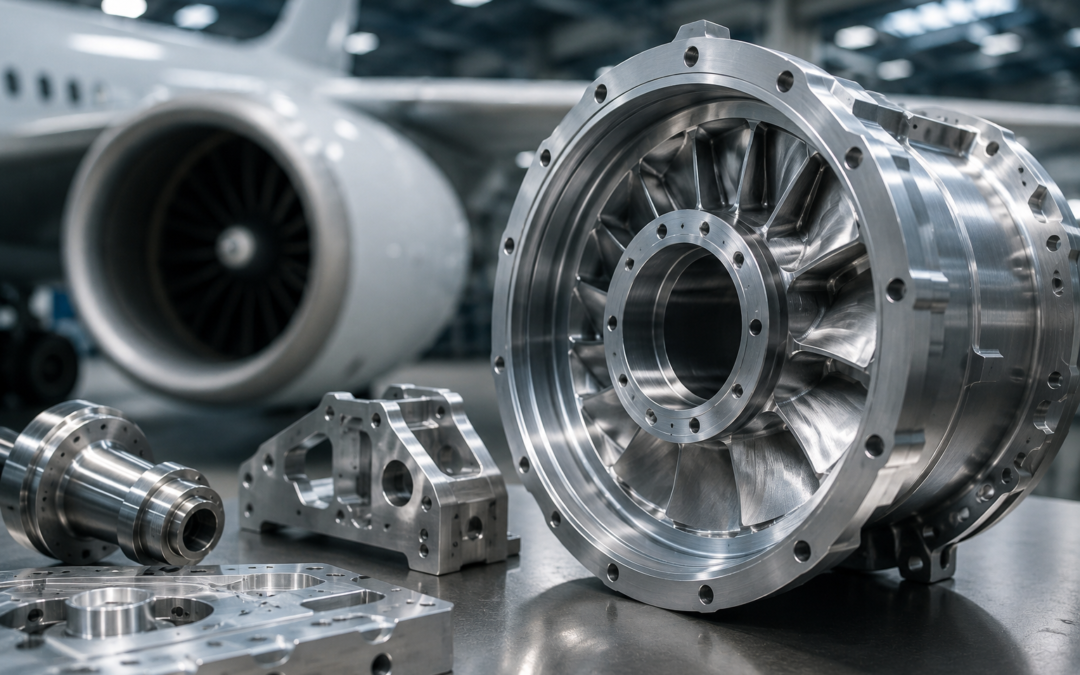
Choosing the right AS9100 CNC machining supplier UK businesses can rely on is a critical decision for aerospace, defence, space, motorsport, medical, and other high-performance engineering sectors. When parts must meet tight tolerances, strict documentation requirements, and demanding delivery schedules, a general subcontract machinist may not be enough. You need a supplier with the right quality system, technical capability, inspection processes, and experience working with regulated supply chains.
AS9100, also known in Europe as EN9100, is the aerospace quality management standard built on ISO 9001 with additional requirements for aviation, space, and defence organisations. AS9100D remains the current revision and includes aerospace-specific requirements such as risk management, product safety, configuration management, and counterfeit parts prevention.
This guide explains how to assess an AS9100 CNC machining supplier in the UK, what questions to ask, what evidence to request, and how to compare suppliers beyond price alone.
Why Choosing an AS9100 CNC Machining Supplier UK Matters
Selecting an AS9100 CNC machining supplier UK customers can trust is about far more than finding a company with CNC machines. Aerospace and high-integrity components often require robust process control, full traceability, controlled documentation, and consistent inspection records. A supplier that understands AS9100 requirements is better placed to support production parts, prototype components, repair schemes, and complex assemblies where quality failures can cause major delays or safety risks.
A strong supplier should be able to demonstrate that quality is built into its daily operations rather than added at the final inspection stage. This includes how enquiries are reviewed, how drawings are controlled, how material is purchased, how non-conformances are managed, and how customer requirements are flowed down through the supply chain. Key reasons to choose an AS9100-certified machining supplier include:
- Improved confidence in quality management and process control
- Better traceability for materials, processes, and inspection results
- Stronger risk management for critical or complex components
- Greater alignment with aerospace and defence customer expectations
- More reliable support for audits, first article inspection, and documentation
What AS9100 Certification Means for CNC Machining
AS9100 certification shows that a supplier operates a quality management system designed for aerospace, aviation, space, and defence requirements. For CNC machining, this matters because the standard goes beyond basic ISO 9001 quality management and places added emphasis on risk, product safety, configuration control, and supplier management. AS9100D incorporates ISO 9001:2015 requirements while adding aviation, space, and defence-specific expectations.
When assessing a CNC machining company, do not simply accept “AS9100 compliant” as enough. Compliance may mean the business follows certain principles, but certification should be independently audited by an accredited certification body. Ask for the certificate, check its scope, and confirm that CNC machining, precision engineering, or component manufacture is covered. A genuine AS9100 CNC machining supplier should be able to provide:
- A current AS9100 or EN9100 certificate
- Certificate scope relevant to CNC machining or precision manufacture
- Certification body details
- Audit expiry date and certificate number
- Evidence that the certificate applies to the site handling your work
AS9100 CNC Machining Supplier UK: Start with Technical Capability
The best AS9100 CNC machining supplier UK manufacturers choose will have the right blend of certification and practical machining capability. Certification alone does not prove that a supplier can manufacture your part accurately, efficiently, or repeatedly. You need to check whether the company has the machines, tooling, programming expertise, materials knowledge, and inspection equipment required for your component.
Consider the type of work you need. An aerospace component machining UK supplier that is excellent at small aluminium prismatic parts may not be suitable for hard metal turning, thin-wall aerospace structures, complex 5-axis milling, or high-volume production. Ask for examples of similar work, but respect confidentiality if the supplier cannot reveal customer names or drawings. Important capability areas to review include:
- 3-axis, 4-axis, and 5-axis CNC milling capacity
- CNC turning and mill-turn capability
- Experience with aluminium, titanium, stainless steel, Inconel, and engineering plastics
- Prototype, batch, and repeat production capacity
- Ability to machine tight tolerances and complex geometries
- CAD/CAM programming capability
- Support for assemblies, inserts, finishing, and secondary operations
Look for Aerospace CNC Machining Experience
Aerospace CNC machining requires a different mindset from general subcontract engineering. Components may involve tight tolerances, controlled radii, thin walls, deep pockets, difficult materials, and extensive documentation. An experienced aerospace parts machining supplier will understand that meeting the drawing is only part of the job; they must also meet purchase order requirements, specification notes, inspection clauses, material controls, and delivery commitments.
Ask whether the supplier has experience working with aerospace primes, tier-one suppliers, defence contractors, UAV manufacturers, satellite companies, or specialist aerospace engineering firms. Even if your project is not aerospace, choosing a supplier with aerospace discipline can improve quality and reliability. Useful questions include:
- Have you manufactured parts for aerospace or defence applications?
- Can you support first article inspection reports?
- Do you understand drawing revision control and configuration management?
- Can you manage customer-specific quality clauses?
- How do you handle key characteristics and critical features?
- What inspection reports can you provide with each delivery?
Check the Supplier’s Quality and Inspection Processes
A reliable AS9100 CNC machining supplier should have a structured approach to inspection from contract review through to final release. Quality should start before material is ordered, with a careful review of drawings, tolerances, specifications, and customer requirements. The supplier should identify risks early, clarify ambiguities, and confirm that inspection methods are suitable for the component.
Inspection capability is especially important for complex or safety-critical parts. A supplier should have calibrated equipment, trained inspectors, and clear procedures for recording results. Depending on the part, this may include CMM inspection, manual measurement, surface finish checks, thread gauging, hardness checks, and dimensional reports. Inspection evidence to request may include:
- FAIR or AS9102-style first article inspection reports
- CMM reports
- Dimensional inspection reports
- Material certificates
- Certificates of conformity
- Calibration records for measuring equipment
- Batch traceability documentation
- Non-conformance and corrective action procedures
Assess Material Traceability and Supply Chain Control
Material traceability is one of the most important factors when choosing an AS9100 CNC machining supplier UK companies can depend on. In aerospace and other regulated sectors, it is not enough for a part to be dimensionally correct. You also need evidence that the correct material was used, that it came from an approved source, and that certificates can be linked to the finished component.
The supplier should be able to explain how raw material is purchased, identified, stored, issued to jobs, and linked to finished parts. This is especially important when machining titanium, aluminium aerospace grades, stainless steel, nickel alloys, and other high-performance materials. A good supplier should control:
- Approved material suppliers
- Mill certificates and certificates of conformity
- Heat and batch traceability
- Material identification during storage and machining
- Subcontract processes such as plating, anodising, heat treatment, and NDT
- Flow-down of customer requirements to external providers
Compare Lead Times, Capacity, and Delivery Reliability
Lead time is often a deciding factor, but the lowest quoted lead time is not always the safest choice. An AS9100 CNC machining supplier should be honest about capacity, material availability, programming time, inspection requirements, and subcontract finishing operations. Unrealistic promises can lead to missed deadlines, quality issues, or expensive rework.
Ask how the supplier manages scheduling and whether they have capacity for repeat orders. If your project is likely to move from prototype to production, check whether the supplier can support both stages. Some AS9100 machine shops are excellent for urgent prototypes but less suitable for stable production schedules, while others are built for repeat batch work. When reviewing delivery performance, consider:
- Quoted lead time versus realistic project complexity
- Availability of raw material
- Internal machining capacity
- Inspection and documentation time
- Subcontract finishing lead times
- On-time delivery history
- Communication if delays occur
Review Communication and Engineering Support
Good communication can make the difference between a smooth project and a costly one. A strong AS9100 CNC machining supplier will review your enquiry carefully and raise technical questions early. This is a positive sign, not a problem. It shows the supplier is checking tolerances, materials, surface finishes, drawing notes, and manufacturing risks before committing to a price.
Engineering support is particularly valuable for prototypes, development parts, and components that may be difficult or expensive to machine. A supplier of CNC machining aerospace parts with strong manufacturing knowledge can suggest design-for-manufacture improvements without compromising function or compliance. Look for a supplier that can help with:
- Drawing review and tolerance feedback
- Material selection advice
- Machining strategy recommendations
- Cost reduction opportunities
- Prototype-to-production planning
- Risk identification before manufacture
- Clear communication during production
Understand Pricing for AS9100 CNC Machining in the UK
Price matters, but it should not be the only factor when choosing an AS9100 CNC machining supplier UK buyers can trust. AS9100-level machining often involves additional controls, documentation, inspection, and traceability. A quote that appears cheaper may exclude essential requirements such as FAIR documentation, material certificates, finishing, packaging, or full dimensional reporting.
When comparing quotes, make sure each supplier is pricing the same scope. A professional supplier should make exclusions clear and ask questions where requirements are uncertain. If a quote is significantly cheaper than others, investigate why. It may reflect a more efficient process, but it may also mean that key requirements have been missed. Compare quotes based on:
- Machining cost
- Material cost and certification
- Programming and setup time
- Inspection requirements
- Documentation package
- Surface treatment or finishing
- Packaging and delivery
- Repeat order pricing
- Cost of quality, not just unit price
Ask About First Article Inspection and Documentation
First article inspection is common in aerospace and high-integrity manufacturing because it confirms that the production process can produce a part that meets all drawing and specification requirements. A capable AS9100 CNC machining supplier should understand first article expectations and be able to produce structured reports when required.
For new parts, revised drawings, or production transfers, documentation can be just as important as the machined component itself. Missing or incomplete paperwork can delay goods-in approval, customer release, or production schedules. Documentation may include:
- First article inspection report
- Ballooned drawing
- Material certification
- Certificate of conformity
- Special process certificates
- Dimensional inspection report
- Surface finish results
- Traceability records
- Packing and delivery documentation
Check How the Supplier Handles Non-Conformance
Even the best suppliers occasionally encounter issues. What matters is how they detect, contain, communicate, and correct them. AS9100 places strong emphasis on non-conformance control, corrective action, and continual improvement, so your supplier should have a clear process for managing problems.
A trustworthy supplier will not hide issues or ship questionable parts without agreement. They should notify you promptly, provide evidence, and work with you on concessions, rework, replacement, or corrective action where required. Ask how the supplier manages:
- Internal non-conformances
- Customer complaints
- Root cause analysis
- Corrective and preventive actions
- Concession requests
- Rework control
- Lessons learned for repeat production
Visit the CNC Machining Supplier Where Possible
A site visit can reveal details that are difficult to assess from a website or certificate alone. When you visit an AS9100 CNC machining supplier, look for organisation, cleanliness, controlled paperwork, identifiable materials, calibrated inspection equipment, and a professional approach to job management. You do not need to inspect every procedure, but the overall culture should give you confidence.
If a visit is not practical, ask for a video call, virtual tour, or sample documentation pack. Many UK suppliers are used to remote customer audits and can provide evidence without compromising confidentiality. During a visit or remote review, consider:
- Workshop organisation
- Machine condition and capability
- Inspection department setup
- Material storage and identification
- Job travellers or route cards
- Document control methods
- Staff knowledge and professionalism
- Evidence of live quality management
Red Flags When Choosing an AS9100 CNC Machining Supplier
Choosing the wrong supplier can lead to late deliveries, rejected parts, audit problems, and costly production delays. Red flags do not always mean a supplier is unsuitable, but they should prompt further questions before you place an order.
Be cautious if a supplier claims AS9100 capability but cannot provide a valid certificate, avoids detailed technical questions, or seems unwilling to discuss inspection and traceability. Poor communication at quotation stage often becomes worse once the job is live. Common warning signs include:
- No valid AS9100 or EN9100 certificate
- Certificate scope does not cover machining activity
- Vague answers about inspection capability
- No clear material traceability process
- Reluctance to provide sample documentation
- Unrealistically low pricing
- Unrealistically short lead times
- Poor response times during enquiry
- Limited understanding of aerospace requirements
Building a Long-Term Relationship with an AS9100 CNC Machining Supplier UK
The best results often come from building a long-term relationship with an AS9100 CNC machining supplier UK teams can involve early in the project. Once a supplier understands your drawings, materials, quality clauses, and delivery expectations, they can help reduce risk and improve efficiency across future orders.
A long-term supplier relationship can support better pricing, shorter repeat lead times, improved manufacturability, and more consistent quality. It also allows both sides to refine inspection plans, packaging, communication routines, and production schedules. To build a stronger relationship, consider:
- Sharing forecast demand where possible
- Providing complete drawing packs and specifications
- Agreeing documentation requirements upfront
- Reviewing performance after initial orders
- Giving feedback on quality and delivery
- Involving the supplier early in new designs
- Standardising repeat order requirements
Final Checklist for Choosing an AS9100 CNC Machining Supplier in the UK
Before choosing your supplier, take a structured approach that balances certification, capability, quality, delivery, and communication. The right AS9100 CNC machining supplier should give you confidence before the purchase order is placed, not just after the parts arrive. Use this checklist to compare potential suppliers:
- Do they hold valid AS9100 or EN9100 certification?
- Does the certificate scope include CNC machining or precision manufacture?
- Do they have experience with aerospace or high-integrity components?
- Can they machine your required materials and tolerances?
- Do they provide FAIR, CMM reports, and certificates of conformity?
- Can they maintain material and batch traceability?
- Do they control subcontract processes properly?
- Are lead times realistic and clearly explained?
- Do they communicate well during quotation?
- Do they understand your industry’s quality expectations?
Choosing the Right AS9100 CNC Machining Supplier UK
Finding the right AS9100 CNC machining supplier UK organisations can rely on means looking beyond price and machine capacity. Certification is important, but it should be supported by technical expertise, inspection capability, material traceability, documentation control, and strong communication.
The best supplier will understand both the engineering and quality demands of your project. They will review requirements carefully, identify risks early, provide clear evidence, and deliver components that meet your drawings, specifications, and audit expectations. By using the checklist in this guide, you can make a more confident decision and choose a CNC machining partner capable of supporting demanding aerospace, defence, and precision engineering work.