
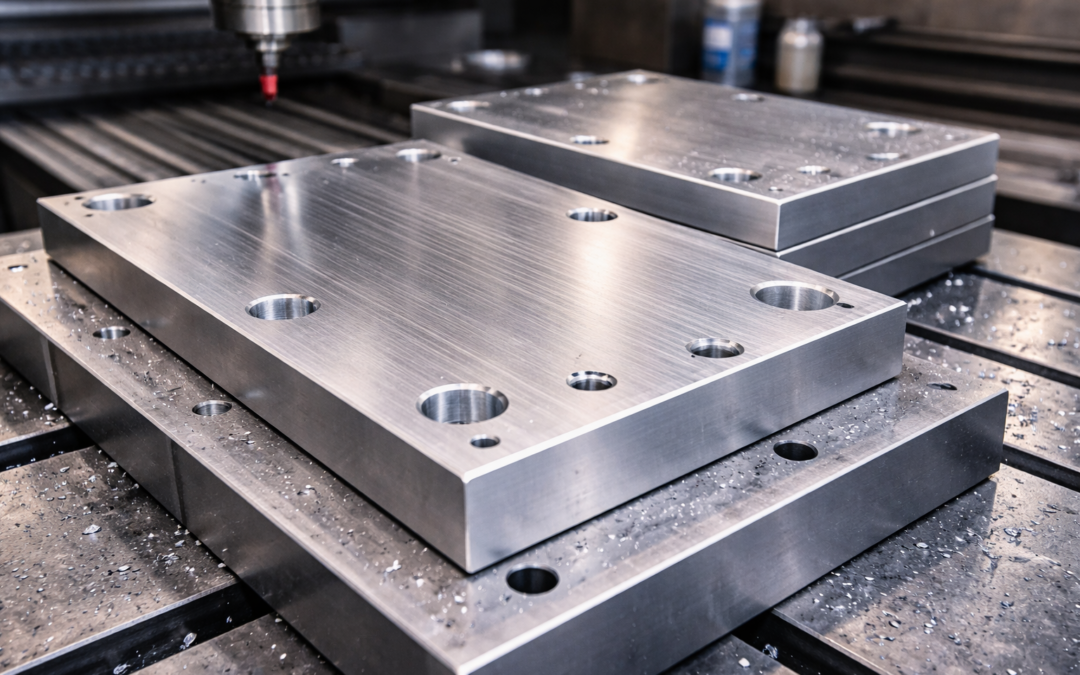
Aluminium tooling plate often comes into the conversation very quickly when engineers, buyers and machinists talk about material for precision fixtures, machine bases, mounting plates and scientific assemblies. That is because it fills an important gap between standard aluminium plate and a material that is already designed to offer improved flatness, better dimensional stability and more predictable behaviour during machining.
In precision engineering, that is why aluminium tooling plate is often specified for more demanding work rather than treated as just another stock material. At Tarvin Precision, this typically comes up in projects where a plate is acting as the foundation for a wider assembly, so flatness, stability and machining approach all matter just as much as the nominal grade.
For many jobs, the real cost of a material is not just the price per kilo or per sheet. It is the time spent squaring it up, the amount of stock that has to be removed, the risk of movement once pockets are machined, and the effort needed to achieve a good cosmetic and dimensional finish. In those situations, aluminium tooling plate can be a very sensible choice. It helps reduce preparation time, supports flatter finished parts and gives design teams a better starting point for precision work.
This guide explains what aluminium tooling plate is, how it differs from standard plate, which grades and product types are commonly specified, and what to consider when selecting and machining it. It is written for engineers, procurement teams and manufacturers who want a straightforward overview rather than marketing jargon.
What is Aluminium Tooling Plate?
At its simplest, aluminium tooling plate is aluminium plate that has been produced or processed to offer higher flatness, tighter thickness control and improved stability for machining applications. It is commonly used where a part needs to act as a base, fixture, support structure, sub-plate or reference surface.
Unlike more general stock aluminium plate, tooling plate is often chosen because it reduces the amount of preparation needed before machining starts. A shop may not need to remove as much material just to create a flat usable face, which can save time and reduce waste. That matters when tolerances are tight, when a component is large, or when the finished part needs to stay stable after a lot of metal has been removed. In practical terms, aluminium tooling plate is often used for:
- base plates
- jigs and fixtures
- machine sub-plates
- mounting plates
- inspection tooling
- vacuum plates
- scientific equipment assemblies
- electronics support structures
- precision frames and carriers
The appeal is not only that the material starts flatter. It is also that the right tooling plate can behave more predictably in machining, which helps machinists control distortion and achieve a better finished part.
Why It’s Different from Standard Aluminium Plate
A lot of confusion comes from the fact that engineers may use the word “plate” to describe several quite different products. Standard aluminium plate, rolled plate, cast plate and aluminium tooling plate are not always interchangeable, even if they appear similar on paper.
The key difference is that tooling plate is intended for precision applications where flatness and stability matter. Standard plate may be fine for many structural or general engineering uses, but it can require more stock removal and may be more prone to movement when heavily machined. By contrast, CNC plates for tooling are usually selected to make the job easier and more reliable. The main advantages of aluminium tooling plate often include:
- improved flatness across the surface
- better thickness consistency
- reduced preparation machining
- more predictable dimensional stability
- good machinability for milling holes, pockets and profiles
- a better starting point for precision assemblies
That does not mean tooling plate is automatically the right answer for every application. For some work, a standard grade plate is perfectly adequate. But where flatness, finish and machining efficiency are priorities, tooling plate is often worth serious consideration.
Common Grades and Families
One of the most useful things to understand is that aluminium tooling plate is not always one single grade. It can refer to several alloy families, specialist variants and branded products that are designed for slightly different priorities, such as machinability, corrosion resistance or stability.
In everyday subcontract machining and precision engineering, some of the most relevant material families include 5xxx and 6xxx series aluminium, with certain branded or modified products sitting alongside them. For example, buyers may ask for 5083 tooling plate, 6082 plate, 6061 plate or a proprietary cast plate product depending on the application. Commonly encountered options include:
- 5083 tooling plate for a good balance of corrosion resistance and performance
- 6082 tooling plate where a strong, versatile 6xxx material is preferred
- 6061 tooling plate on drawings influenced by international or US-based specifications
- branded cast tooling plates with very high flatness and stability
- specialist products chosen for precision base and fixture applications
The important point is that alloy number alone does not tell the full story. Two products may be close in chemistry but still differ significantly in flatness, temper, machinability or residual stress. That is why material selection should look at both the nominal grade and the exact form of product being supplied.
5083 Plate and Where it Fits
Among the most common requests in UK precision engineering, 5083 aluminium tooling plate stands out as a very practical option. It is widely known, reasonably familiar to designers and often associated with stable performance in the right plate format.
For base plates, support structures and mounting applications, 5083-based tooling plate can be very attractive because it combines good corrosion resistance with dependable machining characteristics. In many subcontract CNC machining workshop environments, it is a logical first material to consider when the job needs a stable plate rather than just a general aluminium stock item. Typical reasons engineers specify 5083-based aluminium tooling plate include:
- good all-round engineering performance
- suitability for base and fixture work
- useful corrosion resistance
- familiarity across many manufacturing sectors
- availability in tooling plate product ranges
For precision work, though, what matters most is not simply “5083” on its own. It is whether the material has been processed and supplied in a way that supports flatness and dimensional control.
6082 Plate for Precision Machining
Another important area is 6082 aluminium tooling plate, especially where engineers want a familiar high-strength general engineering alloy in a precision plate format. 6082 is often specified in machining environments because it is widely used, versatile and well understood.
For some applications, 6082 can be an appealing choice where the finished component needs to combine plate-like form with robust mechanical properties. However, it is important to distinguish between standard 6082 plate and a precision plate product that has been supplied with tooling plate performance in mind. This matters because teams choosing aluminium tooling plate are usually concerned with more than simple strength. They also care about:
- flatness before machining
- consistency of the starting stock
- how the plate behaves once material is removed
- the quality of the machined finish
- suitability for tapped holes, mounting patterns and precision faces
When a job will become a base for other machined components in an assembly, those factors can be just as important as the nominal alloy strength.
Cast Aluminium Plate vs Rolled Plate
A frequent selection question is whether to use cast tooling plate or rolled plate. This is one of the most important decisions in the aluminium tooling plate category because it has a direct effect on stability, flatness and machining expectations.
Cast tooling plate is often chosen specifically because it offers excellent flatness and dimensional stability. That can make it a very good option for jig plates, machine bases, inspection tooling and mounting structures. Rolled plate, meanwhile, may still be suitable for many CNC machining parts, but it can behave differently and may require more preparation work. When comparing cast and rolled aluminium tooling plate, the differences often come down to:
- flatness requirements
- thickness tolerance expectations
- material movement during machining
- availability in required sizes
- finish requirements
- cost versus machining efficiency
There is no universal winner. The right choice depends on the job. But for highly machined parts where a plate must stay stable and flat, cast tooling plate often has a strong case.
Branded Aluminium Tooling Plate Products
The market for aluminium tooling plate includes a number of branded products, and these are worth understanding because many customer enquiries use brand names rather than generic alloy descriptions. Buyers may ask for a particular trademarked plate because that is what they have used before, what a drawing calls up, or what an OEM originally specified.
In some cases, the branded plate is essentially a proprietary variation designed to deliver improved flatness, machinability or stability compared with general stock plate. In others, it may be the most commonly recognised product name in a given sector. Examples of branded or strongly recognised tooling plate products often requested in the market include:
- CAL5
- MIC6
- KASTAL 300
- other cast precision plate products
- modified 5xxx-based and 6xxx-based plate variants
For subcontract manufacturers, the practical issue is often less about the brand itself and more about understanding what the customer needs from the material. Sometimes the exact product is essential. At other times, an equivalent aluminium tooling plate may do the job just as well if the functional requirements are understood properly.
Choosing for Base Plates and Assemblies
One of the most common uses for aluminium tooling plate is as a base to mount other machined parts in a larger assembly. This is especially relevant in scientific, laboratory, electronics and precision mechanical equipment where flatness and positional accuracy matter.
In that kind of application, the plate is not just raw stock. It becomes the reference foundation for the rest of the build. If the base is unstable, distorted or inconsistent, the downstream assembly becomes more difficult. Hole positions, component interfaces and alignment features all depend on the material behaving predictably. When selecting aluminium tooling plate for a base or sub-plate, it is sensible to review:
- the required flatness of the finished part
- whether both faces will be machined
- the amount of pocketing or material removal planned
- the operating environment of the assembly
- corrosion resistance requirements
- cosmetic finish expectations
- whether the part supports metrology or alignment functions
This is where practical machining knowledge matters just as much as material availability. A good material choice can reduce risk, but the machining process must still be controlled to avoid introducing distortion.
Machining Tooling Plate Without Warping
Even the best aluminium tooling plate will not guarantee a perfect result if the machining method is poor. Precision plate still needs sensible process control, especially when a part includes large pockets, thin walls, asymmetrical stock removal or tight flatness requirements.
Machinists know that avoiding movement is partly about the material and partly about the method. Balanced machining, careful workholding, realistic clamping pressure and sensible sequencing can all make a major difference. The more metal that is removed, the more important those decisions become. Good practice when machining aluminium tooling plate often includes:
- starting with the right stock size and allowance
- removing material in a balanced sequence
- minimising aggressive clamping distortion
- allowing for stress equalisation where needed
- using sharp tooling and appropriate feeds
- supporting the plate properly during machining
- checking flatness at key stages rather than only at the end
This is one reason why material advice and manufacturing knowledge are closely linked. A customer may know they need a plate, but not yet know which version of aluminium tooling plate will be most forgiving for the part geometry they have designed.
Surface Finish, Flatness and Tolerance Considerations
A major reason to choose aluminium tooling plate is to make it easier to achieve a high-quality finished part. That does not only mean appearance. It also includes flatness, hole position accuracy, face quality and consistency across multiple parts.
For buyers, it is useful to define clearly what actually matters. Sometimes a drawing calls for tooling plate because the designer wants reassurance, but the part may only need moderate flatness. In other cases, the plate is acting as a mounting or reference surface where very small deviations matter a great deal. Questions worth clarifying at the enquiry stage include:
- What flatness does the finished part need?
- Is the supplied stock flat enough, or will both faces be machined anyway?
- Are there large internal pockets likely to release stress?
- Is the plate part of a cosmetic assembly or a hidden substructure?
- Does the plate need anodising or another post-machining treatment?
The more clearly those points are understood, the easier it is to recommend the right aluminium tooling plate and machining route.
Scientific and Technical Applications
In many precision engineering environments, aluminium tooling plate is particularly valuable for scientific and technical equipment. That is because such projects often involve plate-based structures that support optics, instrumentation, sensors, electronics or complex sub-assemblies.
These parts are rarely just simple rectangles with holes. They may carry critical interfaces, alignment features, mounting faces and precision datum structures. A base plate can be the core of the whole assembly, even when it looks relatively simple in its raw form. Typical scientific and technical uses for aluminium tooling plate include:
- instrument base plates
- electronics mounting structures
- laboratory equipment frames
- sensor mounting platforms
- optical support plates
- test and inspection fixtures
- bespoke machine sub-assemblies
For companies working in these areas, material choice is often tied closely to manufacturing experience. At Tarvin Precision, for example, this sort of requirement often centres on aluminium plates that will support other machined components within a finished assembly, where finish quality, stability and confidence in the machining route are all important.
In these sectors, the best results usually come from combining the right material choice with realistic design for manufacture. That means understanding not only what the plate is made from, but how it will be machined, handled, assembled and used.
How to Choose the Right Aluminium Tooling Plate Supplier
A good aluminium tooling plate supplier is not just a business that can quote a material description. The best suppliers help clarify what product is actually needed, whether a branded plate is essential, and whether an alternative would achieve the same engineering result.
For manufacturers and buyers, supply chain flexibility can be important. Some products are asked for regularly, while others are harder to source consistently. That is particularly true with niche or brand-led specifications. A helpful supplier will often do more than take an order; they will help interpret the requirement and align it with what is practically available. When assessing a supplier or manufacturing partner for aluminium tooling plate, it helps to look for:
- familiarity with multiple grades and product types
- an understanding of machining behaviour, not just stock codes
- willingness to discuss application and not only price
- realistic advice on availability and lead times
- the ability to suggest alternatives when appropriate
- experience with flatness-sensitive applications
That practical support can make a real difference, especially where a plate is central to the performance of the finished assembly.
Aluminium Tooling Plate Decisions
For engineers and buyers working in precision manufacturing, aluminium tooling plate is one of those materials that can quietly solve several problems at once. It can reduce preparation time, support better flatness, improve machining predictability and create a stronger starting point for assemblies that depend on stable base structures.
The most important thing is not to treat all plate as the same. Standard plate, rolled plate, cast plate and specialist branded products all have their place. The right choice depends on what the part needs to do, how much material will be removed, and how critical flatness and stability are to the finished component.
That is why the best decisions around aluminium tooling plate usually come from a combination of design intent, material knowledge and machining experience. In practice, a good manufacturing team will help assess whether 5083, 6082, 6061 or a branded tooling plate product is the best fit, and whether the part geometry itself needs any changes to reduce the risk of movement.
If you are choosing material for a new project, the most useful starting question is often not simply, “Which aluminium grade is cheapest?” It is, “Which aluminium tooling plate will give the most reliable finished result?” On precision jobs, that is usually the better question to ask. That is also why companies such as Tarvin Precision tend to look beyond the alloy name alone and focus on the finished application, the machining strategy and the stability the customer needs from the completed part.