
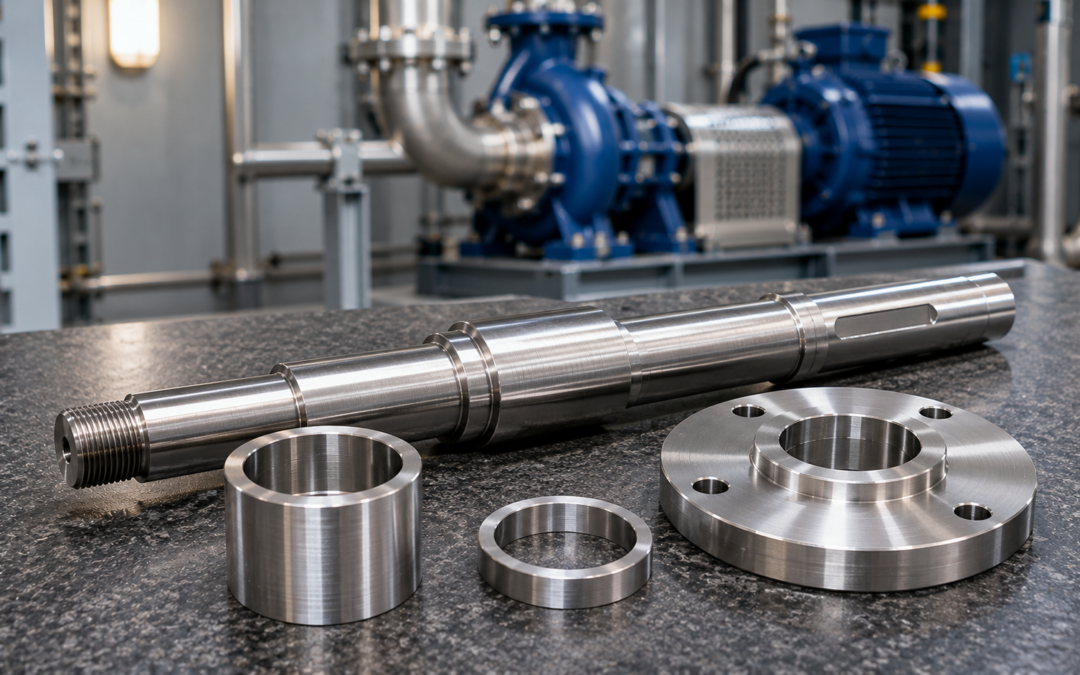
Naval vessels and submarines depend on a wide range of mechanical systems to support safe and reliable operation. Among these are fluid handling systems used for cooling, lubrication, drainage and other essential engineering functions.
Within these systems, pumps perform an important role, but their reliability depends on more than the overall pump design. Individual components must be manufactured accurately to ensure correct assembly, controlled mechanical interfaces and dependable operation.
CNC machining for naval pumps supports the production of precision shafts, sleeves, housings, flanges, adaptors and other mechanical components required by specialist marine pump manufacturers.
For equipment manufacturers supplying the naval defence sector, sourcing these components involves balancing dimensional accuracy, material requirements, surface finish, quality assurance and manufacturing consistency.
This article explores the role of precision CNC machining in marine pump component manufacturing, the technical considerations involved and how specialist UK subcontractors can support naval equipment supply chains.
The Role of Pumps in Naval and Submarine Equipment
Pumping systems are widely used throughout marine engineering, supporting the movement and control of liquids across different onboard applications.
Depending on vessel design, these may include cooling water circulation, lubrication systems, drainage arrangements, freshwater services and other fluid handling requirements.
Submarines and naval vessels can present particularly demanding engineering environments, where equipment may need to operate within restricted spaces and meet specified requirements relating to reliability, vibration, noise and maintenance.
The precise operating conditions vary considerably between systems. A pump used for a general auxiliary service may have very different requirements from equipment associated with a more critical function.
For this reason, individual components must be designed and manufactured to the specifications established by the pump manufacturer and relevant equipment authority.
Within the wider naval defence supply chain, specialist manufacturers develop and assemble complete pumping equipment, while subcontract precision engineering companies can contribute by producing individual machined parts.
This division of manufacturing expertise allows equipment manufacturers to access specialist CNC machining capabilities without necessarily maintaining every production process in-house.
CNC Machined Components Used in Marine Pump Manufacturing
Marine pumps incorporate different combinations of mechanical components depending on their operating principles and intended applications.
Centrifugal pumps, positive displacement pumps and specialist fluid handling equipment each have their own design requirements. However, many involve component geometries suitable for precision CNC turning, milling or a combination of manufacturing processes.
Precision Pump Shafts
Pump shafts transmit rotational motion from the drive arrangement to the pumping element.
Depending on the design, a shaft may incorporate multiple diameters, shoulders, threads, keyways and bearing locations. These features must maintain the dimensional and geometric relationships specified by the manufacturer.
For example, bearing journals may require controlled diameters, roundness and surface finish, while mounting locations for other rotating components may need defined runout characteristics. An incorrectly manufactured shaft can introduce assembly difficulties or affect the operation of the wider rotating assembly.
Precision CNC turning provides an effective method for manufacturing many shaft features, with secondary milling operations used where additional geometry is required.
Shaft Sleeves and Bushes
Shaft sleeves are commonly used in pumping equipment to provide an interface around a shaft or protect selected areas from wear.
Depending on the application, sleeves may incorporate accurately controlled internal and external diameters, shoulders, grooves and specified surface finishes. Bushes and other cylindrical components may also be used to establish mechanical interfaces or support particular assembly arrangements.
The relevant fits must be appropriate to their intended function. An interference fit, for example, places different manufacturing demands on a component from a clearance fit intended to permit movement or straightforward assembly.
Selecting and achieving the correct dimensional requirements is therefore an important consideration during both component design and machining.
Pump Housings and Mechanical Interfaces
Pump housings and associated components can contain complex combinations of machined features. These may include bearing locations, sealing interfaces, mounting faces, threaded connections and accurately positioned holes.
Some pump casings are manufactured primarily through casting or fabrication, with precision machining used to finish the required functional surfaces and interfaces.
For subcontract manufacturers, the machining work may involve producing a complete component from solid material or carrying out specified machining operations on an existing blank. The appropriate approach depends on component size, material, geometry and production quantity.
Flanges, Adaptors and Mounting Components
Flanges and adaptors provide mechanical connections between elements of a fluid handling system.
Although they may appear relatively simple, accurate manufacturing can be important where these parts require controlled mating faces, bolt-hole positions or sealing surfaces. Mounting brackets and support components may also need accurate dimensional relationships to ensure correct alignment within the pump assembly.
For naval equipment manufacturers, these smaller components can be just as important to successful assembly as more complex machined parts.
Why Tight Tolerances Matter in Pump Component Machining
Not every dimension on a pump component requires an exceptionally tight tolerance. However, certain features can be particularly important to assembly, mechanical alignment and operating performance.
These may include bearing diameters, shaft locations, seal interfaces, mating surfaces and accurately positioned mounting features. The key is identifying which characteristics are functionally important and ensuring the manufacturing process can achieve them consistently.
Concentricity, Runout and Rotating Components
For rotating machinery, the relationship between features along a shaft or within a supporting housing can be significant.
Excessive runout may affect the relationship between rotating and stationary components. Depending on the design, this can contribute to unwanted mechanical contact, vibration or difficulties during assembly. Engineering drawings may therefore specify requirements for circular runout, total runout, cylindricity or positional relationships.
The most suitable manufacturing approach depends on the particular characteristics being controlled. CNC turning can be especially effective for many rotational features, although setup methods, workholding and inspection must all be considered.
Surface Finish and Sealing Interfaces
Surface finish is another important consideration in pump component manufacturing.
A machined surface that meets its dimensional tolerance may still be unsuitable if its surface texture does not satisfy the specified functional requirements.
For example, shaft surfaces associated with particular sealing arrangements may require defined surface characteristics. Similarly, static sealing faces and mating surfaces may need suitable finishes to support the intended gasket or sealing arrangement.
However, there is no single surface finish requirement appropriate to every pump design. The manufacturer’s drawing and relevant seal supplier specifications should determine what is required.
Managing Dimensional Fits
Pump assemblies frequently contain features where the fit between two components is important. Examples can include shafts and bearings, bushes and housings, or components designed to be located using controlled diameters.
A clearance fit allows defined relative movement or assembly clearance, while an interference fit creates a tighter mechanical engagement. Transition fits fall between these conditions. Understanding these distinctions is essential when specifying and manufacturing mating components.
For further information, our guide to clearance, transition and interference fits in CNC machined parts explains how these fit types influence component design, assembly and manufacturing requirements.
CNC Turning for Marine Pump Shafts and Sleeves
Many pump components contain predominantly cylindrical geometry, making CNC turning a particularly relevant manufacturing process. Typical examples include shafts, sleeves, bushes, collars, spacers and cylindrical adaptors.
Modern CNC turning equipment can manufacture combinations of external diameters, internal bores, shoulders, grooves and threaded features. However, the machining strategy must account for the component’s material, dimensions and tolerance requirements.
Long or relatively slender shafts, for example, may introduce challenges associated with workpiece deflection and maintaining geometric accuracy. Machining thin-walled sleeves may require careful consideration of workholding forces to avoid unwanted distortion.
Where several critical diameters must maintain a defined relationship, the sequence of operations can also influence the finished result. An experienced CNC machining subcontractor should consider these factors before production begins.
At Tarvin Precision, our CNC turning capabilities support the production of precision components requiring controlled dimensions, repeatability and documented manufacturing processes.
CNC Milling for Pump Housings, Flanges and Mounting Components
While turning is suited to rotational parts, CNC milling is often appropriate for components containing more varied geometry.
Pump housings, mounting brackets, adaptor plates and mechanical interfaces may require a combination of flat surfaces, pockets, holes, threads and machined profiles. Some components also contain features that must be accurately positioned across multiple faces.
Multi-axis CNC milling can offer benefits where reducing setups helps maintain feature relationships or improve manufacturing efficiency. However, the most complex machining process is not always the most appropriate.
The preferred manufacturing route should reflect the component geometry, required accuracy, material and production quantity. Our CNC milling services support customers requiring complex precision components manufactured to engineering drawings.
For pump equipment manufacturers, access to both milling and turning capabilities can simplify subcontract sourcing where a project includes several different component types.
Material Selection for Naval Pump Components
The materials used in marine fluid handling equipment must be appropriate for the intended operating environment.
Factors that may influence material selection include exposure to seawater, the properties of the pumped fluid, temperature, pressure, mechanical loading, corrosion resistance and compatibility with neighbouring components.
Pump manufacturers may specify several different material families depending on these requirements.
Stainless Steels
Stainless steels are used in many engineering applications where strength and corrosion resistance are important. However, the corrosion resistance of stainless steel varies between grades and operating conditions.
Exposure to chloride-containing fluids, including seawater, can introduce particular challenges. The material grade must therefore be selected by reference to the intended environment and relevant design requirements.
Aluminium Alloys
Aluminium alloys offer useful strength-to-weight characteristics and good machinability.
They may be considered for certain housings, brackets or associated mechanical components where their properties are suitable. However, corrosion protection and compatibility with the operating environment must be considered carefully, particularly in marine applications.
Copper Alloys and Specialist Materials
Copper-based alloys and other specialist materials are used in selected marine engineering applications because of their particular mechanical and corrosion-related characteristics.
Some pump components may also require specialist stainless steels or higher-performance alloys.
Different materials introduce different machining considerations relating to cutting conditions, tool wear, dimensional control and surface finish.
For a subcontract CNC machining company, the responsibility is to manufacture the component using the specified material grade and condition. Any proposed material substitution must be agreed through the customer’s approved engineering process.
Inspection and Quality Control for Precision Pump Components
Manufacturing precision pump components requires appropriate inspection throughout the production process. 
The extent of inspection depends on the component’s requirements, the relevant contract and any specified customer quality standards. For example, a relatively simple spacer may need straightforward dimensional verification, while a complex shaft or housing may involve several critical characteristics requiring more detailed measurement. Inspection activities may include checking:
- External and internal diameters
- Critical lengths and shoulder positions
- Hole locations and mounting features
- Runout and geometric tolerances
- Surface finish where specified
- Thread conformity
- Material identification and traceability
Inspection planning should take account of the drawing’s datum structure, tolerance requirements and any customer-specific documentation.
Where components form part of a larger rotating assembly, inspection of the individual machined part contributes to overall quality assurance, but does not replace the assembly manufacturer’s testing and validation.
The importance of dimensional control is also recognised by the Electrical Apparatus Service Association (EASA), whose technical material on pump close-tolerance fits examines critical interfaces, including bearing arrangements, impeller fits and casing features.
For pump manufacturers, accurate components are an essential starting point for dependable assembly and operation.
AS9100 and Traceability in Naval Defence Manufacturing
Naval equipment manufacturers may need to demonstrate controlled manufacturing processes and appropriate supplier assurance throughout their supply chains.
Depending on the contract, requirements can extend beyond dimensional inspection to include material certification, production records, drawing revision control and documented management of nonconforming products.
An AS9100-certified quality management system provides a structured framework relevant to aerospace and defence manufacturing.
AS9100 builds on ISO 9001 and includes additional requirements associated with operational risk, configuration management, product safety and quality assurance. For subcontract CNC machining, these principles can support:
- Review of technical and contractual requirements
- Control of manufacturing documentation
- Material identification and traceability
- Planned production and inspection operations
- Management of engineering changes
- Control of nonconforming components
- Retention of appropriate quality records
Individual customers may also require first article inspection, certificates of conformity or additional supporting documentation.
It is important to recognise that AS9100 certification does not automatically qualify a supplier for every naval equipment application. Customer-specific approvals, technical standards and contractual requirements must still be established.
For procurement teams, a supplier’s quality management credentials are most valuable when supported by suitable manufacturing capability and a clear understanding of the actual component requirements.
Supporting Low-Volume and Specialist Marine Pump Production
Naval pump manufacturers do not always require large quantities of identical components.
Specialist equipment programmes, development projects, maintenance requirements and replacement parts may involve relatively small production batches. This can present challenges when sourcing components from suppliers primarily organised around high-volume manufacturing.
Low-volume, high-variety CNC machining offers a different approach. Manufacturers working in this environment are accustomed to handling multiple component types, varying materials and changing production requirements. Such flexibility can be useful where a pump manufacturer needs small quantities of complex components or a mixture of turned and milled parts.
It can also support development work, where prototype components may need to be assessed before a design is approved for repeat production. Once the component design is finalised, maintaining controlled manufacturing instructions and drawing revisions becomes important for consistency across later batches.
For specialist naval equipment manufacturers, finding a machining partner capable of supporting both initial manufacture and repeat requirements can help reduce unnecessary supply chain complexity.
Why UK-Based Subcontract Machining Matters for Naval Pump Manufacturers
The UK’s naval defence sector relies on a broad network of equipment manufacturers, engineering specialists and subcontract suppliers.
For companies producing marine pumping equipment, access to dependable UK precision engineering capacity can offer practical advantages. Direct communication with manufacturing engineers can help resolve technical queries, review drawings and assess proposed changes.
Domestic sourcing can also simplify certain logistics arrangements and make supplier visits or quality reviews more straightforward. However, choosing a UK supplier should still involve a thorough assessment of capability, quality, delivery performance and commercial suitability.
For pump manufacturers, a useful subcontractor is one that understands how the individual component fits into the wider manufacturing process, while respecting the customer’s responsibility for the completed equipment design and performance.
A collaborative approach during quotation and manufacturing can help identify potential issues before they affect delivery or component conformity.
Precision CNC Machining at Tarvin Precision
Based in Hawarden, North Wales, Tarvin Precision is a privately owned British precision engineering company specialising in low-volume, high-variety CNC machining.
We manufacture precision components to customer drawings, supporting projects that require CNC turning, milling and controlled manufacturing processes. Our experience includes complex components, close-tolerance features and repeat production for demanding engineering applications.
Tarvin Precision operates an AS9100D-certified quality management system, holds JOSCAR registration and is certified to Cyber Essentials Plus.
These credentials support the quality assurance, supplier assessment and information security considerations relevant to defence procurement. As a Made in Britain member, we are also committed to supporting British manufacturing and strengthening domestic engineering supply chains.
For specialist marine pump manufacturers, our combination of turning and milling capabilities, manufacturing flexibility and quality management provides a basis for discussing subcontract component requirements.
Whether the project involves cylindrical components, housings, mounting brackets or other precision mechanical parts, we can review customer drawings and assess their suitability for our manufacturing capabilities.
Further information is available on our defence manufacturing page.
Discuss Your Naval Pump Component Machining Requirements
Naval pumping equipment depends on accurately manufactured mechanical components that meet the requirements established by the equipment designer.
From turned shafts and sleeves to machined housings, flanges and mounting components, precision CNC machining can contribute to dependable manufacturing and assembly.
For specialist marine pump manufacturers, selecting a machining subcontractor involves balancing technical capability, dimensional control, quality assurance and responsive service.
At Tarvin Precision, we welcome enquiries from naval equipment manufacturers and marine engineering companies seeking a reliable UK CNC machining partner.
If you have drawings for precision-machined pump components or specialist marine fluid handling equipment, request a quotation from Tarvin Precision to discuss your material, tolerance, batch quantity and inspection requirements.