
Not every precision-machined component needs complex geometry to perform an important job.
Sometimes the most interesting parts are those that appear relatively simple but have been designed for a very specific purpose within a much larger manufacturing process. These brass components are a good example.
Manufactured by Tarvin Precision for use in industrial electroforming tanks, the parts will act as anode hooks. Their role is to support anodes within the tank while also providing the electrical connection required to conduct current into them.
Following machining, the brass hooks will be electroless nickel plated before entering service. It is a straightforward-looking component, but one whose material, geometry, surface finish and electrical function all need to work together.
As always with our Inside the Part series, customer confidentiality means we are not sharing the identity of the customer or the specific electroforming application. However, the component provides an interesting opportunity to look at the engineering behind an industrial process most people rarely get to see.
What Is Electroforming?
Electroforming is a specialist manufacturing process in which metal is deposited onto a shaped surface or mandrel using electrodeposition.
Unlike conventional machining, where material is removed to create a component, electroforming builds up metal to create the required form. The process can be used to manufacture components with highly controlled shapes, surfaces and dimensions, and has applications across a wide variety of industries.
Nickel is particularly important within industrial electroforming and can be used to produce everything from intricate technical components to tooling and specialised engineered products.
Within the electroforming tank, however, the process relies on more than the component being formed. Anodes, electrical connections, tank equipment, fixtures and supporting hardware all form part of the wider system required to maintain the electrochemical process.
That is where these brass hooks come in.
A Simple Component with an Important Function
At first glance, there is not an enormous amount going on.
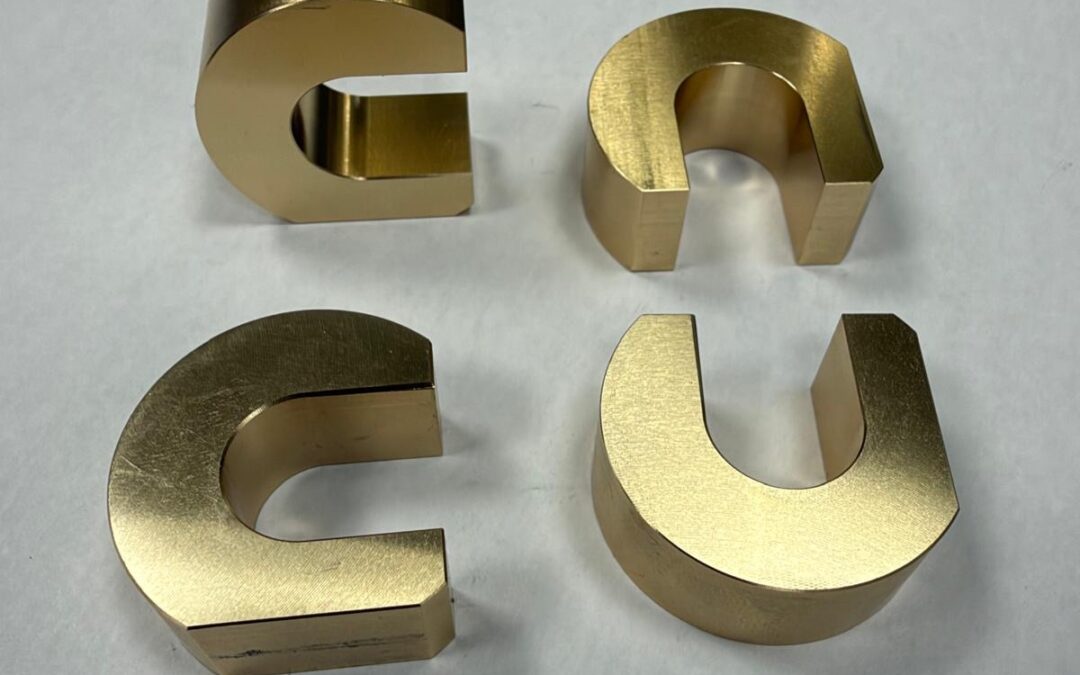
Each component has a substantial curved outer profile with an internal opening and a machined slot allowing it to locate around or connect with other parts of the tank system. There are no complicated pockets, extensive arrays of holes or multi-axis features. Yet the simplicity of the geometry should not be confused with the importance of the component.
These hooks will be used to suspend the anodes within electroforming tanks. At the same time, they provide part of the electrical path carrying current into those anodes.
Good electrical contact is a fundamental requirement within electrolytic processes. Anodes do not simply need to be physically positioned inside a tank; they also need a reliable electrical connection to the power system.
The Nickel Institute’s guidance on industrial nickel plating, for example, identifies conducting electrical current into the electrolyte as one of the principal functions of the anode and highlights the importance of maintaining good electrical contact with the anode bar.
So although these components may look simple, they effectively combine two jobs: mechanical support and electrical connection.
Why Manufacture the Hooks from Brass?
Brass is a natural material to encounter in this type of application because it combines several useful engineering characteristics.
It is a copper-based alloy and offers useful electrical conductivity alongside excellent machinability. That makes it suitable for many components where electrical performance and accurately machined geometry both matter.
The Copper Development Association describes conductivity and machinability among the key properties offered by brasses, with brass widely used in electrical and electronic applications as well as general engineered components.
From a machining perspective, brass is also capable of producing very clean features and good surface finishes. That can be seen clearly in these components. The curved internal and external surfaces have a clean machined appearance, while the straight slot faces and transition between the different sections create the final hook geometry.
The result is a robust component with relatively simple geometry, produced in a material specifically suited to its eventual function.
Mechanical Support Meets Electrical Conductivity
One of the interesting things about these parts is that their function cannot be considered purely mechanically.
If they were only required to hang something inside a tank, material choice could be approached principally around strength, weight and environmental conditions. These components also need to form part of an electrical circuit.
In an electroforming installation, current passes through the system to the anodes positioned within the electrolyte. The connection therefore needs to support the anode physically while maintaining dependable electrical contact. That means contact surfaces, material selection and the way the component interfaces with the surrounding equipment all become relevant.
This is a useful example of how understanding a component’s function matters when manufacturing it. A drawing provides the geometry and tolerances required to manufacture a part, but the eventual application often explains why those features and materials have been specified in the first place.
Machining the Hook Profile
The main geometry of each component consists of an almost circular body interrupted by an open slot.
That creates the characteristic hook or horseshoe form visible in the photograph. The internal profile needs to transition cleanly into the straight machined faces of the opening, while the external curved surface defines the overall size and shape of the component.
Although there are relatively few features, that does not remove the requirement for dimensional control. The width and position of the slot, internal profile, external profile and overall thickness all contribute to how the hook interfaces with the equipment around it.
For a component designed to carry an anode, the geometry also needs to allow the part to locate as intended rather than simply looking correct in isolation.
This is a recurring theme in precision engineering. Part complexity should not always be measured by the number of features on the drawing. A component with five important dimensions can be every bit as functionally significant as one containing fifty.
Consistency Across Repeated Components
The photograph shows four finished hooks together. This also highlights another important requirement in low-volume component manufacture: repeatability.
Each part needs to perform the same job and interface with the same surrounding equipment. Producing one good component is therefore only part of the requirement.
The profile, opening and overall form need to remain consistent across the batch. For a relatively simple component, visual comparison can make inconsistency particularly obvious. There is little complex geometry to disguise variation.
Producing clean, repeatable parts therefore depends on controlled machining, appropriate tooling and a manufacturing process capable of holding the required dimensions from one component to the next.
Why Electroless Nickel Plate the Brass?
Once machining is complete, these hooks will receive an electroless nickel coating.
Electroless nickel differs from conventional electroplating because the nickel coating is deposited through a controlled chemical reaction rather than by using an applied electrical current during the coating process.
One of the major advantages is the ability to produce a highly uniform coating, including across components with more complex shapes. Electroless nickel is also widely used where engineering components require characteristics including wear resistance and corrosion protection. That distinction is interesting in this particular application.
The hooks themselves will eventually form part of an electrically powered electroforming process, but their own nickel coating is being applied using an electroless process. In other words, electricity is central to what the hooks will eventually do, but it is not what deposits their nickel finish.
Machining Before Surface Treatment
Whenever a machined component is going on to receive an engineered coating, the finished condition needs to be considered before the component leaves the machine shop.
The drawing may define dimensions in relation to the final coated part, meaning the relationship between machining and subsequent processing needs to be understood.
Surface condition also matters. A coating follows the surfaces underneath it, so good component preparation begins with producing a suitable machined part. Electroless nickel is particularly useful where consistent coating thickness is required across different surfaces because the chemical deposition process can provide very uniform coverage.
For a hook containing curved and straight faces, internal and external surfaces, that uniformity is a useful characteristic of the process. The finished nickel-plated components will therefore look quite different from the brass parts shown here.
These photographs capture them at the point between two manufacturing stages: precision machining completed, surface treatment still to come.
Components That Support the Manufacturing Process
Another reason these parts make an interesting Inside the Part subject is that they are not components destined for a consumer product. They are components used to help manufacture other things.
Electroforming equipment is part of the manufacturing infrastructure behind specialist engineered products. The anode hooks form part of that infrastructure.
Their job is not particularly visible once the process is operating. They sit within or around the electroforming tank, supporting anodes and providing the required electrical connection. Yet without reliable supporting equipment, the process itself cannot operate as intended.
This type of component appears throughout industry. Fixtures, contacts, brackets, clamps, holders, tooling and process equipment rarely attract the same attention as the final products they help manufacture, but they remain essential parts of industrial production.
Brass Machining for Electrical Applications
These anode hooks also demonstrate why CNC machining covers a much wider range of work than highly complex aerospace-style components. Sometimes the customer’s requirement is a relatively simple, robust machined component produced accurately from the correct material.
In this case, brass provides the combination of properties required for a part that performs both a mechanical and electrical function. Its machinability allows the required profiles and contact features to be produced cleanly, while its electrical characteristics make it suitable for industrial components where current needs to pass through the material.
Brasses have long been used for electrical contacts, terminals and related components because they provide a practical combination of conductivity, strength and manufacturability.
The correct engineering solution does not always require greater complexity. Sometimes good engineering is about selecting the appropriate material and producing a straightforward design consistently and accurately.
From Brass Stock to Electroforming Tank
The manufacturing journey for these components is relatively easy to follow.
They begin as brass material. The required external and internal profiles are machined to create the distinctive open hook geometry. The components are inspected to ensure that the required dimensions and features meet the customer’s drawing. From Tarvin Precision, they will move on to the next stage of their manufacturing route: electroless nickel plating.
Once coated and incorporated into the customer’s equipment, their role changes from being machined brass parts to working components within an electroforming tank. There, they will support the anodes while helping conduct electrical current into them.
It is a good illustration of the wider supply chain behind industrial manufacturing and of how several specialist processes often contribute to even a seemingly simple component.
What Buyers Can Learn from a Part Like This
There are a few useful lessons in these brass anode hooks for engineering and procurement teams.
The first is that complexity should be judged by function as well as geometry. These parts contain relatively few machined features, but they have an important job within a specialist industrial process.
Second, material choice matters. The conductivity and machinability offered by brass help make it appropriate for a component that must perform both mechanical and electrical duties.
Third, subsequent processes need to be considered during manufacture. These components are not finished when the machining ends. Electroless nickel plating forms another stage in their production route, and machining needs to be carried out with the final finished component in mind.
Finally, repeatability remains important regardless of complexity. Whether a batch consists of intricate multi-axis aerospace components or comparatively simple industrial hooks, the customer still requires components that match the drawing and perform consistently.
Precision Engineering Isn’t Always Complicated
Our Inside the Part series often looks at components where the machining complexity is immediately obvious. This time, the interesting engineering lies somewhere else.
These brass anode hooks are simple, solid components with a very particular purpose: supporting anodes inside electroforming equipment while providing the electrical connection needed to conduct current into them. After machining, electroless nickel plating will complete the next stage of their manufacturing route before they enter service.
They are a useful reminder that precision engineering is not about making every component complicated. It is about making the right component, from the right material, to the right specification, for the job it needs to perform.
At Tarvin Precision, our low-volume, high-variety approach means that can range from large, feature-rich aluminium parts to straightforward brass components such as these.
If you have a requirement for precision machined brass parts, specialist industrial components or low-volume CNC machining, contact the Tarvin Precision team to discuss your project.