
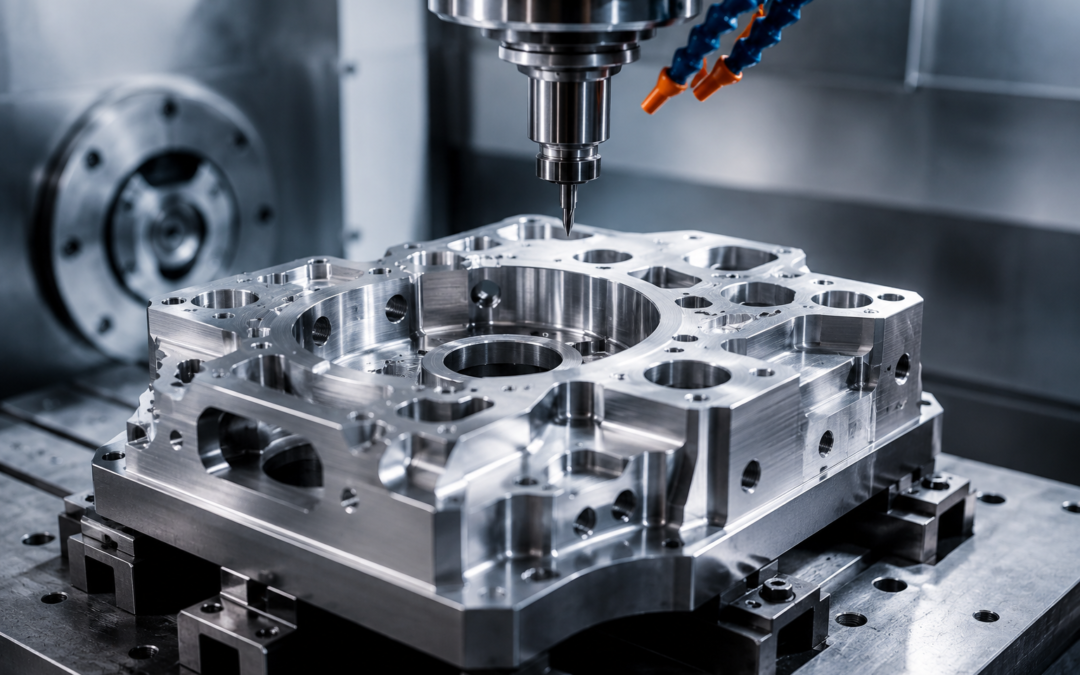
Aerospace CNC milling services play a vital role in producing accurate, reliable and traceable components for aircraft, defence, space, satellite, UAV and high-performance engineering applications. In aerospace manufacturing, machined parts are rarely judged on appearance or dimensional accuracy alone. They must also meet strict requirements for material control, inspection, documentation, repeatability and risk management.
For buyers, engineers and procurement teams, choosing the right CNC milling supplier is about more than finding available machine capacity. The supplier must be able to understand aerospace drawings, work with demanding materials, manage tolerances, support inspection requirements and maintain clear records throughout the manufacturing process.
This guide explains what to look for when sourcing aerospace CNC milling services, including materials, tolerances, AS9100 controls, inspection processes, finishing requirements and the practical information needed to obtain accurate quotations.
Aerospace CNC Milling Services for Precision Components
Aerospace CNC milling services are used to manufacture precision components where accuracy, strength, weight, consistency and traceability are all important. These parts may be used in structural assemblies, avionics systems, engine-adjacent applications, test equipment, ground support systems or specialist defence and space projects.
Unlike general subcontract machining, aerospace milling usually involves tighter control at every stage. Drawings must be reviewed carefully, material specifications need to be followed, and the finished component may require inspection reports, certificates of conformity and full batch traceability. A minor error in material selection, revision control or dimensional inspection can cause costly delays further down the supply chain. Typical CNC milled aerospace components include:
- Structural brackets and mounting plates
- Lightweight aluminium housings and covers
- Avionics enclosures and electronic cases
- Titanium fittings and high-strength parts
- Hydraulic and pneumatic manifolds
- Defence and satellite components
- Prototype and development parts
- Test rig and ground support components
The most effective suppliers combine machining capability with disciplined process control. This helps ensure parts are not only manufactured to drawing, but also supported by the correct evidence and documentation.
Why Aerospace Machining Services Require Specialist Control
Aerospace CNC milling services require a more controlled approach because the parts often operate in demanding environments and form part of larger safety-critical assemblies. Components may need to withstand vibration, temperature changes, pressure, corrosion, fatigue or repeated mechanical loading.
The level of control required depends on the component’s function and the customer’s specification. Some parts may be non-flight development items, while others may be used in certified aerospace systems. Even where a component is relatively simple, the documentation and traceability expectations can still be significant. Aerospace machining control often includes:
- Contract review before manufacture
- Drawing revision and specification checks
- Material certificate verification
- Controlled CNC programming and set-up
- In-process inspection
- Final dimensional inspection
- First article inspection where required
- Batch records and certificate management
This structured approach reduces the chance of errors passing unnoticed. It also gives customers confidence that the supplier understands both the technical and administrative expectations of aerospace manufacturing.
CNC Milling Materials Used in Aerospace Manufacturing
Material selection has a direct effect on component performance, machining strategy, cost and lead time. Aerospace CNC milling services commonly involve aluminium alloys, titanium, stainless steel, nickel alloys and engineering plastics, each with its own machining characteristics and inspection considerations.
Aluminium is often chosen for aerospace components because it offers a strong balance of low weight, strength and machinability. Titanium is selected for applications requiring high strength, corrosion resistance and low weight, but it is slower to machine and demands careful toolpath planning. Stainless steels and nickel alloys are used where heat resistance, wear resistance or corrosion performance are important. Common aerospace milling materials include:
- Aluminium alloys for lightweight brackets, housings and structures
- Titanium alloys for high-strength, low-weight fittings and critical parts
- Stainless steels for corrosion-resistant components and hardware
- Nickel alloys for high-temperature or demanding applications
- Engineering plastics for insulation, weight reduction and specialist uses
- Tooling boards and composites for development fixtures and patterns
A capable CNC milling supplier should understand how each material behaves during machining. Thin aluminium walls can distort, titanium can generate heat and accelerate tool wear, and stainless steel can work harden if feeds and speeds are not controlled properly.
Tolerances and Critical Features
Aerospace CNC milling tolerances are driven by the drawing, the assembly function and the inspection requirements. Not every feature needs to be extremely tight, but features that control fit, alignment, sealing, load transfer or movement often need close dimensional control.
A good supplier will identify critical-to-quality features during the quotation and planning stage. These may include bores, datums, bearing locations, sealing faces, hole positions, mounting surfaces or geometrically toleranced features. Understanding which dimensions matter most helps the supplier plan the correct machining sequence and inspection method. Typical tolerance considerations include:
- Positional tolerance on bolt patterns and interface holes
- Flatness and parallelism on mounting faces
- Bore size and roundness for pins, bushes or bearings
- Surface finish on sealing or sliding areas
- Profile tolerances on complex milled forms
- Datum relationships across multiple faces
- Repeatability across prototype and batch production
Over-tolerancing can increase cost and lead time without improving performance. Where possible, engineers and buyers should work with the machining supplier to confirm which features are genuinely critical and which can be produced to standard machining tolerances.
AS9100 Controls for Aerospace CNC Milling Services
AS9100 controls are important in aerospace CNC milling services because they help suppliers manage risk, traceability, documentation and product conformity. AS9100 builds on ISO 9001 and adds aerospace-specific requirements around product safety, configuration management, counterfeit part prevention, supplier control and risk-based thinking.
For customers, an AS9100-aligned supplier can provide greater confidence that manufacturing is carried out under a structured quality management system. However, certification or compliance is only valuable when it is applied properly in day-to-day production. The system must be visible in how drawings are reviewed, materials are purchased, parts are inspected and records are retained. AS9100-related controls may include:
- Contract review and feasibility checks
- Drawing issue and revision control
- Material traceability and certificate retention
- Approved supplier management
- Calibration control for inspection equipment
- Non-conformance reporting and corrective action
- First article inspection processes
- Clear release documentation
These controls are particularly important when components form part of regulated or safety-related supply chains. A part that is dimensionally correct but made from unverified material, or produced to an outdated drawing revision, can still create serious quality issues.
First Article Inspection for Aerospace Milled Parts
First article inspection is often required for aerospace milled parts when a component is manufactured for the first time, when a design changes or when a production process is altered. It provides documented evidence that the manufacturing process can produce a part that meets the drawing and specification requirements.
A first article inspection report typically records each drawing characteristic, the required value, the measured result and the conformity status. This helps identify any issues with programming, machining, fixturing, interpretation or inspection before a full batch is completed. First article inspection may be required when:
- A new component is produced for the first time
- A drawing revision has changed
- Production has moved to a new machine or supplier
- Tooling, fixtures or methods have changed
- Manufacturing resumes after a long break
- The customer requests AS9102-style reporting
For buyers, first article inspection provides an additional level of confidence before repeat production. For suppliers, it creates a formal checkpoint that reduces the risk of batch-wide errors.
5-Axis CNC Milling for Aerospace Components
5-axis CNC milling is particularly valuable for aerospace components with complex geometry, tight positional relationships or features that are difficult to access using conventional 3-axis machining. By allowing the cutting tool or workpiece to move through five axes, the machine can reach angled faces, deep pockets, sculpted surfaces and multiple sides of a component in fewer set-ups.
Reducing set-ups can improve accuracy because the part does not need to be repeatedly removed, re-clamped and re-datumed. This is especially useful for aerospace component machining UK suppliers where multiple features must relate accurately to one another across different faces. 5-axis aerospace CNC milling is useful for:
- Lightweight structural brackets
- Complex housings and enclosures
- Angled holes and interface faces
- Pocketed aerospace components
- Prototype parts with complex forms
- Components with tight datum relationships
- Reduced set-up machining strategies
However, 5-axis capability alone does not guarantee quality. The supplier also needs strong programming knowledge, suitable fixturing, toolpath simulation, collision avoidance and accurate inspection methods.
Aerospace Prototype CNC Milling and Development Work
Aerospace prototype CNC milling supports engineering teams during design validation, testing, fit checks and early-stage product development. Prototypes may be needed for ground testing, assembly trials, certification support, performance evaluation or customer approval before production begins.
Prototype work often requires flexibility because designs can change quickly. Drawings may be updated, materials may be reviewed and engineers may need feedback on manufacturability. A responsive machining supplier can help identify risks early and suggest practical improvements without compromising the component’s intended function. Prototype CNC milling can support:
- Design validation and functional testing
- Fit and assembly checks
- Test rig components
- Pre-production sample parts
- Engineering change evaluation
- Low-volume development batches
- Legacy component replacement
Where possible, using the same supplier for prototype and repeat production can reduce risk. The supplier gains knowledge of the part, the machining process, inspection requirements and any lessons learned during development.
Inspection and Quality Reporting for Aerospace CNC Milling
Inspection is a central part of aerospace CNC milling services. It should not be treated as a final activity carried out after machining is complete. Instead, inspection planning should begin during quotation and process review so that the supplier knows how each important feature will be verified. 
For complex components, coordinate measuring machines are often used to check dimensional accuracy, hole positions, profiles and geometric tolerances. Other inspection tools may include micrometers, bore gauges, thread gauges, surface roughness testers, height gauges and optical measurement equipment. Quality reporting may include:
- Dimensional inspection reports
- First article inspection reports
- Material certificates
- Certificates of conformity
- Surface finish measurements
- Thread and bore verification
- Batch traceability records
- Final release documentation
Clear inspection requirements help avoid misunderstandings. If a drawing includes geometric tolerancing, the supplier and customer should understand the datum scheme and agree how the feature will be measured.
Surface Finishing and Post-Processing for Aerospace Parts
Surface finishing can affect the performance, appearance and durability of aerospace machined parts. Depending on the material and application, a component may require anodising, hard anodising, chemical conversion coating, passivation, plating, painting, bead blasting, polishing or other post-processing operations.
Finishing requirements should be considered early because they can affect final dimensions, masking, conductivity, corrosion resistance and assembly fit. If a coating adds thickness, the drawing or purchase order should make clear whether dimensions apply before or after finishing. Common finishing considerations include:
- Anodising for aluminium corrosion resistance
- Hard anodising for wear and durability
- Chemical conversion coating for corrosion protection and conductivity
- Passivation for stainless steel components
- Bead blasting for controlled cosmetic appearance
- Deburring and edge breaking for safe handling
- Masking of threads, bores and contact faces
If finishing is subcontracted, the machining supplier should use controlled and approved external processors where required. Traceability should continue through finishing and final inspection.
Cost Drivers in Aerospace CNC Milling Services
The cost of aerospace CNC milling services depends on more than machine time. Material grade, complexity, batch size, tolerance requirements, inspection level, finishing, tooling and documentation all influence the final price.
A simple aluminium plate with generous tolerances will usually be far quicker and less expensive to manufacture than a complex titanium fitting requiring tight positional tolerances, specialist tooling, first article inspection and full traceability. Understanding these cost drivers when CNC machining aerospace parts helps buyers make informed decisions at the design and quotation stage. Common cost drivers include:
- Material type, grade and availability
- Component size and complexity
- Number of CNC milling operations
- 3-axis, 4-axis or 5-axis machining requirements
- Tight tolerances and geometric controls
- Thin walls or distortion risk
- Specialist tooling or fixtures
- Inspection and reporting requirements
- Finishing and external processing
Early supplier involvement can help control cost. Small design changes, such as increasing internal radii, simplifying datum access or reviewing unnecessary tight tolerances, may reduce machining time and improve repeatability.
How to Brief a Supplier for Aerospace CNC Milling Services
A clear enquiry pack helps the supplier quote accurately, assess risk and manufacture the component correctly. Missing information often leads to delays, assumptions or revised pricing once the full requirements become clear.
Buyers should provide both 2D drawings and 3D CAD models where available. The drawing should define tolerances, material, finishing, revision status and inspection requirements. The CAD model supports programming and geometry review, but the drawing remains essential for controlled manufacturing and inspection. A strong enquiry pack should include:
- 2D engineering drawing with revision status
- 3D CAD model in a suitable file format
- Material grade and specification
- Required quantity and target delivery date
- Surface finish or coating requirements
- Critical features or functional notes
- Inspection and certification requirements
- Packaging, labelling and traceability needs
The more complete the information, the easier it is for the supplier to provide a reliable quotation and identify any manufacturability concerns before production begins.
Choosing the Right Aerospace CNC Milling Partner
Choosing the right supplier for aerospace CNC milling services means assessing both machining capability and quality discipline. Modern CNC machines are important, but they must be supported by skilled programmers, experienced machinists, robust inspection processes and clear communication.
A strong supplier will not simply accept a drawing and machine the part without question. They will review the requirements, identify potential risks, clarify unclear details and support the customer with practical manufacturing advice. When selecting a supplier, consider:
- Experience with aerospace and high-precision components
- CNC milling capacity and multi-axis capability
- Ability to machine required materials
- Inspection equipment and reporting capability
- AS9100 or aerospace quality controls
- Material traceability and document control
- Communication and responsiveness
- Ability to support prototypes and repeat batches
The best supplier relationships are built on trust, transparency and technical understanding. This is especially important in aerospace, where quality, delivery and documentation all matter.
Aerospace CNC Milling Services Explored
Aerospace CNC milling services require a careful balance of precision machining, material knowledge, inspection capability and quality control. The finished component must meet the drawing, but the supplier must also provide confidence that the part has been manufactured through a controlled and repeatable process.
For engineers and procurement teams, the most successful projects begin with clear requirements and early supplier involvement. By discussing materials, tolerances, finishing, inspection and documentation before production starts, customers can reduce risk and improve delivery outcomes.
Whether the requirement is for prototypes, low-volume batches or repeat production, choosing an experienced CNC milling partner can make a significant difference. The right supplier will help produce accurate, traceable and reliable aerospace components that meet both technical and quality expectations.