
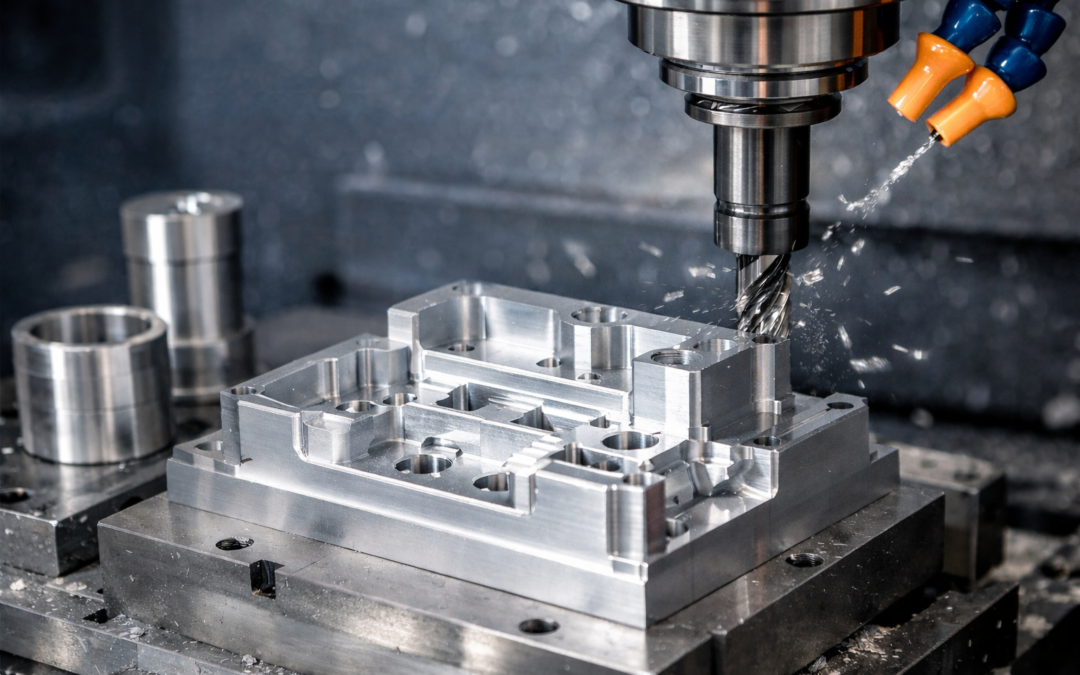
Aluminium CNC machining plays an important role across modern manufacturing because it combines precision, speed, repeatability and material efficiency in a way that suits a huge range of parts. From aerospace brackets and electronics housings to automotive components, medical parts and bespoke industrial assemblies, aluminium remains one of the most commonly machined engineering materials for good reason. It is lightweight, corrosion resistant, versatile and generally easier to machine than many steels or exotic alloys, making it a practical choice when high-quality results and efficient production both matter.
This guide explains what aluminium CNC machining is, why aluminium is so widely used, which grades are commonly selected, and what design and production considerations make the biggest difference to finished part quality. It also looks at how surface finish, tolerances, tooling, coolant strategy and inspection all affect outcomes. For design engineers, buyers and anyone sourcing precision machined parts, understanding these factors can make it much easier to achieve reliable, cost-effective production.
What is Aluminium CNC Machining?
Aluminium CNC machining is the process of using computer numerical control equipment to cut, drill, bore, tap, mill or turn aluminium into a finished component. CNC technology allows machine tools to follow programmed instructions with a high degree of consistency, which is why it is so valuable for both prototype development and repeat production. Whether the requirement is for simple plates with accurately positioned holes or more complex multi-face components with fine tolerances, CNC machining offers a dependable route to achieving the desired specification.
Because aluminium is relatively light and machinable, it is often chosen for components that need a good balance between strength, weight and manufacturability. It also suits a broad range of machining operations, which gives engineers flexibility when designing parts. In many industries, aluminium CNC machining is not only a practical manufacturing method but also one of the most commercially sensible ones. Some of the most common CNC operations used on aluminium include:
- CNC milling for pockets, faces, slots and complex geometries
- CNC turning for shafts, rings, bushes and cylindrical parts
- Drilling and tapping for threaded features and assembly points
- Reaming and boring for tighter hole tolerances
- Engraving or marking for traceability and identification
Why Aluminium is Widely Used in CNC Machining
One of the main reasons aluminium CNC machining is so popular is that the material offers an excellent combination of properties. Aluminium is much lighter than steel, has good corrosion resistance, and can provide very good strength depending on the grade selected. It also responds well to machining, allowing manufacturers to achieve clean finishes and accurate features at efficient cycle times.
This makes aluminium especially useful when low mass is important, such as in aerospace, motorsport, electronics and portable equipment. At the same time, aluminium machined parts can also be highly suitable for general industrial use where productivity, dimensional stability and good cosmetic appearance are important. In practical terms, it is often easier to machine than tougher materials, which can help reduce tool wear and keep costs under control. Key benefits of aluminium for CNC machining include:
- High machinability compared with many other engineering metals
- Good strength-to-weight ratio
- Natural corrosion resistance
- Suitability for anodising and other surface finishes
- Good thermal and electrical conductivity
- Availability in a wide range of grades and stock forms
Benefits of Aluminium for Precision Components
The benefits of aluminium CNC machining go beyond simple ease of cutting. In precision engineering, the material can support excellent repeatability when the right process controls are in place. It is capable of holding tight tolerances, producing complex machined features and achieving attractive surface finishes, all while remaining efficient to process.
For many customers, the appeal lies in the balance between quality and practicality. Aluminium parts can often be machined faster than equivalent steel parts, which may help reduce lead times and improve production efficiency. This can be especially valuable in prototype work, low-to-medium batch production, and ongoing repeat supply where consistency matters as much as speed. Other practical advantages include:
- Faster machining cycles in many applications
- Lower component weight for assembled products
- Cleaner cutting in many milling and drilling operations
- Good compatibility with precision inspection requirements
- Strong potential for both one-off and batch production work
Common Aluminium Grades Used in CNC Machining
Choosing the right material grade is a key part of any aluminium CNC machining project. Although “aluminium” is often discussed as if it were a single material, different grades behave differently in machining and in service. Some offer higher strength, some better corrosion resistance, and some are especially well suited to precision machining.
For example, 6082 is widely used in engineering applications thanks to its strength and general machinability. 6061 is also popular for machined components and structural uses. 7075 may be selected where higher strength is required, while 5083 tooling plate can be chosen where corrosion resistance is particularly important, although it behaves differently in machining compared with free-machining grades. Frequently used aluminium grades include:
- 6082 aluminium for general engineering and structural components
- 6061 aluminium for versatile machined parts across multiple sectors
- 7075 aluminium for high-strength applications
- 5083 aluminium for corrosion resistance and plate-based applications
- 2011 aluminium where very high machinability is needed
The right choice depends on the application, drawing requirements, finish, environment and budget. In a precision machining environment, material selection is never just about strength on paper. It is also about how predictably the material machines, how stable it remains during processing, and how suitable it is for finishing and final use.
Aluminium CNC Milling and Turning Processes Explained
Aluminium CNC machining normally includes a combination of milling and turning, depending on the shape of the part. CNC milling is used for prismatic and multi-face components, where features such as pockets, holes, slots, contours and flat surfaces need to be created. CNC turning is used for rotational parts, such as spacers, sleeves, adaptors and shafts.
Both processes can produce high-quality results in aluminium, but the best approach depends on part geometry, tolerance requirements and batch size. In many cases, a part may even require both turning and milling operations to complete it efficiently. This is one reason why planning the route from raw material to finished part is so important in precision engineering. Typical milling and turning considerations include:
- Workholding stability to reduce vibration and movement
- Toolpath strategy for efficient material removal
- Cutter selection for surface finish and feature accuracy
- Chip evacuation to avoid recutting and marking
- Machine capability for multi-axis or high-speed operations
When handled well, aluminium can machine very cleanly. However, it is not a material that should be treated casually. Built-up edge, poor chip control and distortion can still cause problems if tooling, feeds, speeds and clamping are not properly considered.
Designing Parts for Aluminium Machining
Good design has a major influence on the success of aluminium CNC machining. Even high-quality machines and experienced machinists can only work within the logic of the part design. Features that are difficult to access, unnecessarily tight tolerances, deep narrow pockets or overly small internal radii can all increase production time and cost without adding real functional value. 
Designing with manufacturability in mind usually produces better results. The aim is not to oversimplify a part but to make sure the geometry works with the machining process rather than against it. That can mean choosing standard hole sizes, allowing sensible corner radii, reducing excessive depth-to-width ratios, and avoiding specifications that are tighter than the fit or function actually requires. Helpful design principles include:
- Use realistic tolerances based on function
- Avoid deep, narrow pockets where possible
- Specify sensible internal radii for cutter access
- Keep wall sections robust enough to reduce chatter or distortion
- Match threads and hole sizes to standard tooling where possible
- Consider how the part will be clamped and referenced during machining
This design awareness is especially useful during early-stage development. A small drawing change can sometimes significantly improve machining efficiency and repeatability. That is one reason companies like Tarvin Precision often bring practical manufacturability thinking into discussions around new parts, not as a sales point, but because it tends to lead to better engineering outcomes.
Tolerances and Quality
Precision is often one of the main reasons customers choose CNC machining, but tolerance control is about much more than machine accuracy alone. Aluminium CNC machining quality depends on the whole process, including material condition, workholding, tooling condition, machine stability, programming, inspection and operator experience.
Aluminium can hold tight tolerances very well, but not every feature should automatically be toleranced to the same level. Critical dimensions should be clearly identified so the machining and inspection process can be matched to what matters most. On some parts, flatness or positional accuracy may be more important than linear size. On others, thread quality or bore finish may be the defining characteristic. Quality control measures may include:
- First-off inspection before batch production
- In-process checks on critical dimensions
- Final inspection using calibrated measuring equipment
- Surface finish verification where required
- Traceability of material and production records
This structured approach is especially important in sectors where compliance and repeatability are central. For example, in aerospace and other high-specification industries, aluminium CNC machining is often expected to meet not only dimensional requirements but also documentation, traceability and process discipline standards.
Surface Finishes for Machined Aluminium Parts
Surface finish can be a major part of the final specification for aluminium CNC machining. In some cases, the as-machined finish is entirely suitable. In others, the component may need deburring, bead blasting, anodising, powder coating, alochroming or another secondary process depending on appearance, corrosion resistance or functional requirements.
Aluminium is particularly well suited to anodising, which is one reason it is so widely used in visible and technical components alike. The final surface requirement should be considered early in the project, because it can affect how the part is machined. Sharp edges may need to be broken, cosmetic surfaces may need protective handling, and dimensional allowances may need to be considered when coatings are applied. Common finish options for aluminium parts include:
- As-machined finish
- Deburred and edge-broken finish
- Bead blasted appearance
- Clear or coloured anodising
- Chemical conversion coating
- Powder coating or painting where appropriate
The required finish also influences cost and lead time, so it is best treated as part of the core specification rather than an afterthought. A well-machined aluminium part with the right finish can perform well technically while also presenting a clean, professional appearance.
Applications Across Industries
Aluminium CNC machining is used across a wide range of industries because the material and process combination is so adaptable. In aerospace, aluminium is valued for low weight and good mechanical performance. In electronics, it is often used for housings, heat sinks and structural frames. In automotive and motorsport settings, it supports lightweight performance-focused design. In industrial equipment, it offers a practical option for brackets, manifolds, covers and tooling components.
This range of applications shows that aluminium is not limited to one type of part or sector. It can support highly technical requirements or more general engineering needs, depending on the grade, process and specification involved. Typical application areas include:
- Aerospace components and assemblies
- Automotive and motorsport parts
- Electronics enclosures and thermal management parts
- Medical and laboratory equipment components
- Industrial automation parts and fixtures
- Jigs, tooling plates and bespoke manufacturing aids
For businesses sourcing machined components, this versatility makes aluminium a dependable choice. It can support both functional performance and efficient manufacture, which is why it remains so widely specified.
Cost Factors in Aluminium CNC Machining
Cost is always an important consideration, and aluminium CNC machining is often seen as a cost-effective precision process. However, cost depends on much more than material price alone. Part complexity, tolerance demands, surface finish, setup time, batch size, and inspection requirements all influence the final quotation.
A simple aluminium part may be quick and economical to machine, but complexity can change that significantly. Multi-sided components with tight tolerances and cosmetic finish requirements take more time and planning than basic plate work. Likewise, prototypes may carry a different cost structure from repeat production because setup and programming time are spread differently. The main cost drivers usually include:
- Aluminium grade and stock size
- Part geometry and machining time
- Number of operations and setups
- Tolerance and inspection requirements
- Surface finishing or post-processing
- Batch quantity and repeat production frequency
Understanding these cost drivers helps buyers make more informed decisions. Sometimes the most economical route is not the simplest-looking one, but the route that best balances machining efficiency, inspection practicality and material utilisation.
Choosing a Supplier for Aluminium CNC Machining
Selecting the right machining partner is about more than finding a company that can physically cut aluminium. The real difference often lies in process discipline, consistency, communication and the ability to understand what the part needs from both an engineering and production point of view. This matters whether the requirement is for a few prototype parts or an ongoing supply of production components.
A good supplier should be able to review drawings sensibly, identify any obvious manufacturability concerns, and produce parts consistently to the agreed specification. In many cases, the strongest suppliers are those who combine technical capability with a practical approach to planning and quality. That is often where an aluminium milling service from companies such as Tarvin Precision adds value quietly, by focusing on process control, clear communication and repeatable standards rather than making exaggerated claims. When assessing a supplier, it helps to look at:
- Experience with aluminium machining and relevant grades
- Range of machining capability and capacity
- Quality systems and inspection processes
- Willingness to review manufacturability issues early
- Ability to handle both prototypes and repeat batches
- Communication, documentation and delivery reliability
Aluminium CNC Machining Solutions
Aluminium CNC machining remains one of the most useful and versatile manufacturing solutions for precision components. It offers an excellent combination of low weight, good machinability, corrosion resistance and design flexibility, which explains why it is used across so many sectors. When the right grade is selected and the machining strategy is properly planned, aluminium can deliver highly accurate, repeatable and cost-effective results.
For engineers and buyers, the key is to think about the full picture. Material grade, design details, tolerances, finish and supplier capability all influence the success of a project. Aluminium may be a familiar material, but achieving the best results still depends on sound engineering judgement and careful process control.
Whether the requirement is for prototype parts, machined tooling, structural components or ongoing batch production, aluminium CNC machining continues to be a highly practical option. With the right design decisions and the right manufacturing approach, it can support both performance and efficiency exceptionally well.