
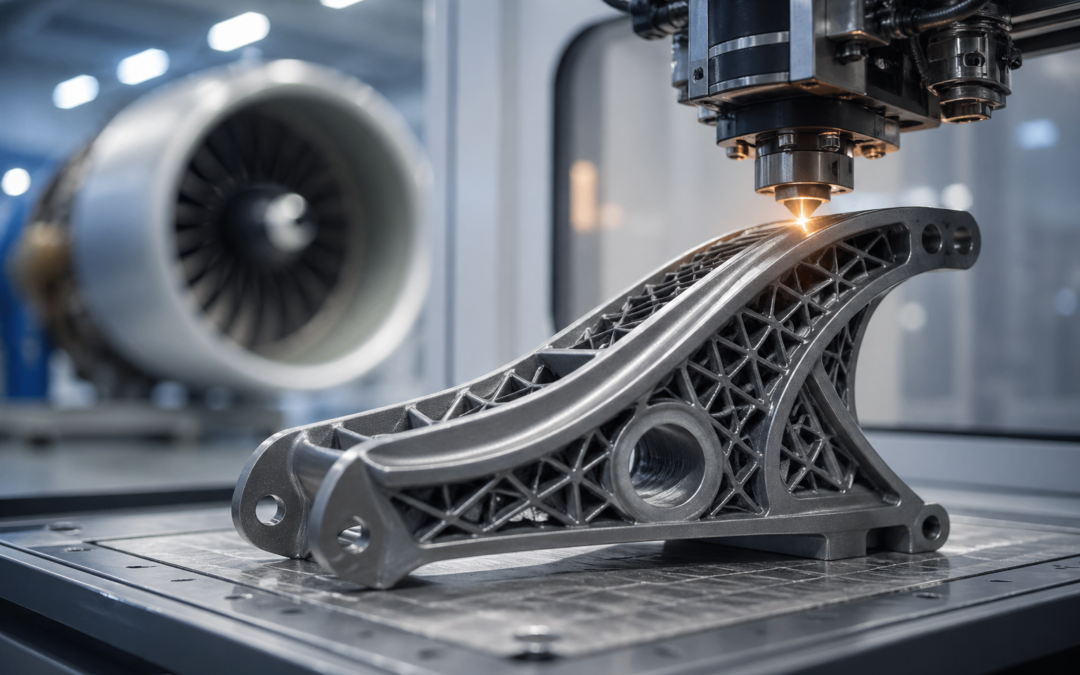
Aerospace additive manufacturing has moved from a niche prototyping method to a serious production and development technology across the wider aerospace sector. From lightweight brackets and ducting to fuel system components, tooling, and cabin parts, manufacturers are using additive processes to solve design and supply chain problems that conventional methods can struggle to address. For aerospace companies, the appeal is clear: reduce weight, consolidate parts, shorten lead times, and unlock geometries that would be difficult or impossible to machine in the traditional way.
At the same time, additive manufacturing for aerospace is not a simple replacement for subtractive manufacturing, casting, or fabrication. It works best when it is chosen for the right reasons and integrated into a wider engineering and quality strategy. Aerospace organisations still need to think carefully about materials, certification, repeatability, post-processing, inspection, and how printed parts will perform in service. In practice, the most successful projects are usually those where design, production, quality, and application requirements are considered together from the start.
This guide explains how aerospace additive manufacturing works, why it matters, where it delivers the most value, and what buyers, engineers, and manufacturers should understand before choosing it for an application.
What Is Aerospace Additive Manufacturing?
Aerospace additive manufacturing refers to the use of layer-by-layer manufacturing technologies to create parts for aerospace applications. Instead of removing material from a billet or block, additive manufacturing builds the part gradually from powder, wire, resin, or filament based on a digital 3D model. In aerospace, that process is used for both polymer and metal components, depending on the function of the finished part.
The key reason additive manufacturing has attracted so much attention is that it changes the design conversation. Looking beyond CNC machining aerospace parts, engineers are no longer limited to shapes that are easiest to machine, cast, or fabricate. They can begin exploring organic forms, internal channels, lattice structures, and part consolidation opportunities that reduce assembly complexity while still meeting performance requirements.
That does not mean every aerospace part should be printed. Aerospace additive manufacturing is strongest when geometry complexity, weight reduction, low-volume production, or lead-time pressure make traditional methods less efficient. Some common aerospace additive manufacturing applications include:
- Lightweight structural brackets
- Air ducting and fluid management components
- Cabin interior parts
- Tooling, jigs, and fixtures
- Prototype and pre-production development parts
- Heat exchangers and thermally optimised components
- Spare parts for legacy or low-volume programmes
Why Additive Manufacturing Is Growing
The growth of aerospace additive manufacturing is closely tied to wider industry pressures. Aerospace manufacturers are expected to improve efficiency, reduce emissions, manage cost, and maintain high standards of safety and quality. Additive manufacturing supports these goals in several ways, especially where performance improvements can justify the development and validation effort.
One of the biggest drivers is weight reduction. In aerospace, even small weight savings can have a meaningful cumulative effect on fuel efficiency, payload, and operating cost. Additive design methods allow engineers to remove unnecessary mass without automatically compromising strength. This makes the technology attractive for both commercial aerospace and defence applications.
Another important driver is supply chain resilience. When long lead times affect castings, forgings, or specialist tooling, aerospace additive manufacturing can offer a different route to supply. It can also support more agile product development, especially where design iterations are frequent or production volumes are relatively low. The main reasons aerospace companies are investing in aerospace additive manufacturing include:
- Lightweighting for improved efficiency
- Part consolidation to reduce assembly steps
- Faster prototyping and development cycles
- Better use of material in selected applications
- Reduced dependency on dedicated tooling
- Support for low-volume and high-mix production
- Potential improvements in aftermarket spare parts availability
Key Processes
There is no single aerospace additive manufacturing process that suits every application. Different technologies are used depending on the material, the required mechanical properties, the surface finish, the geometry, and the final use of the component. Understanding the main process families helps buyers and engineers make better decisions early in a project.
For metal aerospace additive manufacturing, powder bed fusion is one of the most widely recognised approaches. It uses a heat source such as a laser or electron beam to fuse layers of metal powder and create highly detailed parts. Directed energy deposition is another important route, often used for larger features, repairs, or near-net-shape applications. For polymer components, various processes such as selective laser sintering and fused filament-based methods may be used depending on performance requirements.
Each process offers a different balance of accuracy, cost, material compatibility, speed, and post-processing needs. Common aerospace additive manufacturing process types include:
- Laser powder bed fusion for detailed metal parts
- Electron beam melting for certain high-performance metal applications
- Directed energy deposition for larger builds or repair work
- Selective laser sintering for polymer components
- Stereolithography for highly detailed prototypes and tooling
- Material extrusion for fixtures, mock-ups, and selected non-flight applications
Aerospace Additive Manufacturing Materials
Materials are central to the success of aerospace additive manufacturing. The process itself is only one part of the equation. The printed part also needs to meet the thermal, mechanical, corrosion, fatigue, and environmental requirements of the intended aerospace application. That is why material selection in aerospace is never just about what can be printed. It is about what can be printed, finished, inspected, and trusted in service.
For metal aerospace additive manufacturing, titanium alloys are especially important because of their strength-to-weight ratio and corrosion resistance. Aluminium alloys are also valuable where lightweight performance is critical, while nickel-based superalloys may be chosen for high-temperature environments. Stainless steels and cobalt-chrome alloys can also appear in certain specialist applications. On the polymer side, high-performance engineering materials are used where suitable flame, smoke, toxicity, and mechanical performance are needed.
Material selection should always consider the full process chain, not just the print stage. Typical materials used in aerospace additive manufacturing include:
- Titanium alloys for high strength and low weight
- Aluminium alloys for lightweight applications
- Nickel superalloys for heat-resistant parts
- Stainless steels for corrosion resistance and robustness
- Cobalt-chrome for specialist wear and temperature performance
- High-performance aerospace polymers for non-metal applications
Design for Aerospace Additive Manufacturing
Design for aerospace additive manufacturing is one of the biggest opportunities and also one of the biggest learning curves. Companies often fail to see the full value of additive because they begin by trying to print a part that was originally designed for machining or casting. While that can sometimes work, it rarely captures the real benefits of the technology.
A better approach is to design specifically for the process. That means thinking about internal features, support strategies, wall thicknesses, stress paths, build orientation, thermal distortion, and post-processing access from the beginning. Good design for aerospace additive manufacturing is not just about making the part printable. It is about making it manufacturable, inspectable, and repeatable within a controlled aerospace environment.
When engineers design properly for additive, they can often reduce part count, eliminate fasteners, simplify assemblies, and improve flow or thermal behaviour. Important design considerations for aerospace additive manufacturing include:
- Part consolidation opportunities
- Build orientation and support requirements
- Residual stress and distortion control
- Wall thickness and feature resolution
- Access for finishing and inspection
- Surface finish requirements
- Machining allowances for critical features
- Fatigue performance in service
Benefits for Aerospace
The benefits of aerospace additive manufacturing can be significant when the process is matched to the right application. One of the most obvious benefits is design freedom. Engineers can create complex geometries that reduce weight, improve airflow, manage heat, or combine several components into one printed part. This design flexibility can directly support better system performance.
Another major benefit is speed during development. Aerospace programmes often involve expensive iterations, long approval cycles, and highly specialised components. Additive manufacturing can reduce the delay between design changes and physical evaluation, helping teams move faster through prototype and early production stages. It can also reduce reliance on dedicated tooling, which is especially useful for lower-volume projects.
That said, the strongest case for aerospace additive manufacturing usually comes from a mix of benefits rather than one alone. The main benefits of aerospace additive manufacturing are:
- Reduced weight through optimised geometry
- Greater design freedom
- Fewer components and simpler assemblies
- Faster prototyping and product development
- Reduced tooling needs
- Better suitability for low-volume production
- Potential inventory reduction through digital part storage
- More responsive aftermarket support for selected parts
Challenges in Aerospace Additive Manufacturing
Despite the promise of aerospace additive manufacturing, it also brings challenges that cannot be ignored. Aerospace is a high-consequence industry, so every manufacturing route must demonstrate repeatability, traceability, and confidence in final part performance. Additive manufacturing introduces variables that need to be carefully controlled, including powder quality, machine calibration, build conditions, thermal history, and post-processing parameters.
Surface finish can also be a limitation, especially where highly critical sealing faces, tight tolerances, or fatigue-sensitive surfaces are involved. In many cases, additive parts still require machining, heat treatment, hot isostatic pressing, inspection, and finishing before they are ready for use. That means aerospace additive manufacturing should be thought of as part of a manufacturing chain rather than a one-step solution.
Cost is another challenge. While additive can reduce tooling and deliver value in complex or low-volume parts, it is not automatically cheaper than conventional production. Common aerospace additive manufacturing challenges include:
- Qualification and certification demands
- Process repeatability and consistency
- Surface finish limitations
- Residual stress and distortion risk
- Post-processing requirements
- Material and machine cost
- Inspection complexity for internal features
- The need for specialist design knowledge
Additive Manufacturing vs Traditional Manufacturing
Aerospace additive manufacturing is often discussed as though it will replace conventional machining, fabrication, and casting, but in reality the two approaches are highly complementary. Traditional aerospace parts machining remains extremely effective for many aerospace components, especially where tolerances are tight, materials are well established, and production volumes justify conventional routes.
Additive manufacturing becomes more attractive when the component is complex, low-volume, lightweight, or difficult to make efficiently with other methods. Even then, a printed part may still need conventional machining for datum features, holes, sealing faces, and critical interfaces. In many aerospace projects, the best outcome comes from combining additive and subtractive processes rather than choosing one over the other.
That is why engineering teams should compare manufacturing methods based on application fit rather than trend or novelty. Aerospace additive manufacturing is often best suited to:
- Complex parts with internal features
- Lightweight design opportunities
- Low-volume specialist components
- Rapid development programmes
- Tooling and fixturing
- Parts where assembly reduction adds value
Traditional manufacturing is often best suited to:
- Simple high-volume parts
- Very tight tolerance features
- Excellent surface finish requirements
- Established repeat production routes
- Applications where material cost efficiency is critical
- Components that do not benefit from additive geometry freedom
Quality, Inspection and Certification
Quality is one of the most important topics in aerospace additive manufacturing. Aerospace parts cannot rely on appearance alone, and printed components need robust verification throughout the process. That includes control of incoming material, machine parameters, build records, heat treatment, finishing operations, dimensional inspection, and where necessary, non-destructive testing. 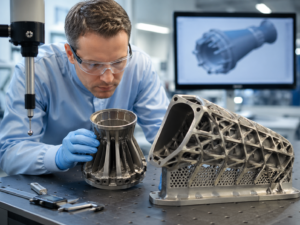
Traceability is especially important. Aerospace customers need confidence that the process used to manufacture a part is documented, repeatable, and suitable for the intended application. That means process control and documentation are just as important as printing capability. In many cases, qualification efforts can be substantial, particularly for flight-critical or structurally demanding parts.
Inspection methods may also need to adapt. Internal channels and lattice structures can create measurement challenges that are less common in conventional manufacturing. Key quality considerations for aerospace additive manufacturing include:
- Material traceability
- Process parameter control
- Machine calibration and maintenance
- Build documentation and route control
- Heat treatment and post-processing validation
- Dimensional verification
- Non-destructive testing where required
- Application-specific qualification and approval
Applications in Practice
The most successful aerospace additive manufacturing applications are usually those where the technology solves a specific engineering or supply problem. For example, a lightweight bracket may justify additive because topology optimisation reduces mass and eliminates several machined and assembled parts. A complex duct may benefit because it includes curved internal passages that are difficult to produce conventionally. Tooling may be printed because lead time matters more than unit price.
Cabin interiors have also been an important area, particularly where customisation, low-volume variation, and reduced weight are valuable. Maintenance and aftermarket use cases are also growing, especially for legacy programmes where original tooling is unavailable or uneconomic to recreate. The important point is that aerospace additive manufacturing works best when applied selectively and intelligently. Examples of practical aerospace additive manufacturing use cases include:
- Cabin brackets and interior fittings
- Environmental control system ducting
- Lightweight mounting structures
- Engine-adjacent components in suitable materials
- Tooling, inspection aids, and assembly fixtures
- Prototype functional test parts
- Replacement parts for older low-volume platforms
- Thermally optimised components such as heat exchangers
How to Decide Whether Additive Manufacturing Is Right for a Part
Choosing aerospace additive manufacturing should be a technical and commercial decision, not just a design preference. A good first question is whether the part genuinely benefits from additive geometry freedom. If the answer is no, conventional manufacturing may still be the better route. If the answer is yes, the next questions should look at material suitability, required certification level, expected production volume, finishing requirements, and total process cost.
It is also important to assess whether the part can be inspected properly and whether the additive process will create downstream challenges that outweigh the benefits. In aerospace, success usually depends on looking beyond the print itself and judging the full part lifecycle. A practical evaluation framework helps avoid costly missteps. Questions to ask an AS9100 machining shop for aerospace before choosing additive manufacturing include:
- Does the geometry benefit from additive design freedom?
- Can weight be reduced meaningfully?
- Can multiple parts be consolidated into one?
- Is the production volume suitable for additive?
- Are the required materials available and proven?
- What post-processing will be needed?
- How will the part be inspected and validated?
- Does the total cost make sense compared with conventional routes?
The Future of Additive for Aerospace
The future of aerospace additive manufacturing looks strong, but it will likely grow through focused industrial adoption rather than hype alone. The industry is becoming more disciplined in where and why it uses additive. That is a positive sign. Instead of treating it as a universal solution, aerospace companies are building it into targeted workflows where it clearly improves performance, responsiveness, or manufacturability.
As machines, software, process controls, and material data continue to improve, aerospace additive manufacturing should become more reliable and more widely accepted across a broader range of applications. At the same time, conventional machining, fabrication, and finishing will remain essential partners in the process chain. The future is not additive instead of traditional manufacturing. It is additive working alongside other advanced manufacturing methods in a more integrated way. For aerospace engineers, procurement teams, and manufacturers, that makes now a good time to understand where additive truly adds value and where it does not.
Understanding the Real Value of Additive for Aerospace
Aerospace additive manufacturing is best understood as a powerful engineering tool rather than a catch-all manufacturing replacement. It offers real advantages in design freedom, lightweighting, part consolidation, agility, and selected supply chain scenarios. It can help aerospace businesses create parts that are more efficient, more innovative, and sometimes faster to deliver.
However, the real-world success of aerospace additive manufacturing depends on choosing the right applications, using the right materials, controlling the process carefully, and planning for inspection and post-processing from the outset. In aerospace, performance and repeatability matter just as much as innovation.
For companies exploring new product development, looking to improve complex components, or assessing manufacturing options for specialist low-volume parts, aerospace additive manufacturing deserves serious consideration. When applied correctly, it can be an important part of a modern aerospace manufacturing strategy.