
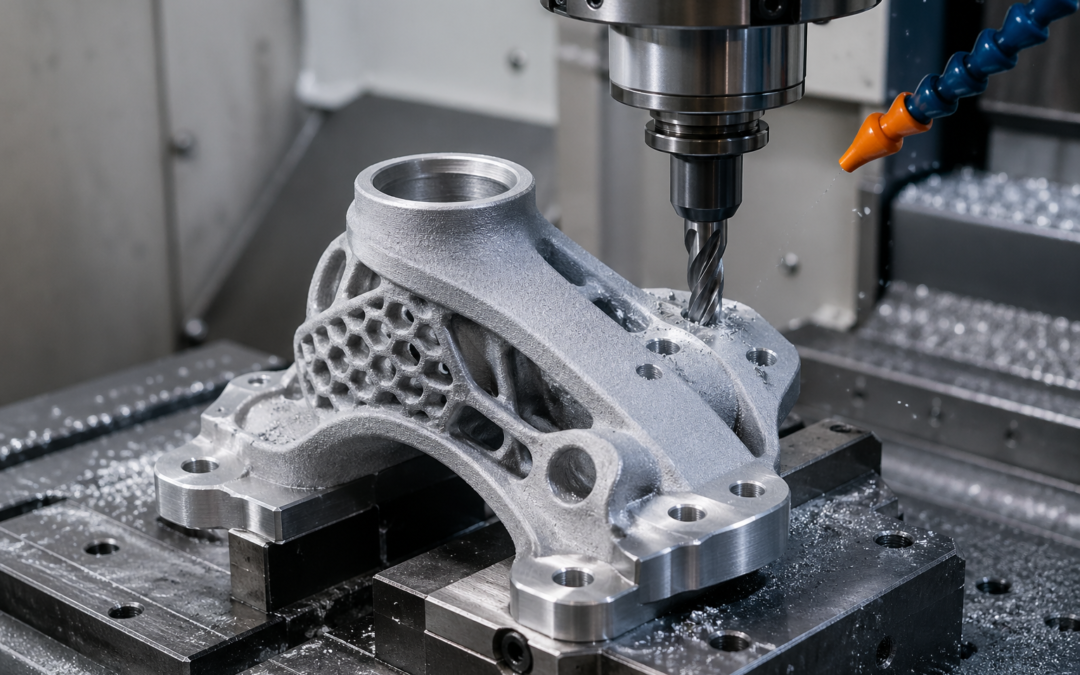
Manufacturers are increasingly combining additive and subtractive processes to get the best of both worlds. While 3D printing makes it possible to produce complex shapes quickly and with less material waste, machining adds the precision, surface finish, and tight tolerances that many end-use parts still require. That is why machining 3D printed parts has become such an important topic for engineers, buyers, and production teams.
In many applications, a printed part is not truly finished when it comes off the printer. It may still need critical holes opened up, sealing faces refined, mating surfaces flattened, threads improved, or cosmetic surfaces brought to a higher standard. By introducing machining at the right point in the process, companies can turn rough additive builds into reliable production-ready components.
This guide explains how machining 3d printed parts works, when it makes sense, what materials behave best, and what engineers should consider when designing for a hybrid manufacturing route. Whether you are working with polymer or metal additive components, the same broad principle applies: print for complexity, machine for precision.
Why Machining 3D Printed Parts Is Often Necessary
3D printing has transformed what is possible in product development and low-volume manufacturing, but it does not eliminate every limitation. Printed parts often have layer lines, support marks, variable tolerances, and surfaces that are not suitable for final assembly or functional use. This is where machining 3d printed parts becomes valuable.
A printed component may be near-net shape, but not at final specification. Machining provides a controlled way to remove small amounts of material and bring important features into tolerance. This is especially useful when a part includes bearing fits, threaded holes, critical bores, datum surfaces, or sealing areas. The reasons companies machine printed parts commonly include:
- Improving dimensional accuracy
- Achieving tighter tolerances on key features
- Producing smoother surface finishes
- Refining holes, threads, and precision bores
- Creating flat faces for sealing or assembly
- Removing distortion or inconsistencies from printing
- Making prototype parts closer to final production intent
In practice, machining is not replacing additive manufacturing. It is complementing it. A hybrid workflow often gives a better result than relying on either process alone.
Benefits for Functional Components
When people think about additive manufacturing, they often focus on design freedom. That is important, but real-world components also need to perform reliably in service. The main advantage of machining 3d printed parts is that it bridges the gap between an innovative geometry and a usable engineering component.
For rapid prototyping companies, machining helps teams test fit, function, and assembly conditions more accurately. For end-use parts, it helps achieve the consistency required in demanding sectors such as aerospace, scientific equipment, automation, medical devices, and specialist industrial machinery. Some of the biggest benefits include:
- Better repeatability from part to part
- Improved compatibility with mating components
- Higher confidence in assembly performance
- Reduced need to redesign parts around loose print tolerances
- More professional appearance on visible surfaces
- Greater ability to combine complex geometry with precision interfaces
This is particularly useful when additive manufacturing is used to create lightweight internal structures or organic shapes, while machined areas provide the precise connection points that make the part practical to use.
Machining 3D Printed Metal Parts Versus Polymer Parts
Not all printed materials behave in the same way, and the approach to machining 3d printed parts depends heavily on whether the part is metal or polymer. Each category presents different opportunities and challenges.
Metal 3D printed parts, such as those made by DMLS or SLM, are often machined after printing to refine high-accuracy features. The printed form can be excellent for complex internal channels, lattice structures, and part consolidation, but surfaces and tolerances may still need finishing. CNC machining is often used on critical areas after heat treatment or stress relief.
Polymer 3D printed parts can also be machined, especially when made from stronger engineering plastics. However, materials used for machined plastic parts may be more sensitive to heat, vibration, and clamping pressure. In some cases, the printed structure can be less dense or more anisotropic than a traditionally machined plastic billet. Key differences usually include:
- Metal printed parts typically allow more aggressive finishing on critical features
- Polymer printed parts often require lighter cuts and careful heat control
- Metal parts may need machining after stress-relief processes
- Plastic parts may need extra support during workholding
- Surface fragility can vary significantly depending on print method and material
The material, print orientation, infill or density, and required end use all shape the machining strategy.
Design Considerations for 3D Printed Part Machining
Good results start before the part is ever printed. Designing with machining 3d printed parts in mind makes finishing easier, more reliable, and more cost effective. If a part is likely to need post-processing, that should be built into the design from the start. 
Engineers sometimes treat machining as an afterthought, but this can create problems. A part may be printed with insufficient stock on critical areas, awkward access for cutting tools, or fragile features that make clamping difficult. By planning a hybrid route early, designers can avoid unnecessary complexity. Important design considerations include:
- Add machining allowance on critical surfaces
- Ensure tool access to holes, faces, and bores
- Define datums that can be located consistently
- Avoid placing delicate features where clamping is required
- Consider print orientation in relation to machining loads
- Leave extra stock on surfaces needing tight tolerances
- Plan threaded features for post-machining where possible
The best hybrid designs are not simply printable and then machinable. They are designed to work well with both processes together.
Surface Finish and Tolerance Improvement
One of the most common reasons for machining 3d printed parts is to improve surface finish and tighten tolerances. Printed surfaces can be acceptable for some brackets, housings, or concept models, but many engineering applications need a smoother and more controlled finish.
Layer-based manufacturing naturally creates visible stepping and local variation. Even advanced printing systems may leave surfaces that are not ideal for sealing, sliding contact, precision location, or cosmetic presentation. Machining provides a predictable method for refining selected areas without losing the design advantages of additive manufacturing. Typical features improved through machining include:
- Flat mounting faces
- Alignment surfaces
- Sealing lands
- Precision bores
- Counterbores and spot faces
- Threaded features
- External datum edges
This selective finishing approach is often more efficient than trying to machine the entire component from solid stock. The printed part provides the complex overall form, while machining upgrades only the features that truly need it.
Common CNC Machining Processes Used
Several subtractive processes can be applied when machining 3d printed parts, depending on the geometry, material, and specification. CNC milling is one of the most common methods, especially for flat surfaces, profiles, pockets, and external features. CNC turning may be used for rotational parts or for refining concentric features.
Drilling, tapping, reaming, and boring are also frequently used on printed components. In some cases, manual secondary operations may be enough for simple prototypes, but repeatable production work usually benefits from CNC control and proper fixturing. Common processes used include:
- CNC milling for faces, pockets, and profiles
- Drilling for accurately located holes
- Reaming for close-tolerance hole finishing
- Boring for larger precision internal diameters
- Tapping or thread milling for stronger threads
- Turning for cylindrical parts and concentric features
- Deburring and edge finishing after machining
The chosen process depends not only on geometry but also on how stable the printed part is during cutting. Thin walls, internal voids, or inconsistent density can affect how a component reacts under machining forces.
Workholding Challenges When 3D Printed Part Machining
Workholding is one of the biggest practical issues in machining 3d printed parts. Printed components often have irregular shapes, thin sections, or lower structural stiffness than machined billet parts. That can make them harder to grip without distortion or damage.
A part that looks simple on screen may be surprisingly delicate once printed. Clamping pressure that would be perfectly safe on a solid machined block could deform a lightweight printed structure. This is particularly true for parts with lattice interiors, thin ribs, or hollow sections. To improve workholding success, manufacturers often use:
- Soft jaws matched to the part geometry
- Custom fixtures or nests
- Vacuum workholding for lighter parts
- Sacrificial tabs or support features
- Reduced clamping pressure
- Staged machining to maintain rigidity
- Datum features designed specifically for fixturing
This is why early collaboration between design, additive, and machining teams matters. A part that is easy to print is not always easy to hold, and that can become a hidden cost if not addressed upfront.
Best Materials for 3D Printed Part Machining
Material choice has a major effect on how successful machining 3d printed parts will be. Some printed materials machine relatively cleanly, while others are more prone to tearing, chipping, melting, or deformation.
In metal additive manufacturing, alloys such as aluminium, stainless steel, titanium, and tool steels may all be machined after printing, but tool selection, cutting parameters, and finishing sequences must reflect the material condition. Heat treatment and residual stress can also affect machinability.
In polymer printing, engineering-grade materials generally perform better than low-cost hobby plastics when post-machined. However, even strong polymers need careful parameter control. Materials often considered suitable include:
- Metal additive alloys with known post-processing routes
- Nylon and filled nylon grades
- PEEK and PEKK in specialist applications
- ABS and similar thermoplastics for development work
- Resin parts for light finishing where appropriate
- SLS components with sufficient wall thickness
- Dense printed materials with predictable internal structure
Suitability is always application specific. The printed process, not just the raw material name, affects how the finished part behaves during cutting.
When Machined 3D Printed Parts Makes Commercial Sense
There is a tendency to assume that adding machining makes a printed part less efficient. In reality, machining 3d printed parts can make excellent commercial sense when it avoids the cost of machining an entire complex component from solid stock.
For low-volume and high-value parts, additive manufacturing can reduce waste and shorten development time. Machining then adds value only where precision is needed. This can be a strong option for prototype-to-production bridges, custom components, and specialist engineered assemblies. It often makes sense when:
- The geometry is too complex for practical full machining
- Only a few critical surfaces need tight tolerance
- Material waste from billet would be excessive
- Internal channels or lattice features are needed
- Lead time matters more than perfect as-printed finish
- The part value justifies hybrid processing
- Functional testing requires precise interfaces
The economics improve further when post-machining is planned properly instead of being used as a rescue step for poor print decisions.
Common Mistakes to Avoid
A hybrid process can deliver excellent results, but there are common mistakes that reduce quality or increase cost. Many problems arise when printing and machining are treated as separate decisions instead of linked stages in one manufacturing strategy.
A part may print successfully but still be unsuitable for efficient finishing. Conversely, a designer may specify machined tolerances on areas that do not actually need them, adding unnecessary time and expense. The best outcomes usually come from selecting only the most important features for machining. Common mistakes include:
- Leaving no machining allowance on critical faces
- Ignoring how the part will be clamped
- Over-specifying tolerances across the entire part
- Choosing print orientation without considering finish access
- Assuming all printed materials machine the same way
- Adding threads in weak as-printed material where machining would improve them
- Failing to inspect for distortion before finishing
Avoiding these issues improves yield, reduces rework, and makes the whole process more predictable.
How to Specify Machined 3D Printed Parts on Engineering Drawings
Clear communication is essential when outsourcing or planning machining 3d printed parts. If the drawing or CAD model does not distinguish between printed-only surfaces and machined surfaces, suppliers may have to make assumptions, which can lead to unnecessary cost or incorrect interpretation.
A good technical package identifies where additive manufacture is acceptable as-finished and where secondary machining is required. It should also define which datums control inspection and how the part is to be referenced during finishing. A strong specification package should include:
- Clearly marked machined surfaces
- Tolerance callouts only where function requires them
- Datum structure for location and inspection
- Material and print process details where relevant
- Machining allowance where needed
- Surface finish requirements on critical areas
- Notes on heat treatment or post-print conditioning
This level of definition helps the supplier choose the right sequence and reduces the risk of delays or avoidable questions.
The Future of Machining 3D Printed Parts in Advanced Manufacturing
As additive technologies mature, machining 3d printed parts will continue to grow as part of a broader hybrid manufacturing model. Rather than viewing 3D printing and machining as competing methods, more manufacturers now see them as complementary tools.
This is especially true in sectors where complexity, material performance, and precision all matter. Additive manufacturing enables shapes that would once have been impossible or uneconomical. Machining then ensures those shapes can interface properly with the rest of the product or system. Looking ahead, the role of hybrid manufacturing is likely to expand through:
- Better integration between CAD, print planning, and machining
- Improved material consistency in printed parts
- More automated fixturing strategies
- Greater use of additive for near-net-shape production
- Faster finishing routes for critical features
- Stronger design-for-hybrid-manufacture practices
- Higher confidence in repeatable end-use part production
For many engineering teams, the question is no longer whether additive or machining is better. It is how to combine them intelligently.
Getting the Best Results from Machining 3D Printed Parts
The real value of machining 3d printed parts lies in balance. 3D printing offers flexibility, complexity, and efficient material use, while machining brings precision, control, and refined finishing where it matters most. Used together, they can create parts that are both innovative and practical.
The best results come from planning early, choosing suitable materials, designing with post-processing in mind, and only machining the features that genuinely need it. That approach keeps costs sensible while still delivering functional, high-quality components.
For engineers and buyers, the key takeaway is simple: print for form, machine for function. When those two processes are aligned from the start, hybrid manufacturing becomes a highly capable route for prototypes, specialist parts, and advanced low-volume production.