
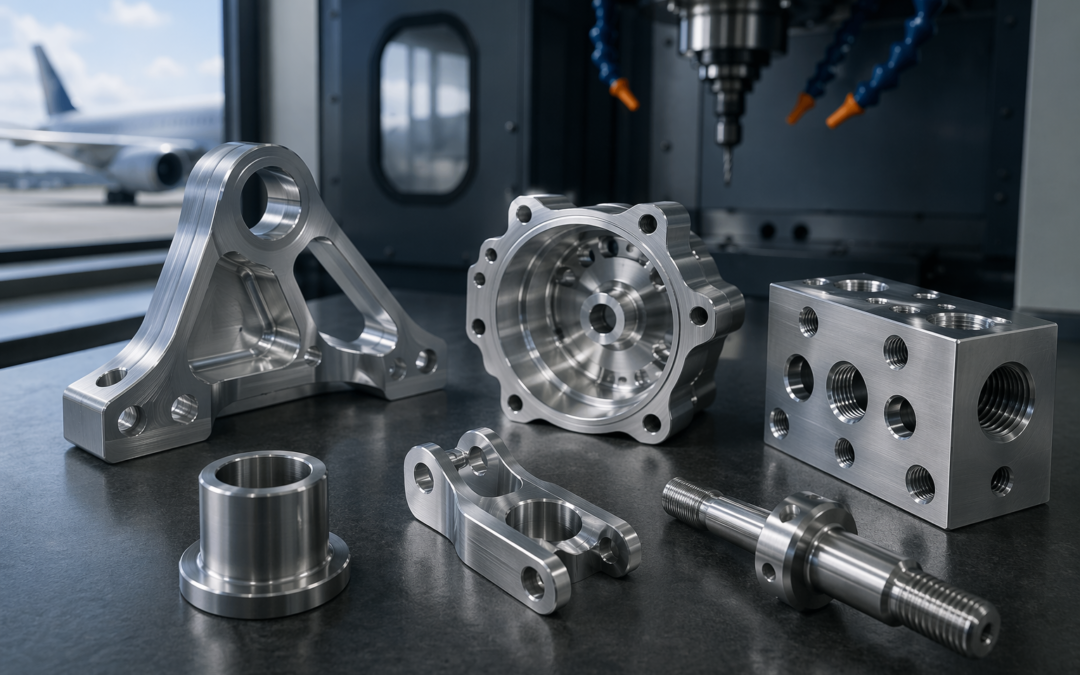
CNC machining aerospace parts is one of the most demanding areas in modern manufacturing. Aerospace components must perform reliably under extreme pressure, vibration, temperature changes, and long service cycles. That means every machined part, from brackets and housings to structural fittings and engine-adjacent components, has to meet strict dimensional, material, and documentation requirements. This guide explains how CNC machining supports the aerospace sector, what makes aerospace work different from general precision engineering, and how buyers and engineers can approach sourcing and production with more confidence.
Aerospace manufacturers rely on CNC processes because they combine repeatability, tight tolerance control, and strong traceability. Unlike low-risk commercial components, aerospace parts often require documented materials, validated inspection routines, and clean, stable machining methods that can reproduce the same result across prototypes, pre-production runs, and ongoing supply. For design teams and procurement specialists alike, understanding the basics of aerospace machining helps reduce risk and improve part quality from the beginning.
Why CNC Machining Aerospace Parts Matters
The reason CNC machining aerospace parts is so critical is simple: failure is not an option. In aerospace, even a seemingly small component can affect structural integrity, assembly fit, weight targets, or long-term performance. A part that is slightly out of tolerance, poorly finished, or inconsistently produced can create downstream issues in installation, maintenance, and certification.
CNC machining is valued in aerospace because it gives engineers control. Multi-axis machining, advanced toolpaths, and digital programming allow manufacturers to create complex shapes while holding exact specifications. This is especially important in an industry where parts often need to be lightweight, strong, and dimensionally stable at the same time. When companies evaluate machining partners, they usually look for strengths such as:
- Tight tolerance capability
- Experience with aerospace-grade materials
- Consistent surface finish control
- Inspection and traceability procedures
- Ability to move from prototype to repeat production
- Clear process documentation and revision control
This is why engineering-led precision suppliers are often preferred in aerospace work. Firms such as Tarvin Precision are often discussed in this context not because aerospace machining should be sold with hype, but because buyers tend to value proven process discipline over broad marketing claims.
Aerospace CNC Machining vs General Precision Machining
Although the equipment may look similar on the shop floor, aerospace machining is not simply standard CNC work with a different label. The difference lies in the level of control expected throughout the whole manufacturing process. Aerospace parts are usually governed by tighter documentation, more demanding tolerances, more complex materials, and more rigorous inspection standards than general industrial components.
A machine shop can be very capable in commercial manufacturing and still find aerospace work challenging. That is because aerospace production requires more than accurate cutting. It also depends on stable workflows, material certification, program validation, controlled change management, and thorough quality records. Key differences for an AS9100 machine shop often include:
- Greater emphasis on batch traceability
- More stringent first article inspection requirements
- Higher expectations for process repeatability
- Closer control of burrs, edges, and cosmetic condition
- Increased need for material certification and test records
- Stronger focus on risk reduction during production transfer
For aerospace buyers, the practical takeaway is that machining capability alone is not the whole story. The supplier’s systems, inspection culture, and process consistency matter just as much as spindle speed or machine count.
Common Aerospace Parts Made with CNC Machining
A wide range of flight-critical and support components are produced using CNC machining. Some are highly visible structural parts, while others are smaller precision elements that support larger assemblies. CNC machining is often chosen when the design requires precision, strength, and reliable repeatability across a specified production volume.
Because aerospace assemblies are so varied, CNC machining can be used for both one-off development work and repeat manufacturing of tightly controlled components. Parts may be machined from billet, plate, bar, or forged stock depending on the design intent and certification route. Typical aerospace CNC machined parts include:
- Brackets and mounting features
- Housings and enclosures
- Bushes, spacers, and sleeves
- Precision pins and fastener-related components
- Valve bodies and fluid system parts
- Sensor mounts and interface plates
- Structural fittings
- Tooling and assembly aids for aerospace production
- Interior aircraft hardware and support components
What matters is not only the shape of the part, but also how it will function in service. Designers often choose CNC machining because it can produce complex geometry without compromising accuracy, particularly in low-to-medium volume aerospace programs.
Materials Used in Aerospace Component Manufacturing
Material choice is central to CNC machining aerospace parts. Aerospace engineers usually select materials based on a mix of strength, weight, corrosion resistance, thermal stability, fatigue performance, and regulatory suitability. That means machinists must be prepared to work with metals and engineering materials that can be significantly more demanding than standard commercial alloys.
Titanium, aluminium, stainless steels, nickel alloys, and specialist plastics all appear in aerospace applications. Each one behaves differently during cutting. Some create heat quickly. Others work-harden. Some are light and easy to remove but require careful handling to avoid distortion. Good aerospace manufacturing depends on understanding these material behaviours before production begins. Common aerospace machining materials include:
- Aluminium alloys for lightweight structures and housings
- Titanium for high strength-to-weight applications and corrosion resistance
- Stainless steel for durability and environmental resistance
- Inconel and nickel alloys for high-temperature environments
- Engineering plastics such as PEEK for specialist non-metal components
- Tool steels for fixtures, tooling, or wear-resistant support parts
Material choice affects much more than cost. It influences cutting speeds, tool wear, fixturing strategy, coolant approach, and inspection planning. A shop with real aerospace capability will treat material selection as a production variable, not just a line on a drawing.
Aerospace Tolerances and Precision Requirements
Tolerances in aerospace machining are often tight because mating parts, aerodynamic surfaces, and safety-related assemblies depend on exact geometry. Even when the tolerance callout appears modest, the real challenge may lie in maintaining it across multiple features, different machines, and repeated batches. That is why process stability matters so much in aerospace production.
Precision is also broader than linear dimensions. Aerospace parts may require control over true position, concentricity, flatness, perpendicularity, thread quality, surface finish, and edge condition. A part can measure correctly in one area and still fail functionally if other feature relationships are not controlled. Important precision considerations include:
- Dimensional tolerance compliance across all critical features
- Geometric dimensioning and tolerancing requirements
- Surface finish expectations for fit or performance
- Burr-free edges and controlled chamfers
- Repeatability between prototype and production batches
- Thermal and fixturing effects during machining
This is where experienced aerospace machinists add real value. They do not just “hit the numbers”; they plan for how the part behaves while it is being cut, measured, and handled. That mindset is often what separates a reliable aerospace component from one that causes costly rework.
CNC Milling and Turning for Aerospace Components
Most aerospace machining projects use a combination of CNC milling and CNC turning, depending on the part geometry. Milling is ideal for complex prismatic features, pockets, contours, and multi-face machining. Turning is commonly used for cylindrical parts, precision diameters, threaded forms, and concentric features. Many aerospace components involve both processes, either through sequential operations or mill-turn equipment.
The growing use of 4-axis and 5-axis CNC machines has made aerospace machining more efficient and more accurate. Fewer setups can mean better positional accuracy, reduced handling risk, and shorter lead times. This is especially useful for complex components where multiple datum relationships must be preserved. Typical aerospace machining process choices include:
- 3-axis milling for simpler plates, brackets, and housings
- 4-axis machining for improved access and fewer refixturing steps
- 5-axis machining for complex geometry and reduced setup error
- CNC turning for shafts, bushes, sleeves, and round precision parts
- Mill-turn operations for combined rotational and milled features
- Secondary operations such as drilling, tapping, reaming, and deburring
Choosing the right process route is often a balance between part complexity, tolerance demands, inspection access, and cost efficiency. In aerospace, the fastest route is not always the best one; the most stable route often delivers the best long-term result.
Quality Control in CNC Machining Aerospace Parts
Quality assurance is a defining part of CNC machining aerospace parts. In many cases, customers are not only buying the finished part. They are also buying the evidence that the part was made correctly. That includes inspection records, material traceability, revision control, and process documentation that can stand up to customer and regulatory scrutiny.
Inspection in aerospace machining usually takes place throughout the production cycle, not only at the end. In-process checks help catch variation before it affects an entire batch. Final verification then confirms that the component meets drawing, specification, and cosmetic expectations before release. A strong aerospace quality process may include:
- Incoming material verification and certification checks
- First article inspection
- In-process dimensional checks
- Final inspection against drawing requirements
- CMM measurement where appropriate
- Surface finish verification
- Batch traceability and document retention
- Non-conformance reporting and corrective action workflows
This kind of discipline is one reason buyers often favour specialist precision engineering firms. A company like Tarvin Precision, for example, may be relevant in sourcing conversations not because aerospace buyers want promotional language, but because they want confidence that machining and AS9100 machining quality systems are treated as one connected process.
Design Considerations for Aerospace Machined Parts
Good results in aerospace machining often begin long before a machine starts cutting. Design decisions have a direct impact on manufacturability, inspection, lead time, and cost. Engineers who understand CNC machining constraints can often improve a part without affecting function, simply by making smart choices around radii, wall thickness, datum structure, and feature accessibility.
Design for manufacture is particularly valuable in aerospace because complex parts can become expensive very quickly. A small drawing revision that improves tool access or reduces setups can make production more stable while protecting precision standards. This is not about lowering quality. It is about supporting quality through better design. Useful design considerations include:
- Avoiding unnecessarily deep, narrow pockets
- Using realistic internal radii for tooling access
- Defining clear datums for machining and inspection
- Minimising fragile thin-wall features where possible
- Aligning tolerance demands with true functional needs
- Planning threads, holes, and sealing surfaces carefully
- Considering whether one part could replace a more complex assembly
The best aerospace projects usually involve early communication between design, quality, and manufacturing. When those conversations happen early, the result is often a part that is easier to machine well and easier to verify consistently.
From Prototype to Production in Aerospace Machining
Prototype work is important in aerospace because it helps validate geometry, fit, and function before broader release. However, a successful prototype is only part of the journey. The real challenge is turning that initial success into a repeatable production method that delivers the same result over time.
This transition from prototype to production is where process control becomes essential. Tooling choices, setup sheets, inspection plans, and revision tracking all need to mature alongside the part. In aerospace, the goal is not merely to make the part once. It is to establish a controlled route that can be trusted across future demand. A smooth transition usually depends on:
- Stable programming and tooling strategies
- Defined setup instructions
- Controlled revision management
- Clear inspection criteria from the start
- Process notes captured during prototype work
- Supplier communication around future volumes and tolerances
Shops that manage this well help customers reduce long-term risk. They treat prototype machining as the beginning of process development, not as a one-off exercise disconnected from future supply.
How to Choose a Supplier for CNC Machining Aerospace Parts
Selecting a supplier for CNC machining aerospace parts is not only about finding the lowest quote. Aerospace buyers usually need confidence in communication, process control, documentation, and repeatability. A supplier may offer competitive pricing, but if they struggle with traceability, inspection discipline, or revision management, the hidden cost can be much higher later on.
A useful way to evaluate a supplier is to look at how they think about risk. Do they ask sensible questions about critical features, material condition, finishing requirements, and inspection expectations? Do they identify potential issues early? Those signs often reveal more than a price sheet. When reviewing aerospace machining suppliers, look for:
- Demonstrated experience with precision aerospace work
- Understanding of certified materials and traceability
- Strong inspection capability and documentation
- Clear communication on lead times and technical issues
- Evidence of repeatability, not just one-off capability
- A structured approach to non-conformance and corrective action
- Willingness to discuss manufacturability during quoting
A supplier relationship in aerospace should feel collaborative, disciplined, and technically grounded. The best outcomes tend to come from teams that understand both machining detail and the wider quality demands of the sector.
CNC Machining Aerospace Parts Manufacture
CNC machining aerospace parts sits at the intersection of precision engineering, quality assurance, and practical manufacturing knowledge. It is not simply about producing metal components to a drawing. It is about creating parts that will perform reliably in one of the world’s most demanding industries, while maintaining consistency, traceability, and confidence at every stage.
For engineers, buyers, and project teams, the most effective approach is to think holistically. Material selection, machining strategy, inspection planning, and supplier capability all influence the final result. Whether the requirement is a development prototype, a repeat production bracket, or a complex multi-axis component, the principles remain the same: clarity, control, and repeatability. As a guide, the key lessons are straightforward:
- Aerospace machining demands more control than general machining
- Material knowledge is essential to process success
- Precision includes geometry, finish, and repeatability
- Quality systems are as important as machine capability
- Early design-for-manufacture thinking can reduce risk
- Supplier selection should focus on process strength, not just price
When these fundamentals are respected, CNC machining becomes a dependable route for high-performance aerospace parts. And when buyers look at capable precision engineering firms, including names such as Tarvin Precision, the most important question is rarely who sounds the most impressive. It is who can consistently produce the right part, with the right records, in the right way.