
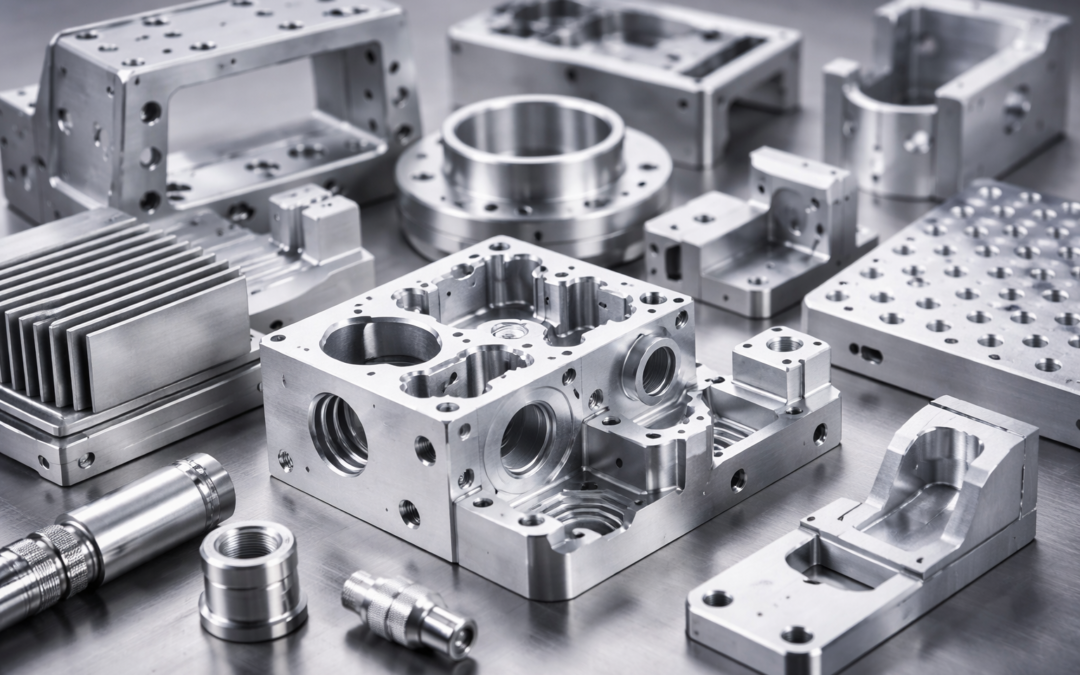
Aluminium machined parts are used across modern manufacturing because they offer a rare mix of strength, low weight, corrosion resistance, and cost-effective machinability. From aerospace brackets and medical housings to electronics enclosures and automation components, aluminium is often the material engineers choose when they need reliable performance without unnecessary weight or complexity.
This guide explains what aluminium machined parts are, why they are so widely specified, and how to get better results when designing, sourcing, or comparing them. It also looks at common alloys, tolerances, finishes, and applications, so the article works both as an introduction and as a practical reference. Businesses that work closely with precision suppliers, including firms such as Tarvin Precision, often find that small choices in design and material selection make a noticeable difference to cost, lead time, and part performance.
What Are Aluminium Machined Parts?
Aluminium machined parts are components made by removing material from a solid piece of aluminium using processes such as CNC milling, CNC turning, drilling, tapping, and boring. Unlike cast or stamped parts, machined aluminium parts are created with precision cutting tools, which makes them ideal for tight tolerances, consistent repeatability, and detailed features.
Because aluminium is relatively easy to machine compared with many steels and exotic alloys, it is commonly used for parts that need both accuracy and efficiency. This includes prototypes, low-volume production runs, and larger repeat batches. The material’s natural versatility also means the same category of part can appear in industries as varied as automotive, robotics, telecommunications, defence, and food processing.
In practical terms, aluminium machined parts can include everything from simple spacers and bushes to complex manifolds, heat sinks, brackets, housings, clamps, mounts, and custom assemblies. The final geometry may be simple or highly intricate, depending on the application and the capabilities of the machining process.
Why Aluminium Machined Parts Are So Popular
The popularity of aluminium machined parts comes from the fact that aluminium solves several engineering challenges at once. It is lightweight enough for applications where mass matters, but still strong enough for many structural and semi-structural uses. It also resists corrosion well and can be finished in different ways to improve appearance, wear resistance, or environmental durability.
For manufacturers, aluminium offers another major benefit: it machines efficiently. Faster cutting speeds and lower tool wear can help reduce production time, especially when compared with harder metals. That is one reason aluminium is often chosen for both prototyping and production. Some of the main reasons engineers choose aluminium machined parts include:
- Low density and reduced component weight
- Good strength-to-weight ratio
- Strong corrosion resistance in many environments
- Excellent machinability and production efficiency
- Good thermal and electrical conductivity
- Suitability for anodising and other surface finishes
- Reliable dimensional stability in precision applications
These advantages make aluminium a practical all-round material rather than a niche option. When performance, appearance, and manufacturability all matter, it is usually near the top of the shortlist.
Common Alloys Used for Precision Aluminium Machining
Not all aluminium machined parts are made from the same alloy, and alloy choice has a direct effect on strength, corrosion resistance, finish quality, and machinability. Selecting the right grade early can prevent avoidable design compromises later.
In machining, a few alloys appear again and again because they offer predictable behaviour and are readily available. The most common examples are 6082, 6061, 7075, and 2024, although many others are also used depending on the application. Here are some widely used aluminium grades for machined parts:
- 6082 aluminium – Often used in the UK and Europe for structural components, offering a good balance of strength, corrosion resistance, and machinability
- 6061 aluminium – Popular for general engineering and CNC machining, with good mechanical properties and broad availability
- 7075 aluminium – A high-strength alloy often selected for aerospace, motorsport, and demanding engineering uses
- 2024 aluminium – Known for excellent strength and fatigue resistance, though typically with lower corrosion resistance than 6061 or 6082
- 5083 aluminium – Chosen more often when corrosion resistance is especially important, including marine-related applications
The best alloy depends on the part’s job, not just the drawing. A lightweight housing, for example, may prioritise corrosion resistance and cosmetic finish, while an aluminium tooling plate fixture may need rigidity and dimensional stability. Machining specialists like Tarvin Precision will usually review alloy suitability alongside tolerance, finish, and intended environment rather than treating material choice as a separate issue.
CNC Aluminium Components and the Machining Process
Most aluminium machined parts are produced using CNC machining, which allows accurate and repeatable control over tool movement. CNC milling is used to create flat faces, pockets, slots, profiles, and complex 3-axis or 5-axis features. CNC turning is used for cylindrical parts such as pins, collars, shafts, and threaded components. 
The aluminium machining process usually starts with a CAD model or technical drawing, followed by CAM programming, material preparation, machining, inspection, and any finishing operations. Because aluminium responds well to high-speed machining, it is often possible to achieve both precision and efficiency when the part is designed sensibly. A typical process for CNC aluminium components includes:
- Reviewing drawings, tolerances, and material requirements
- Selecting suitable aluminium stock and tooling
- Programming milling or turning operations
- Machining the part in one or more setups
- Deburring and edge finishing
- Inspecting critical dimensions and features
- Applying post-machining finishes such as anodising or bead blasting
This process sounds straightforward, but the details matter. Tool access, clamping strategy, wall thickness, and datum selection all affect the final result. Well-designed aluminium machined parts are easier to hold, easier to machine, and easier to inspect.
Design Tips for Better Aluminium Machined Parts
Good design has a major influence on how successful aluminium machined parts will be. A part may look simple in CAD but become expensive or difficult in production if features are too deep, too thin, or unnecessarily complex. Designing with machining in mind by an aluminium milling service usually improves both quality and cost control.
One of the biggest mistakes is specifying tighter tolerances than the function actually requires. Another is introducing features that demand specialist tooling or multiple setups when a simpler geometry would do the same job. Design for manufacturability does not mean compromising performance; it means matching the part to the process intelligently. When designing aluminium machined parts, it helps to keep these points in mind:
- Use realistic tolerances based on function, not habit
- Avoid excessively deep pockets and narrow internal corners
- Maintain sensible wall thickness to reduce vibration and distortion
- Standardise threads, radii, and hole sizes where possible
- Consider how the part will be clamped during machining
- Allow space for tool access on internal features
- Identify critical surfaces clearly on the drawing
The earlier these issues are addressed, the smoother the project usually runs. This is especially important for custom aluminium parts, where every design decision has a direct effect on machining time and repeatability.
Tolerances and Accuracy in Aluminium Machined Parts
Precision is one of the main reasons buyers choose aluminium machined parts over alternative manufacturing methods. CNC machining can deliver tight tolerances, but achievable accuracy depends on geometry, feature type, machine capability, inspection method, and the alloy itself.
Flatness, perpendicularity, concentricity, hole position, and thread quality can all be controlled to a high level, but they should be specified in line with actual functional needs. Overly strict tolerance demands can increase costs significantly without improving performance in the finished assembly. Important tolerance considerations include:
- General dimensional tolerances for non-critical features
- Tight tolerances only where fit or function requires them
- Geometric tolerances for alignment and location-critical surfaces
- Surface finish requirements on sealing or mating faces
- Clear datum references for inspection and repeatability
- Thermal movement considerations for very precise assemblies
Aluminium can also react differently from steel during machining because of its thermal behaviour and relative softness. That is why experienced suppliers pay close attention to workholding, cutting strategy, and measurement conditions when producing precision aluminium machining work.
Surface Finishes for Aluminium Machined Parts
The finish applied to aluminium machined parts can affect appearance, wear resistance, corrosion protection, and usability. Some parts are left as-machined, which is often perfectly acceptable for internal or functional components. Others require additional finishing for cosmetic or environmental reasons.
Anodising is one of the most common finishing options because it creates a controlled oxide layer that improves surface durability and can also provide colour. Bead blasting is another popular option when a more uniform matte appearance is wanted before anodising or as a standalone aesthetic finish. Common finishing options for aluminium machined parts include:
- As-machined finish – Suitable for many functional engineering parts
- Deburred finish – Removes sharp edges and improves handling safety
- Bead blasted finish – Produces a uniform matte texture
- Clear anodised finish – Improves corrosion resistance and appearance
- Black anodised finish – Popular for components needing a clean technical look
- Hard anodising – Used where additional wear resistance is required
- Powder coating or painting – Applied when colour or added protection is needed
Finish choice should always reflect the end use. A machine bracket, a visible enclosure, and a marine component may all be made from aluminium, but they rarely need the same finish specification.
Applications for Custom Aluminium Parts Across Industries
One reason aluminium machined parts remain in such high demand is that they fit so many applications. The material works well in sectors where low weight matters, but it is equally valuable in industries that prioritise corrosion resistance, conductivity, or visual quality.
In electronics, aluminium is often used for housings, panels, and heat-dissipating components. In automation and robotics, it appears in fixtures, arms, carriers, and sensor mounts. In aerospace and motorsport, weight savings and strength-to-weight ratio are key drivers. Even in food, packaging, and laboratory settings, aluminium machined parts are used where cleanability and corrosion performance are important. Typical applications include:
- Brackets, mounts, and support frames
- Enclosures, covers, and instrument housings
- Heat sinks and thermal management components
- Pneumatic and hydraulic manifolds
- Jigs, fixtures, and tooling plates
- Precision spacers, pins, bushes, and collars
- Aerospace, automotive, and motorsport assemblies
This breadth of use means aluminium machining is rarely a one-size-fits-all discipline. The right solution depends on the application, environment, and assembly requirements around the part.
How to Choose a Supplier for Aluminium Machined Parts
Choosing a supplier for aluminium machined parts is about more than finding a competitive unit price. The best results usually come from working with a manufacturer that understands design intent, can advise on alloy and finish options, and has robust inspection processes in place.
A good machining partner should be comfortable discussing tolerances, lead times, batching strategy, and whether a part is better suited to milling, turning, or a combination of both. They should also be able to explain where cost drivers sit, such as tight tolerances, multiple setups, special tooling, or post-machining finishes. When comparing suppliers, it helps to look for:
- Experience with precision aluminium machining
- Clear communication on tolerances and manufacturability
- Reliable inspection and quality control procedures
- Flexibility for prototypes and repeat production
- Understanding of finishes, assemblies, and secondary operations
- Consistent lead times and realistic technical feedback
This kind of practical partnership is often more valuable than a purely transactional approach. Companies such as Tarvin Precision are typically most useful when they are brought in early enough to flag design or process improvements before production begins.
Cost Factors in Aluminium Machined Parts
The cost of aluminium machined parts is influenced by far more than raw material price. Machining time, setup complexity, inspection requirements, and finishing operations all play a role. In many cases, a part can be made more cost-effective through small design changes rather than major compromises.
Simple, accessible geometries are usually faster to machine. Features that require multiple setups, long tool reach, ultra-tight tolerances, or extensive deburring will generally increase the price. Batch size also matters, as setup time has a different impact on prototype work than on repeat production. The most common cost drivers are:
- Choice of aluminium alloy and stock size
- Part complexity and number of machining operations
- Tight tolerances and critical inspection points
- Surface finish or anodising requirements
- Quantity ordered and repeat scheduling
- Packaging, traceability, or special documentation needs
Understanding these factors helps buyers make better decisions. In many projects, the most cost-effective aluminium machined parts are not the simplest-looking ones, but the ones designed with manufacturing logic in mind.
Aluminium Machined Parts That Work
Aluminium machined parts continue to play a central role in precision engineering because they offer such a strong balance of machinability, performance, finish quality, and versatility. Whether the requirement is a lightweight structural component, a custom enclosure, a precision fixture, or a repeat production part, aluminium remains one of the most practical engineering materials available.
The key to getting the best outcome lies in matching the alloy, geometry, tolerance, and finish to the actual application. Well-designed parts are easier to machine, easier to inspect, and more cost-effective to produce. That is why experienced manufacturers and engineering teams put so much emphasis on design review at the start of a project.
For businesses researching suppliers or refining a component design, understanding the fundamentals of aluminium machined parts makes it much easier to ask the right questions and avoid costly assumptions. When that process includes informed input from a precision engineering partner, whether for prototypes or production batches, the end result is usually better in both technical and commercial terms.