
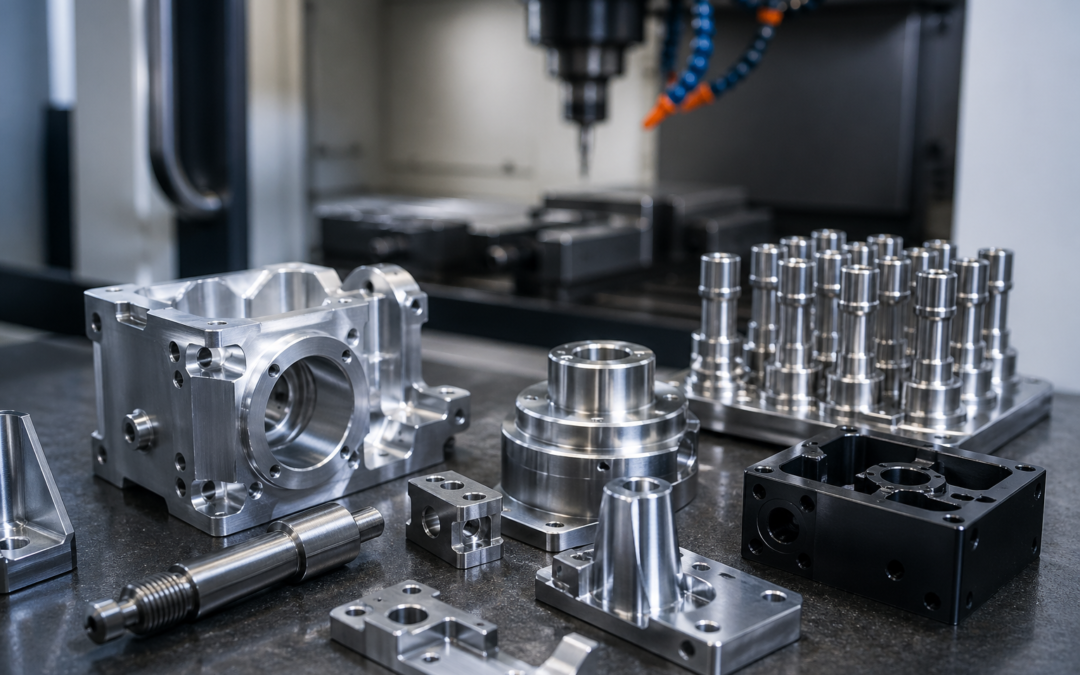
Small batch CNC machining is one of the most effective ways to produce precision parts when you need more than a one-off prototype but do not yet require full-scale mass production. It sits in the valuable middle ground between development and volume manufacture, giving businesses the flexibility to order accurate, repeatable components in manageable quantities. For many engineering teams, OEMs, product developers, and procurement specialists, this approach offers the ideal balance of cost control, speed, and quality.
In simple terms, small batch CNC machining usually refers to the production of a limited number of parts using computer-controlled machining processes such as milling, turning, drilling, and threading. These quantities might range from a handful of components to a few hundred, depending on the part, the material, and the production need. It is especially useful when designs are still evolving, when inventory risk needs to be reduced, or when parts are required for specialist applications.
This guide explains what small batch CNC machining involves, when it makes sense, what benefits it offers, and how to approach a successful project. It also covers materials, tolerances, lead times, and the factors that influence cost, so buyers and engineers can make more confident decisions.
What Is Small Batch CNC Machining?
Small batch CNC machining is the production of relatively low quantities of machined parts using CNC equipment. Rather than setting up for thousands of units, the process is geared around producing smaller runs efficiently while still delivering the precision, consistency, and surface finish expected from high-quality machined components. It is commonly used for bridge production, specialist assemblies, product launches, spares, and ongoing demand for lower-volume parts.
Unlike manual machining, CNC machining uses programmed instructions to control cutting tools and movement. This means even a small quantity of parts can be produced with excellent repeatability. Once a program is proven out, identical parts can be made across the batch with a high level of consistency, which is essential for engineering applications where fit, function, and quality matter. Small batch CNC machining is often chosen for:
- Pre-production runs
- Product validation and testing
- End-use parts in low-to-medium demand
- Custom or specialist equipment
- Spare parts and replacement components
- Aerospace, medical, scientific, and industrial components
Why CNC Machining Is Ideal for Low-Volume Production
Low-volume production often creates a challenge. Businesses may need more than a prototype, but committing to large quantities can tie up cash, increase storage needs, and create waste if the design changes. This is exactly where small batch CNC machining becomes valuable. It allows companies to buy what they need, when they need it, without sacrificing precision or quality.
The real strength of this approach is flexibility. A small batch can be used to support pilot builds, satisfy early customer demand, or supply ongoing niche requirements. It also gives engineering teams a chance to refine designs before moving to larger production runs. If adjustments are needed, they can often be made between batches with far less disruption than in high-volume manufacturing. Some of the main reasons businesses choose small batch CNC machining include:
- Lower upfront investment than mass production
- Reduced inventory and warehousing costs
- Easier design updates between runs
- Faster route from development to production
- Better control over quality and process refinement
- Less risk of being left with obsolete stock
The Benefits of Precision Small Batch Machining
Precision matters whether you need ten parts or ten thousand. One of the main advantages of small batch CNC machining is that it delivers the same core machining benefits associated with larger production work. Tight tolerances, strong repeatability, and clean finishes are all achievable when the process is planned properly and matched to the application.
This is particularly important in technical sectors where low-volume does not mean low importance. In many cases, the parts produced in small batches are critical components used in assemblies, instruments, fixtures, or high-performance systems. The ability to manufacture these parts accurately in modest quantities can help businesses stay agile while maintaining engineering standards. Key benefits of precision small batch CNC machining include:
- Accurate and repeatable dimensions
- Consistent quality across all parts in the batch
- Compatibility with a wide range of metals and plastics
- Good surface finish and detail
- Suitability for complex geometries
- Reliable production of functional end-use parts
When to Choose Low Volume CNC Machining Over Other Processes
Choosing the right manufacturing method depends on the quantity, complexity, material, and end use of the part. Small batch CNC machining is often the best option when precision and material performance are more important than achieving the lowest possible unit price at very high volumes. It is also ideal when tooling costs for other processes would be difficult to justify.
For example, injection moulding can be cost-effective for very large quantities, but tooling can be expensive and design changes are less flexible. Additive manufacturing is useful for some prototypes and complex forms, but it may not always deliver the dimensional control, material properties, or surface finish required for production components. Small batch CNC machining fills that gap by offering excellent accuracy with relatively low setup commitment. It is often the right choice when:
- Quantities are too low to justify expensive tooling
- Parts need tight tolerances
- Material strength and machinability are important
- Production parts are needed quickly
- Designs may still change after the first batch
- Surface finish and dimensional stability matter
Common Applications for Small Batch CNC Machining
Small batch CNC machining supports a wide variety of industries because many businesses have ongoing needs for limited quantities of specialist components. These are not always prototype parts. In many cases, they are fully functional production items made in smaller numbers due to the nature of the product, the market, or the application.
Engineering teams commonly use this process for brackets, housings, manifolds, plates, connectors, instrument parts, enclosures, shafts, and custom fittings. It is especially useful where products are built in specialist volumes or where maintenance and spares support must continue over a long lifecycle. In regulated or high-spec sectors, the ability to reproduce the same part accurately in future small batches with processes like 5-axis machining is a major advantage. Typical applications include:
- Aerospace and defence components
- Scientific instrument parts
- Medical device components
- Industrial automation parts
- Robotics and control system housings
- Automotive development and motorsport components
- Custom jigs, fixtures, and tooling
- Replacement parts for legacy equipment
Materials Used in Low Volume CNC Machining
One reason small batch CNC machining is so widely used is its compatibility with a broad range of engineering materials. The right material choice depends on the part’s environment, load requirements, corrosion resistance, weight targets, and finish expectations. Because CNC machining is a subtractive process, it can produce highly accurate parts from solid billets, blocks, rods, or plate in both metals and plastics.
Aluminium is often a popular choice because it machines efficiently, offers a good strength-to-weight ratio, and works well for many industrial and aerospace applications. Stainless steel is chosen where corrosion resistance and strength are important. Brass is valued for electrical and decorative applications, while the material choice for machined plastic parts is based on the requirement for insulation, chemical resistance, or lower weight. Common materials for small batch CNC machining include:
- Aluminium grades such as 6082 and 7075
- Stainless steel grades such as 303, 304, and 316
- Mild steel and tool steel
- Brass and copper alloys
- Titanium for specialist high-performance applications
- Delrin, PEEK, PTFE, Nylon, and other engineering plastics
Design Considerations for Small Batch Machined Parts
Good results in small batch CNC machining start with good design. Even though CNC machines are capable of producing highly detailed parts, some features are more efficient to machine than others. Designing with manufacturability in mind can help reduce setup time, improve consistency, and lower the overall cost of the batch without compromising function.
Features such as unnecessarily deep pockets, ultra-thin walls, or very small internal radii can increase machining difficulty. Likewise, overly tight tolerances on non-critical features can drive up cycle times and inspection requirements. The most successful projects usually involve a practical balance between design intent and manufacturing efficiency. Helpful design guidelines include:
- Use tolerances only as tight as the application requires
- Avoid very deep cavities where possible
- Include realistic internal corner radii
- Keep wall thicknesses practical for the material
- Standardise hole sizes and thread types where possible
- Clearly identify critical dimensions and datum features
Tolerances and Quality in Small Batch CNC Machining
Quality is often one of the main reasons companies choose CNC machining for small batches. The process is well suited to achieving consistent dimensions and maintaining control over critical features. However, tolerances should always be discussed in relation to the application. Not every surface needs the same level of precision, and clear communication helps ensure time and cost are focused where they matter most.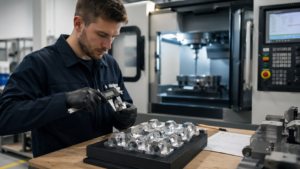
In small batch work, inspection can be especially important because customers often need confidence that each part meets specification before moving further into assembly or product launch. This may involve first-off inspection, in-process checks, and final verification using calibrated measuring equipment. When handled properly, small batch CNC machining can provide excellent traceability and repeatability from one order to the next. Quality considerations often include:
- Dimensional inspection of critical features
- First article or first-off verification
- Material certification where required
- Deburring and surface finish checks
- Repeatability across the full batch
- Documentation for regulated or high-spec sectors
How Small Batch CNC Machining Affects Cost
Cost in small batch CNC machining is shaped by several factors, and understanding them helps buyers make better sourcing decisions. Because the production quantity is lower, setup and programming costs are spread across fewer parts than they would be in a high-volume run. That means unit prices can appear higher, but the overall project cost is often lower than committing to excess stock or expensive tooling.
The most significant cost drivers are usually material choice, machine time, setup complexity, tolerance requirements, and finishing processes. Parts with multiple operations, tight tolerances, or difficult materials naturally take longer to produce. On the other hand, working with a subcontract CNC machining company who can help simplify the design, using standard stock sizes and aligning specifications with actual need can make small batch production very cost-effective. The main factors that influence cost are:
- Batch quantity
- Material type and availability
- Part complexity
- Setup and programming time
- Tolerance and inspection requirements
- Surface finishing or secondary operations
- Packaging, certification, and delivery needs
Lead Times and Flexibility
Lead time is one of the strongest advantages of small batch CNC machining. Because there is usually no need for complex production tooling, parts can move from drawing review to manufacture relatively quickly. This makes the process ideal for urgent projects, pilot production, development schedules, and supply chain situations where flexibility is essential.
Smaller runs are also easier to schedule and adapt. If demand changes, a follow-on batch can often be planned without the disruption associated with retooling an entire production line. Working with rapid prototyping companies gives buyers better control over inventory and cash flow while allowing engineers to respond to feedback from testing or field use. Small batch CNC machining helps with lead time by offering:
- Faster setup than many tooling-heavy processes
- Quicker response for urgent requirements
- Easier adaptation to design revisions
- Better support for phased purchasing
- Reduced need to hold excessive stock
- A practical route for bridge manufacturing
How to Choose the Right Supplier
The quality of the finished parts depends not only on the design and process, but also on the machining supplier you choose. For small batch work, it helps to work with a company that understands both precision machining and the commercial realities of lower-volume manufacturing. A good supplier should be able to advise on manufacturability, communicate clearly, and maintain consistent quality from batch to batch.
It is worth looking beyond headline price alone. The cheapest quote does not always reflect the best long-term value, especially if there are issues with communication, inspection, lead time reliability, or repeatability on future orders. Strong technical support at the quotation and planning stage can often prevent delays and cost increases later. When evaluating a supplier, consider:
- Experience with small batch CNC machining
- Ability to machine the required materials
- Quality systems and inspection capability
- Willingness to review drawings and offer feedback
- Realistic lead times and production capacity
- Consistency for repeat and ongoing batches
Best Practices for Ordering Low Volume Machined Parts
A well-prepared enquiry makes the process smoother for everyone involved. Clear information helps the machinist quote accurately, identify any risks early, and produce the parts more efficiently. Even in small quantities, the more precise the communication, the better the outcome is likely to be.
At a minimum, most machining suppliers will need a technical drawing, material requirement, quantity, and any special notes relating to finish, inspection, or application. If a part is replacing an existing component or is part of a larger assembly, that context can also be helpful. For repeat small batch CNC machining, keeping revision control tidy is especially important so there is no confusion between one run and the next. Useful information to provide with an enquiry includes:
- 2D drawings and 3D CAD files where available
- Material grade and any alternatives
- Batch quantity and expected repeat demand
- Critical tolerances and functional features
- Surface finish or coating requirements
- Inspection or certification needs
- Delivery date and shipping requirements
Small Batch CNC Machining Solutions
Small batch CNC machining is a practical, precise, and commercially sensible solution for many modern manufacturing needs. It allows businesses to access high-quality machined parts without the burden of committing to large production volumes too early. Whether the goal is bridge production, specialist manufacturing, spare parts support, or flexible low-volume supply, it offers a dependable route to accurate and repeatable components.
Its value lies in balance. Small batch CNC machining combines the technical strengths of CNC manufacturing with the agility that product developers and buyers increasingly need. It helps reduce risk, supports design evolution, and enables better control over stock and spending. For companies operating in demanding sectors or working with specialist products, that combination can be a major advantage.
When approached with clear drawings, realistic tolerances, and a capable machining partner, small batch CNC machining can provide an efficient path from concept to production. It is not just a stopgap between prototype and mass manufacture. In many cases, it is the right long-term manufacturing strategy in its own right.