
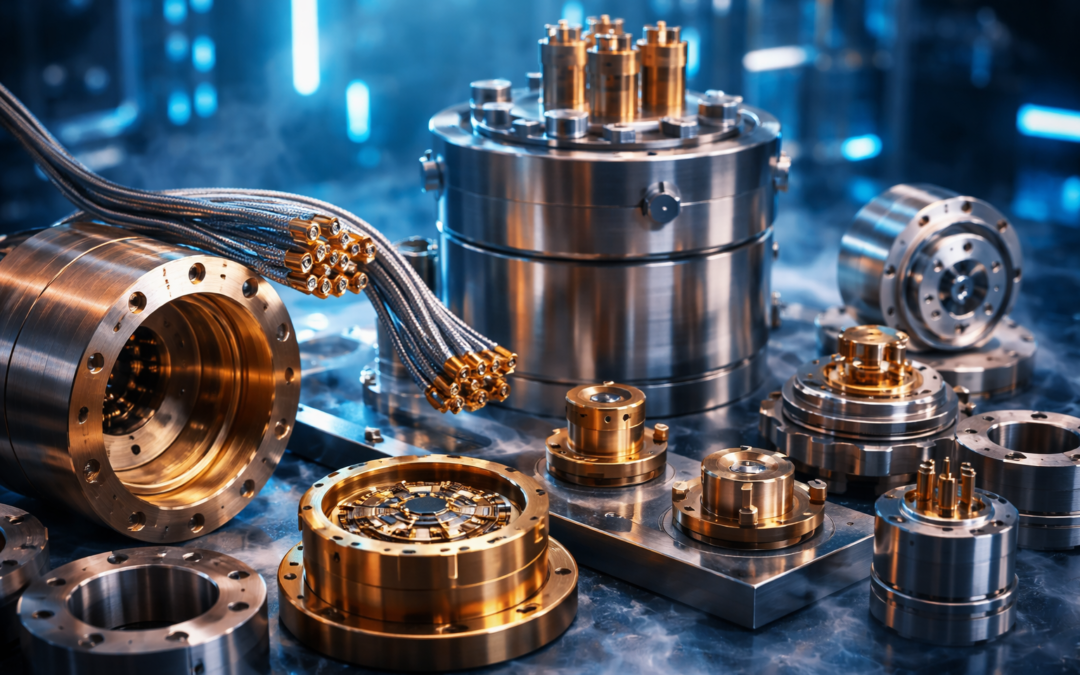
Quantum computing components sit at the intersection of advanced physics and practical engineering. While most conversations about quantum computing focus on qubits, algorithms, or error correction, the reality is that quantum hardware also depends on a large ecosystem of precision-made parts.
Depending on the platform, those parts can include cryogenic housings, hermetic feedthroughs, flexible signal interconnects, radiation shields, vacuum chambers, optical mounts, ion trap structures, photonic packages, and support hardware that keeps the whole system stable, clean, and repeatable.
Quantum computing components are not ordinary mechanical parts. They often have to work in ultra-cold, high-vacuum, electromagnetically sensitive, or optically aligned environments where small dimensional errors, trapped contamination, vibration, poor sealing, or surface defects can directly affect performance. For a manufacturer, that makes quantum hardware an especially demanding but highly interesting category of precision engineering.
What are Quantum Computing Components?
At a practical level, quantum computing components are the physical parts that allow a quantum processor to function reliably as part of a larger system. In superconducting systems, that means components inside and around a cryostat such as hermetic feedthroughs, flexible ribbon cables, superconducting coaxial lines, magnetic shielding, amplifiers, processor packaging, and fridge infrastructure. In trapped-ion systems, the component stack includes ion trap chips, vacuum chambers, laser-facing assemblies, electrode structures, and stable mechanical platforms that help isolate the qubits from the surrounding environment. In photonic systems, the hardware extends into silicon photonic chips, optical switching, cryogenic components, copper heat sinks, and modular rack-style infrastructure.
It is useful to think of quantum computing components as a broad manufacturing category rather than a single product line. The term covers the machined, fabricated, and assembled parts that make quantum computing hardware possible. That broader framing is important because it reflects how buyers in the sector often think: not only about qubits, but about housings, interfaces, precision fixtures, thermal paths, shielding, vacuum compatibility, and manufacturability. A good article on quantum computing components should therefore connect the physics to the hardware realities.
Why Precision Machining Matters for Quantum Computing Hardware
Quantum computing hardware is unusually sensitive to its environment. IBM describes quantum processors operating at about a hundredth of a degree above absolute zero inside a complex cryogenic assembly, while Bluefors highlights that very low temperature systems must be kept in vacuum and protected by staged radiation shields. Bluefors also notes that mechanical vibration can effectively become heat, which is exactly the kind of systems-level issue that turns “ordinary” machining details into performance-critical design features.
That sensitivity changes the role of machining. In a conventional industrial assembly, a bracket or enclosure may simply need to fit and hold position. In quantum systems, the same type of part may also have to support thermal stability, minimise vibration transfer, preserve vacuum integrity, maintain cable routing, reduce unwanted electromagnetic effects, or keep optical paths repeatable. Rigetti explicitly links scalable superconducting systems to cryogenic interconnects, control-signal stability, phase coherence, and low thermal load, which shows how mechanical and electrical performance quickly become inseparable in this field.
From a manufacturing perspective, quantum computing components reward the disciplines that already matter in complex cnc machining work: process control, consistent tolerances, good fixturing, careful deburring, documented cleaning, and rigorous inspection. This is one reason precision subcontract machining is relevant to the sector. A company such as Tarvin Precision does not need to be making the qubit itself to contribute meaningfully; the value often sits in producing the surrounding high-spec hardware that lets advanced devices operate in the right conditions.
Key Quantum Computing Components That Rely on Precision Engineering
Quantum computing components vary by architecture, but several recurring categories appear across the industry. Understanding them helps explain where precision machining supports quantum computing hardware most directly.
Cryogenic Housings and Cold-Stage Hardware
Superconducting quantum systems rely on cryostats, feedthroughs, shields, cold plates, and signal-routing hardware designed for ultra-cold operation. IBM and Bluefors both highlight the importance of tightly sealed entries, flexible low-crosstalk wiring, and staged shielding in these environments.
Vacuum Chambers and Vacuum-compatible Subassemblies
Trapped-ion systems and some other modalities depend on vacuum isolation. IonQ describes trapped ions as being confined in vacuum and manipulated with lasers, and it also discusses the need for hermetic sealing, bake-out, and carefully chosen materials in advanced vacuum package development.
Ion Trap and Electrode Support Structures
Quantinuum’s trapped-ion systems use electromagnetic fields, microwave signals, and lasers, while its more recent material on QCCD architecture shows increasing emphasis on chip-based scaling and junction transport. That means the surrounding hardware has to support both fine electrical function and very stable mechanical integration.
Optical and Laser-alignment Hardware
IonQ’s system architecture explicitly includes a laser system, vacuum chamber, ion trap, and qubit species as part of one integrated hardware stack. Wherever lasers must hit a target repeatedly and predictably, alignment hardware, mounts, reference faces, and thermal stability become essential.
Photonic Packages and Thermal Management Parts
PsiQuantum describes photonic quantum hardware built on silicon wafers and integrated into packages with cryogenic control electronics, PCBs, copper heat sinks, bump bonding, and modular backplane-style cooling infrastructure. That creates clear opportunities for precision-machined support and package hardware.
Interconnect and Shielding Components
From IBM’s flexible ribbon cables and magnetic shielding to Rigetti’s high-density flexible circuits and cryogenically compatible interconnect systems, the industry repeatedly points to packaging and interconnect as scaling bottlenecks. Those supporting components must be mechanically accurate as well as electrically suitable.
Materials for Quantum Computing Components
Material choice is a major part of manufacturing quantum computing components because the environment often drives the specification. In vacuum service, Oxford Instruments’ Andor technical guidance says materials should have low outgassing, be carefully machined to minimise cracks or defects that trap gas or moisture, and tolerate bake-out temperatures. IonQ similarly describes bake-out, hermetic sealing, getters, ion pumps, and careful material choices as part of its advanced vacuum packaging work.
In cryogenic systems, copper is especially visible because of its thermal role. Bluefors refers to copper heat links and copper shielding options around experimental space, while PsiQuantum notes the use of copper heat sinks in its manufacturable photonic packages. Those references point to a broader engineering truth: for quantum computing components, materials are often selected not just for machinability, but for thermal conductivity, magnetic behaviour, cleanliness, and compatibility with vacuum or low-temperature operation.
That does not mean one material is always “best.” An aluminium milling service may make sense where low mass and good machinability matter. Stainless steels remain attractive for many vacuum interfaces because they are durable and compatible with cleaning and bake-out. Copper and copper alloys can become critical where thermal transfer or shielding performance dominates. The right decision usually comes from balancing design intent, operating environment, joining method, and achievable inspection strategy rather than chasing a single universal material.
Tolerances, Surface Finish and Cleanliness in Quantum Computing Components
When manufacturers talk about precision machining for quantum computing hardware, the conversation often begins with tolerances. That matters, but it is only part of the picture. Flatness, positional accuracy, concentricity, and repeatability are all important, yet surface condition and cleanliness can be just as influential. Oxford Instruments’ vacuum guidance is very clear that vacuum-facing parts should be carefully machined to minimise sites that trap gas or moisture, and that bake-out is used to drive impurities out of exposed surfaces.
For cryogenic quantum computing components, surface condition also affects assembly quality and thermal contact. Poorly controlled burrs, damaged sealing faces, or inconsistent surface finish can complicate mounting, sealing, cable routing, or shield installation. In systems where IBM and Rigetti are both emphasising scalable packaging, signal integrity, and stable interconnects, the mechanical execution behind the assembly becomes part of the system performance story rather than a background detail.
Cleanliness deserves equal attention. Quantum hardware buyers are often less interested in whether a part looks cosmetically perfect than whether it is documented, repeatable, and clean enough for the application. That can mean controlled handling, ultrasonic cleaning where appropriate, vacuum-compatible packaging, and process documentation that travels with the part. In practice, the best suppliers treat cleanliness as a manufacturing operation, not an afterthought.
Design for Manufacturability in Quantum Computing Hardware
One of the most useful ways to approach quantum computing components is through design for manufacturability. The physics may be cutting-edge, but the hardware still benefits from classic engineering questions: can this be fixtured securely, can datum structures be inspected consistently, can sealing surfaces be protected, and can the part be reproduced without hidden process variation?
That matters even more as quantum hardware moves from lab prototypes toward scalable systems. IBM talks openly about modular cryogenic infrastructure and componentised fridge design, Rigetti describes replacing multiple coax lines with compact flexible circuits to improve density and thermal load, and Quantinuum has written about the shift from bulky hand-assembled trapped-ion hardware toward chip-based, wafer-fabricated approaches. Those are all signs of a sector moving from scientific demonstration toward manufacturable product architecture.
For machine shops, that shift is encouraging. It means there is room not only for making to print, but also for contributing engineering feedback on tolerances, part consolidation, fixture access, material condition, and inspection methods. The most valuable machining support in quantum computing hardware often comes from reducing risk before a difficult part ever reaches the spindle.
From Prototype Parts to Repeatable Production
Many quantum hardware programmes begin with low-volume development work. Early assemblies may change frequently, incorporate bespoke interfaces, or require iterative fitting alongside other disciplines such as optics, RF, cryogenics, or vacuum engineering. As the technology matures, however, the requirement changes from “can this be made once?” to “can this be made again, consistently, with traceable quality?”
That transition is already visible across the market. Quantinuum has described the evolution from bulky, hand-assembled trapped-ion hardware to silicon-wafer-fabricated traps and more scalable laser integration, while PsiQuantum is explicitly pursuing high-volume foundry fabrication, manufacturable packaging, and modular infrastructure. Those developments suggest that future demand for quantum computing components will not be limited to one-off R&D parts; it is likely to include repeatable, tightly controlled batches of specialised hardware.
This is where established precision manufacturers can be especially useful. Shops with experience in prototypes, tight-tolerance milling and turning, fixture design, and controlled inspection are well placed to support the bridge between research and production. That is also why companies like Tarvin Precision are relevant to emerging sectors like quantum computing: the transferable skill is disciplined, repeatable precision engineering rather than hype.
Quality, Traceability and Inspection for Quantum Computing Components
Inspection is not just a box-ticking exercise in this sector. Quantum computing components often sit inside assemblies that are expensive to build, awkward to access, and highly sensitive to rework. If a part reaches final integration with a hidden dimensional issue, contamination problem, or sealing-face defect, the cost of failure can escalate quickly.
A sensible quality approach therefore combines dimensional inspection with process discipline. Depending on the part, that might include first-article inspection, documented material certification, thread verification, flatness checks, surface-finish control, cleaning records, and packaging methods designed to preserve vacuum-facing or precision reference surfaces. The underlying logic is consistent with what the hardware companies themselves emphasise: stable interconnects, controlled environments, shielding, and repeatable infrastructure are all essential to usable quantum systems.
Choosing a Machining Partner for Quantum Computing Components
If you are sourcing quantum computing components, the best machining partner is rarely the one making the boldest claims about quantum. More often, it is the supplier that understands controlled manufacturing in difficult environments. Look for evidence of capability in tight tolerances, complex materials, clean assembly thinking, documentation, and willingness to engage with unfamiliar but well-defined technical requirements.
It also helps to choose a supplier that understands the difference between a prototype mindset and a production mindset. Quantum computing hardware still contains a lot of development work, but the industry direction is clearly toward scalability, modularity, and manufacturable systems. Suppliers who can support both the first-off part and the later repeat batch will usually add more value over time.
Precision Machining for Quantum Computing Hardware
Quantum computing components may sound futuristic, but many of the manufacturing fundamentals are familiar: accuracy, repeatability, cleanliness, and process control. What changes is the consequence of getting them wrong. In cryogenic, vacuum, optical, and electromagnetically sensitive systems, support hardware is never just support hardware. It becomes part of the performance envelope.
That is why precision machining for quantum computing hardware is such an important topic. As superconducting, trapped-ion, and photonic platforms continue to mature, demand will grow not only for better qubits, but also for better enclosures, shields, interfaces, fixtures, packages, and thermal-management parts. For manufacturers able to deliver high-spec, repeatable work, quantum computing components are likely to become an increasingly valuable niche within advanced engineering.