
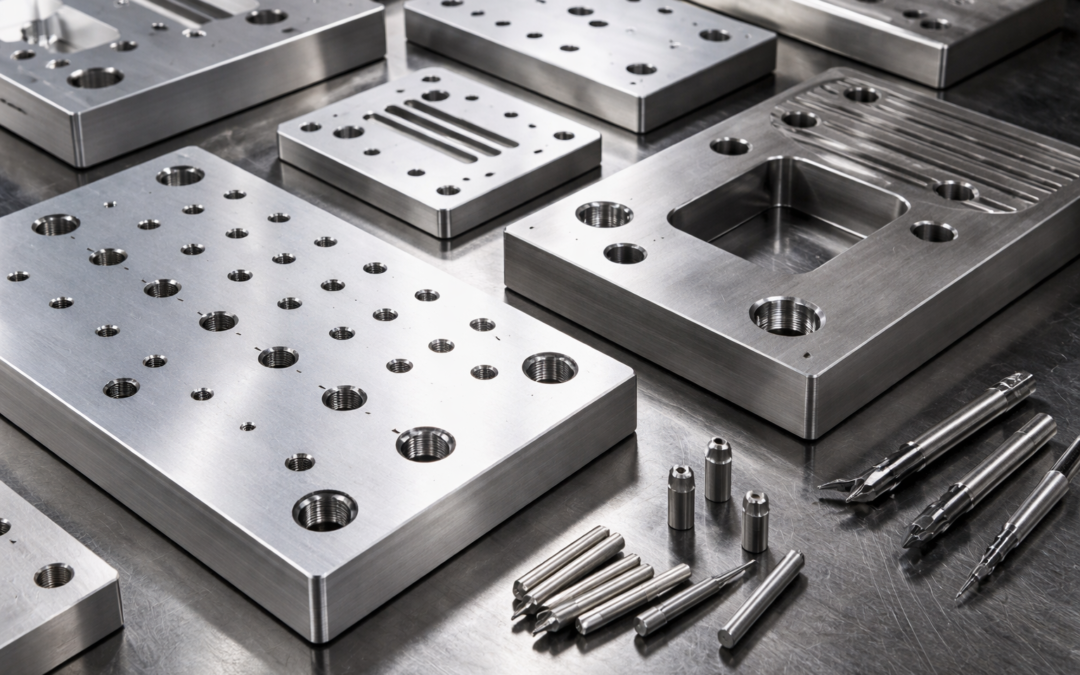
CNC plates are one of those deceptively simple components that show up everywhere: fixtures, brackets, base plates, adaptor plates, machine guards, mounting plates, tooling plates, and structural sub-assemblies. Because a “plate” sounds basic, it’s easy to underestimate how many decisions sit behind a good one – material grade, thickness, flatness, hole position, datums, surface finish, and whether you need thread inserts, counterbores, pockets, keyways, or ground faces.
This guide breaks down how to specify and buy CNC plates without surprises. You’ll see where cost and lead time really come from, which tolerances matter, how plate material behaves under machining, and how to avoid common drawing and quoting mistakes. If you’re working with a machine shop like Tarvin Precision (or any precision supplier), the goal is the same: make the functional requirements crystal clear so the manufacturing route is efficient and the plate arrives ready to build.
What are CNC Plates and Why Do They Matter in Assemblies?
CNC plates are flat stock components machined on CNC mills (and sometimes 5-axis machines) to add features like holes, slots, pockets, counterbores, tapped holes, dowel locations, datum edges, and precision faces. In many machines and products, the plate becomes the reference surface that everything else aligns to. That makes plate accuracy less about “pretty machining” and more about controlling geometry so parts assemble smoothly and repeatably.
Even if a plate is “just a mounting plate,” the knock-on effects of small errors can be big: misaligned bearings, binding slides, uneven gasket compression, poor sensor alignment, or assemblies that need hand-fitting. The best CNC plates are designed with measurable datums and sensible tolerances—tight where function demands it, relaxed everywhere else. Common uses for CNC plates include:
- Fixture and tooling plates for manufacturing cells
- Machine base plates and sub-plates for automation
- Mounting plates for motors, gearboxes, and linear rails
- Adapter plates and interface plates between components
- Protective plates, covers, guards, and inspection plates
- Aerospace/defence brackets and structural interface plates
CNC Plates vs Laser-cut Plates vs Waterjet
A lot of “plate” parts start life as cut profiles. Laser, waterjet, and plasma can be great – fast, economical, and perfect for non-critical profiles. CNC plates come into their own when you need precision features, controlled flatness, true positions, and good perpendicularity between faces and edges.
Laser-cut plates can have heat-affected zones and edge taper (depending on thickness and process). Waterjet avoids heat but can introduce taper and edge striations. Plasma is typically rougher but can be fine for heavy fabrication. CNC machining is how you take a cut blank and turn it into a functional datum-driven component. A practical process selection checklist:
- Choose laser/waterjet only when:
- Hole tolerances are generous (e.g., clearance holes)
- Edge condition isn’t critical
- Flatness requirements are loose
- Choose CNC plates when:
- Dowel holes, bearing fits, or datum edges matter
- You need controlled pocket depths or counterbores
- Positional tolerances and perpendicularity are important
- You need threads, inserts, or accurate tapped patterns
- Choose a hybrid route (cut + CNC finish) when:
- The outer profile can be cut quickly
- Critical faces/holes are finish-machined for accuracy
Material Selection: Aluminium, Steel, Stainless and Engineering plastics
Material choice drives machinability, stability, corrosion resistance, weight, and cost. For CNC plates, stability under machining (and in service) is often the hidden factor. Some materials move when you release internal stresses, especially if you remove a lot of material from one side.
Aluminium CNC Plates: Lightweight and Versatile
Aluminium is the default for many CNC plates because it machines quickly, is easy to handle, and offers a great stiffness-to-weight ratio. The most common grades are 6082 and 6061 in the UK/EU context, with 7075 used when strength is critical. Aluminium plate considerations:
- 6082/6061: general structural plates, good machinability
- 7075: higher strength, more expensive, less corrosion resistant than 6xxx
- Specify condition/temper if important (e.g., T6 aluminium)
- Consider anodising for wear/corrosion protection
Mild Steel and Alloy Steel CNC Plates: Stiffness and Durability
Steel plates are common for tooling bases, machine mounts, and anything needing high stiffness or wear resistance. Mild steel is cost-effective; alloy steels can improve strength and heat treatment options. Steel plate considerations:
- Mild steel: economical, may need paint/plating for corrosion
- Alloy steel: improved strength, can be heat-treated
- Stress relief may be important for large machined plates
- Heavier handling and higher machining time than aluminium
Stainless Steel CNC Plates: Corrosion Resistance Where it counts
Stainless is used where corrosion resistance is essential – medical CNC machining, food, marine, outdoor and chemical environments. It machines slower and can distort with heat if parameters aren’t right, but it’s excellent for long-life assemblies. Stainless plate considerations:
- 303: best machinability, reduced corrosion resistance vs 304
- 304/316: stronger corrosion performance, slower machining
- Watch for galling on threads; consider coatings/inserts
Plastic CNC Plates: Lightweight, Insulating and Low Friction
Engineering plastics can be ideal for wear strips, insulation plates, sensor mounts, or chemical resistance. Variants typically used for machined plastic parts can also move with temperature and can creep under load, so design with real-world service conditions in mind. Common plastics for CNC plates include:
- Acetal (POM): stable, easy machining, good for wear surfaces
- Nylon: tough, moisture absorption can affect stability
- PTFE: low friction, softer, harder to hold tight tolerances
- PEI/PEEK: higher performance, higher cost
Thickness, Flatness and Stress: What Makes a Plate “Stable”?
Plates like to move. Not always visibly, but enough to matter when you’re trying to hold flatness or keep dowel patterns true. Plate movement typically comes from residual stress in rolled material, uneven material removal, or clamping distortion during machining.
If you’re machining deep pockets, large recesses, or removing 60–80% of one side, you’re basically “springing” the plate. This is where planning matters: roughing both sides, allowing rest time, stress relief, and finishing with light cuts can be the difference between a plate that stays flat and one that becomes a potato crisp. Ways to improve CNC plate stability:
- Use tooling plate (cast aluminium tooling plate) for high flatness needs
- Remove material symmetrically from both sides where possible
- Rough machine → rest → finish machine (for sensitive jobs)
- Specify stress-relieved material if available/appropriate
- Avoid over-clamping thin plates; use proper fixturing support
Designing for Manufacturability: Datums, Edges and Feature Strategy
CNC plates are easiest to make when the drawing tells a clear story: what surfaces matter, how parts locate in the assembly, and which features define alignment. That starts with datums. A plate with “floating tolerances” (no datums, no GD&T strategy) often ends up being over-quoted because the shop has to assume worst-case inspection and setup risk.
A common approach is to define:
- Datum A = primary face (mounting face)
- Datum B = a long edge (orientation)
- Datum C = a perpendicular edge (clocking)
Then locate critical holes/pockets relative to those datums. DFM tips for CNC plates:
- Use dowel holes for repeatable location; use clearance holes for bolts
- Avoid tight tolerances on every hole—tighten only the ones that locate parts
- Prefer standard counterbore and countersink sizes
- Add generous chamfers on handling edges if operators will handle them
- Consider thread engagement: thicker plates for stronger threads, or add inserts
Tolerances for CNC Plates: What’s Realistic and What Drives Cost?
With CNC plates, tolerance cost is not linear. Going from ±0.2 mm to ±0.1 mm might be trivial. Going from ±0.05 mm to ±0.01 mm can multiply machining time, inspection time, and scrap risk – especially over larger spans.
Also, it’s easy to accidentally over-tolerance a plate by applying a blanket tolerance to everything. A better strategy is to tolerance critical interfaces (dowel true position, bearing bores, mating faces) and let non-critical features be looser. Typical CNC plate tolerances (very general guidance):
- General profile/overall size: ±0.1 to ±0.2 mm (depends on size)
- Hole positions for non-locating bolts: ±0.1 mm often fine
- Dowel holes / locating patterns: tighter true position as required
- Flatness: define only if assembly demands it; consider functional callouts
If you’re unsure, a quick DFM review with your supplier (Tarvin Precision included) can often reduce cost by relaxing non-functional tolerances while protecting the features that actually drive alignment.
Flatness and Parallelism on CNC Plates
Flatness is one of the most misunderstood specs on plates. If your assembly references a plate face as a sealing surface, a rail mounting surface, or a precision datum, flatness matters. If the plate is bolted down against a rigid base and the bolts define the shape, you may not need an aggressive flatness tolerance.
Also note: if you specify very tight flatness on a thin plate, you may be forcing grinding, lapping, or specialised finishing—especially if the plate is large. Sometimes the more practical solution is increasing thickness, changing material to tooling plate, or adding ribs. Flatness strategy tips:
- Specify flatness only on the face that matters (often Datum A)
- Use tooling plate or stress-relieved stock for tight flatness needs
- Consider how the plate is clamped in service – bolts can “pull” it flat
- Don’t assume “machined = flat” for large thin plates
Hole Making: Clearance, Tapping, Dowels and Reaming
Holes are the heart of many CNC plates because they define how everything else mounts and aligns. Your hole strategy should separate fasteners (bolts) from locators (dowels). Bolts clamp; dowels locate. Mixing those roles can create assemblies that shift or are painful to build.
For locating holes, reamed dowel holes or precision bores give repeatability. For fasteners, clearance holes and slots give assembly tolerance. For threads, consider engagement depth and whether repeated assembly could wear threads out. Hole and thread best practices for CNC plates:
- Use dowel pins for repeatable location between plate and mating part
- Use reamed holes for dowels, not drilled only
- Use helicoils/inserts in aluminium where threads will be used repeatedly
- Avoid very deep blind tapped holes if chips can pack (unless managed)
- Add lead-in chamfers to tapped holes for assembly friendliness
Surface Finishes and Coatings
Surface finish is often specified as a Ra value, but in practice, plates need finishes for reasons like sealing, wear resistance, corrosion protection, conductivity, or appearance. Aluminium plates may be anodised. Steel plates might be blacked, zinc plated, painted, or coated. Stainless may be left as-machined or passivated depending on environment.
Coatings can affect dimensions (anodising grows; plating adds thickness). If you have tight fits or dowel holes, you need to decide whether those features are masked, post-processed, or tolerance-adjusted for coating.
- Common finishes for CNC plates:
- As-machined (functional, cost-effective)
- Bead blasted (uniform appearance, may affect Ra slightly)
- Anodised aluminium (corrosion/wear protection; consider thickness)
- Zinc plating (corrosion protection for steel)
- Black oxide (appearance + light corrosion resistance; often oiled)
- Paint/powder coat (good coverage; mask precision features)
Inspection and Quality Control for CNC Plates
Inspection strategy should match function. There’s no point paying for comprehensive CMM reports on every clearance hole if only two dowel holes control alignment. On the other hand, if the plate is a master datum for an assembly, investing in proper inspection can save far more time downstream.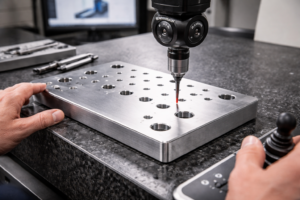
A well-made drawing will identify critical-to-function characteristics. If you use GD&T (flatness, true position, perpendicularity), ensure the datum scheme is consistent and measurable. Practical quality/inspection calls for CNC plates:
- Identify critical hole patterns (dowel/locating features)
- Call out flatness/parallelism only where required
- Add a note for deburr and edge break (to avoid sharp edges)
- Specify inspection deliverables only if needed (e.g., CMM report for key features)
- Ensure datum features are accessible for probing and measurement
Cost Drivers: What Affects Price and Lead Time
If you want to reduce cost on CNC plates, focus on the few variables that truly move the needle: material, thickness, amount of machining, number of setups, tolerance/inspection, and finishing. “It’s just a plate” can still become expensive if it’s large, needs tight flatness, has deep pockets, or requires extensive inspection.
A good RFQ package can reduce back-and-forth and get more accurate quotes quickly, especially if the supplier can see what matters and what doesn’t. Main cost drivers for CNC plates:
- Large stock size and thick material (raw material cost + handling)
- Deep pockets/high material removal (machining time)
- Tight flatness/parallelism on thin plates (risk + finishing)
- Many tapped holes or complex features (cycle time)
- Multiple setups due to features on both sides (fixturing time)
- Coatings with masking requirements (labour + process steps)
- High documentation requirements (inspection/reporting time)
How to Specify Plates on Drawings
The easiest way to get the right CNC plates is to be explicit about function. If you’re sending a plate drawing to a shop, your checklist should cover material, thickness, datums, critical features, finish, and any special requirements like inserts or marking.
Many suppliers, including Tarvin Precision, will do a quick manufacturability check and flag potential issues (like thin walls near threaded holes or overly tight blanket tolerances) if the intent is clear. CNC plate drawing/RFQ checklist:
- Material grade + condition/temper (and cert requirements if needed)
- Thickness and any flatness requirement on the primary face
- Datum scheme (A/B/C) tied to how the plate assembles
- Critical hole patterns identified (dowel holes vs bolt holes)
- Thread specs (depth, class if relevant, insert requirements)
- Surface finish/coating + masking notes for precision features
- Deburr/edge break requirement
- Quantity, revision, and any inspection/documentation needs
Common Mistakes and How to Avoid Them
Most plate issues aren’t caused by bad machining – they’re caused by unclear intent. A supplier can machine what’s drawn, but if the drawing doesn’t communicate what truly matters, you may pay more than necessary or get a plate that technically passes but doesn’t assemble as expected. Frequent CNC plate pitfalls:
- Tight tolerances applied to every feature “just in case”
- No datum scheme, making positional tolerances ambiguous
- Assuming cut edges are square/true enough for datum references
- Calling flatness too tight on thin plates without considering stability
- Ignoring coating thickness and its effect on fits/holes
- Using bolts as locators instead of dowels (assembly shifts)
- Leaving out deburr notes (sharp edges, poor handling safety)
CNC Plates for Fixtures and Tooling
Tooling plates and fixture plates often need repeatability more than “ultra precision.” The winning approach is usually a stable plate material (cast tooling plate or stress-relieved stock), a good datum scheme, and dowel strategies that make assembly repeatable.
If the plate is going into a production cell, think about maintenance and rework too – thread inserts, replaceable wear strips, and standardised hole patterns can extend life and reduce downtime. Fixture plate considerations:
- Cast aluminium tooling plate for stability and flatness
- Dowel-based repeatable location for changeovers
- Replaceable threaded inserts for high-cycle clamping points
- Standardised grid patterns if future flexibility matters
Buying Plates: RFQ Tips
A clean quote happens when the supplier can see: what the plate is, how it functions, and what level of quality is genuinely required. If you provide a clear 2D drawing (PDF) and a 3D model (STEP), plus a short note on critical features, you’ll usually get faster and more accurate pricing.
For low-volume prototypes, you might accept a slightly looser cosmetic finish to shorten lead time. For production plates, you might focus on process capability and inspection consistency. Either way, be clear about the goal. RFQ pack essentials for CNC plates:
- PDF drawing with datums/tolerances
- STEP model if available
- Material and finish requirements
- Quantity and target lead time
- Any special notes: inserts, marking, certs, inspection reports
CNC Plates That Assemble Right Start with Clear Intent
CNC plates aren’t complicated, but they are foundational. The best results come from matching the manufacturing process to the functional needs, choosing stable materials, controlling the few critical tolerances that drive alignment, and avoiding blanket over-specification. If you do that, plates assemble easily, stay stable, and reduce the hidden cost of hand-fitting and rework.
Whether you’re working with Tarvin Precision or another CNC supplier, the winning formula is the same: define the datum scheme, identify critical features, and let everything else be as simple as it can be. That’s how CNC plates stay both accurate and economical, especially when they’re used as the backbone of bigger assemblies.