
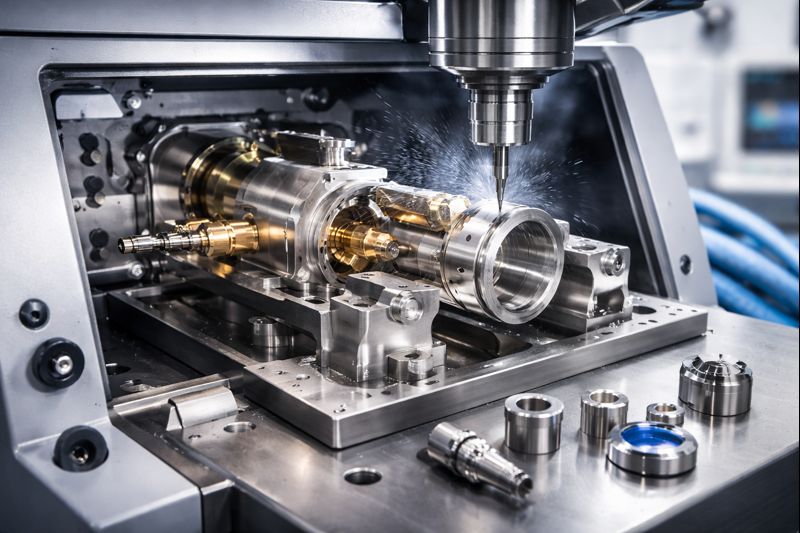
Medical component manufacturers sit at the intersection of engineering, traceability, and patient safety. Whether you’re developing a new diagnostic device, an instrument assembly, a fluid-handling module, or a precision subcomponent for a regulated product, the manufacturer you choose will influence reliability, validation workload, and total lifecycle cost. It’s not just about hitting a drawing tolerance; it’s about controlling variation, documenting what happened, and being able to prove it later.
This guide breaks down what capable medical component manufacturers actually do, what “good” looks like in quality systems, where projects typically stumble, and how to compare suppliers without turning your sourcing exercise into a never-ending audit. The aim is practical: help you specify better, reduce risk, and get parts that pass inspection the first time, consistently.
What Medical Component Manufacturers Actually Provide
At a basic level, medical component manufacturers make parts to print. In practice, they often do much more: helping you choose materials that won’t create compliance headaches, advising on design-for-manufacture to protect critical dimensions, and setting up controlled processes that keep output stable over long production runs.
Medical devices frequently include features that are deceptively difficult to produce and verify – micro bores, fine threads, thin-wall sections, sealing faces, or polished surfaces. Add in cleanliness requirements, material certification, and a need for documented change control, and you start to see why “general precision machining” isn’t always enough. The best partners understand how to build manufacturing plans around risk: identify what matters, prove capability, and keep the process from drifting.
Precision Medical Device Components and Typical Use Cases
Precision requirements in medical work vary widely. Some components are non-implantable but still critical to function, like valve bodies for analysers, optical mounts for imaging devices, or housings for sterile consumables. Others sit inside devices where consistent performance is non-negotiable: metering components, needle guides, pump parts, and miniature mechanical interfaces.
In many cases, the challenge is not the single tight tolerance, it’s the accumulation of tolerances across an assembly. A component can pass inspection and still cause a poor fit, a leak path, or misalignment that shows up only during final assembly or end-of-line testing. Good medical component manufacturers will ask questions about stack-ups, datum strategy, mating parts, and functional checks, because they know the drawing doesn’t always tell the whole story.
Choosing Medical Component Manufacturers for Regulated Products
If your product sits under a regulated quality system, supplier selection should be about risk management as much as price and lead time. The right manufacturer will align with how you need to document and control production. That means clear revision control, traceability to raw material batches, inspection records, and a disciplined approach to process changes.
You don’t necessarily need the “biggest” supplier, often you need the most consistent and responsive one. Smaller, agile manufacturers can be excellent when they have strong systems and communicate well. For example, Tarvin Precision works with customers who need dependable machining with structured quality practices, without adding unnecessary bureaucracy to early-stage builds.
When comparing suppliers, look for evidence of process thinking rather than just a list of machines. Ask how they control critical characteristics, what they do when a dimension trends, and how they document deviations and corrective actions.
Quality Management Systems and Traceability Expectations
Quality frameworks are often used as shorthand, but what matters is how a system shows up on the shop floor. A good quality management system translates into stable processes, controlled documents, trained operators, calibrated measurement equipment, and a clear chain from incoming material to shipped component. Certifications can be helpful signals, but you’ll learn the most from how the manufacturer handles real-world issues like nonconformances, rework, and changes.
If you are building products that require supplier controls, validation evidence, or strict traceability, ensure your chosen manufacturer can support:
- Material traceability from bar/plate to finished parts
- Document control for drawings, routers, inspection plans, and revisions
- Calibration systems for gauges and CMM equipment
- Nonconformance management with documented disposition and corrective actions
- Change control so process or supplier changes don’t silently alter your product
CNC Machining for Medical Components
CNC machining is one of the most common processes used by medical component manufacturers because it offers flexibility, accuracy, and repeatability. It’s especially useful for low-to-medium volumes, complex geometries, and frequent iteration, exactly what many medical device teams need during development and early production.
The difference between “a machined part” and “a medical-ready machined part” often lies in process control: tooling strategy, burr management, surface condition, and inspection discipline. Features like deep small bores, thin ribs, and sharp internal corners can introduce chatter, drift, or deformation if the process isn’t engineered carefully. A capable manufacturer of CNC components will also guide you toward design changes that protect manufacturability without compromising function – like adding radii, adjusting thread callouts, or changing datum schemes to reflect how the part will be held and measured.
Materials for Medical Components: Stainless, Titanium, Plastics, and More
Material choice can be a success factor, or a slow-burning problem. Even for non-implantable components, medical environments bring unique demands: repeated cleaning, chemical exposure, tight temperature control, and sometimes contact with sensitive reagents. Your manufacturer should be comfortable working with common medical materials and understanding the consequences of each selection.
Typical materials include:
- Stainless steels (often for corrosion resistance and strength)
- Aluminium alloys (for weight reduction and housings, where appropriate)
- Titanium (common in high-performance and biocompatible contexts)
- Engineering plastics such as PEEK, acetal, PTFE, UHMW-PE, and PPS (often for low friction, insulation, and chemical resistance)
Material compliance can also matter. You may need certificates of conformity, material test reports, or proof of resin grade and batch. If your product has exposure to disinfectants, solvents, or sterilisation processes, ensure you understand how the material behaves over time, especially regarding cracking, swelling, or stress whitening in polymers.
Surface Finish, Burr Control and “Hidden” Quality Risks
Many project problems don’t come from the obvious dimensions, they come from edges, surfaces, and secondary effects. Burrs can break free and contaminate fluid paths. Surface roughness can change sealing performance. Small edge breaks can alter fit or interfere with assembly. These issues often appear only after you start building devices, which is why it’s worth addressing them early.
Surface requirements should be tied to function. Specify finishes where they matter – sealing faces, sliding interfaces, optical mounting planes, rather than applying tight surface requirements everywhere. That approach reduces cost and increases manufacturability while still protecting performance.
In medical and scientific assemblies, a manufacturer’s deburring approach is a key differentiator. Ask how they define deburr standards, how they verify them, and whether they use controlled processes for particularly sensitive features like micro holes or fine threads. Common controls to consider include:
- Edge break standards (define acceptable radii/chamfers rather than vague notes)
- Burr inspection on critical flow paths, threads, and sealing areas
- Surface roughness measurement where function depends on it
- Handling rules to avoid scratches on cosmetic or functional surfaces
- Post-process cleaning steps, especially before packaging or assembly
Cleanliness, Contamination Control and Packaging Requirements
Even when a component is not supplied sterile, cleanliness expectations are often higher than in general engineering. Contamination can cause assembly failures, leaks, cosmetic rejects, or functional issues in sensors and optical systems. Packaging can also influence quality: poor packing can nick edges, introduce debris, or trap moisture during transit.
If your components interface with fluids, optics, or sensitive electronics, it’s worth defining cleanliness and packaging requirements on the drawing or a separate specification. This doesn’t always mean a cleanroom; sometimes it means controlled final cleaning, bagging, and handling. Typical items to specify include:
- Cleaning method (e.g., aqueous wash, ultrasonic where appropriate)
- Drying requirements and avoidance of residues
- Bagging/packaging (double-bagging, part separation, protective caps for threads/ports)
- Labelling and traceability on outer packaging
- Shipping protection to prevent fretting and impact damage
Tolerances, Inspection and Metrology for Medical Component Manufacturers
One of the fastest ways to increase cost and lead time is to apply unnecessarily tight tolerances. Medical component manufacturers can help you identify what must be tight for function and what can be relaxed for manufacturability. The goal is not to “make everything perfect,” but to make the right things controllable and measurable.
Inspection strategy matters just as much as the machining strategy. Some features are difficult to verify without specialised gauges, pins, air gauging, vision measurement, or CMM fixtures. If you don’t consider inspection early, you can end up with a part that is theoretically manufacturable but practically uninspectable at reasonable cost.
Good practice includes a defined approach to critical-to-quality (CTQ) features and a measurement plan that matches risk. For example, you might require full inspection on early batches, then move to statistical sampling once capability is proven. Areas worth discussing with your supplier include:
- Datum strategy aligned with how the part is functionally assembled
- Gauge selection and access for probing/measurement
- First Article Inspection expectations and reporting format
- Sampling plans for production and how trends are monitored
- Handling of out-of-tolerance results and documented containment actions
DFM Support: Designing for Manufacture Without Losing Function
Design for Manufacture (DFM) isn’t about cutting corners; it’s about choosing geometry that is stable to produce repeatedly. Medical parts often include legacy callouts or inherited features that made sense in a prototype but create recurring variability at volume.
A strong manufacturing partner will highlight risk areas early: thin walls that deflect, deep features that chatter, sharp internal corners that force tiny cutters, or threads that sit too close to critical sealing faces. Small changes, like adding a radius, increasing a wall thickness slightly, or moving a datum, can dramatically improve yield.
DFM conversations are also where “value engineering” should live: not in stripping requirements, but in improving robustness. Tarvin Precision, for instance, tends to support customers best when brought in early enough to recommend manufacturable tolerances and sensible finishing approaches, rather than after a design has already locked in avoidable complexity.
Prototyping to Production: Scaling With Stable Processes
Many medical projects start with prototypes, then move into pilot builds, and later into higher-volume production. The manufacturing approach that works at prototype stage – manual setups, extensive inspection, iterative adjustments – can become expensive or unreliable at scale unless the process is formalised.
When evaluating medical component manufacturers, ask how they transition processes across phases. A mature supplier will:
- Lock down workholding and toolpaths that minimise variation
- Create process documentation that can be repeated across shifts and operators
- Validate special processes (finishing, cleaning, bonding) if needed
- Use capability evidence (e.g., Cp/Cpk where appropriate) for CTQs
- Implement controlled suppliers for materials and secondary operations
This scaling mindset is often what separates “a shop that can make one good part” from “a partner that can make ten thousand consistent parts.”
Secondary Processes: Anodising, Plating, Passivation and Marking
Medical components frequently require secondary operations after machining. These processes can alter dimensions, surface properties, corrosion resistance, and appearance. If not planned, they can break assemblies, create thread fit issues, or shift tight tolerances out of spec. Secondary processes commonly include:
- Passivation for stainless steels
- Anodising for aluminium housings and cosmetic parts
- Electropolishing to improve surface condition or cleanability
- Plating where conductivity or corrosion performance is required
- Laser marking for traceability (with rules around depth and readability)
The key is to treat secondary processes as part of the dimensional plan, not an afterthought. If plating or anodising builds thickness, define where it applies, what thickness range is acceptable, and which features must be masked. Also consider how finishing affects measurement, some surfaces become harder to probe accurately, and some coatings change friction in assemblies.
Supplier Communication, Documentation and Change Control
In regulated environments, communication and documentation are not “admin” – they’re risk control. You want a supplier who can respond clearly to questions, document decisions, and maintain stable revisions. Late-stage surprises often come from undocumented assumptions: an unagreed deburr standard, a finish interpreted differently, or a subtle process change that wasn’t communicated.
Look for manufacturers who have structured quoting and review steps. The best medical component manufacturers will flag ambiguities in drawings, ask about functional requirements, and document agreed interpretations. That reduces disputes later and protects your validation package. Practical indicators of strong supplier control include:
- Clear quote breakdowns and notes on assumptions
- Documented drawing review and DFM feedback
- Defined inspection reports and traceability records
- Formal handling of deviations (with your approval where needed)
- A disciplined approach to revision changes and obsolescence
Questions to Ask Medical Component Manufacturers Before You Commit
A short conversation can save months of trouble, if you ask the right questions. Instead of only focusing on machine list and price, explore how the supplier thinks about risk, control, and repeatability. Here are useful questions to ask:
- How do you identify and control critical-to-quality characteristics?
- What does your first article inspection look like, and what do you include?
- How do you manage traceability from raw material to shipped parts?
- What happens if a feature trends toward a limit, do you track process capability?
- How do you handle burr control on micro features and internal passages?
- Which secondary processes do you routinely manage, and how do you control them?
- What is your approach to change control for tooling, programs, or suppliers?
- How do you package parts to prevent damage and contamination in transit?
You don’t need perfect answers to every question, but you do want to hear a coherent system—one that matches the risk level of your product.
Getting Better Outcomes With Medical Component Manufacturers
Better outcomes usually come from better inputs. If you want consistent, inspection-friendly parts, invest time in clarifying what matters. Tie tolerances to function, specify finishes only where necessary, and document handling and packaging expectations for sensitive components.
A good manufacturer will meet you halfway: suggesting practical DFM adjustments, flagging ambiguous callouts, and building an inspection plan that proves the part is right. That’s how projects move faster, not by skipping quality steps, but by making them predictable.
If you’re comparing suppliers, consider including an early pilot order that tests not just machining accuracy, but the whole delivery system: documentation, inspection reporting, packaging, and responsiveness to questions. Teams who do this often find that the “lowest unit price” supplier isn’t always the lowest-risk or best total-cost option.
Tarvin Precision is one example of a UK-based precision manufacturer that supports medical and scientific customers where controlled quality and pragmatic engineering matter, particularly when you need clear communication and repeatable results without excessive formality. The right fit, however, always depends on your device class, your regulatory obligations, and the functional risks in your design.
A Practical Checklist for Selecting Medical Component Manufacturer Partners
Medical component manufacturers aren’t interchangeable. The best ones combine precision machining capability with real process control: traceability, documented inspection, sensible DFM, and dependable change management. If you treat supplier selection as a risk decision, not just a pricing decision, you can reduce validation burden, avoid late surprises, and scale with confidence.
Keep your focus on what drives success:
- Define CTQs and functional requirements clearly
- Match tolerances and finishes to real needs
- Ensure traceability and documentation align with your QMS
- Confirm inspection capability for difficult features
- Plan secondary processes and packaging early
- Choose a supplier who communicates clearly and controls change
With that approach, you’ll be in a strong position to select medical component manufacturers who can support your product from prototype to production, reliably and repeatably.