
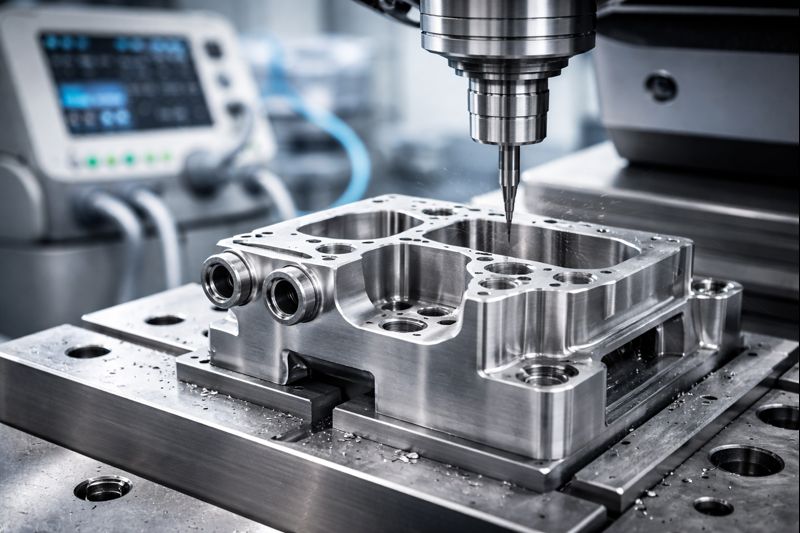
Medical CNC machining sits at the intersection of advanced manufacturing and patient safety. From surgical instruments and diagnostic device components to precision housings and orthopedic hardware, CNC (computer numerical control) machining helps produce complex parts with repeatable accuracy- often in materials and finishes that must withstand sterilisation, cleaning chemicals, or even long-term use.
This guide explains how medical CNC machining works, where it’s used, what materials and processes matter most, and how to specify parts so you get reliable quality without unnecessary cost. If you’re sourcing components, developing a new medical product, or refining drawings for production, you’ll find practical checklists and decision points you can apply immediately.
What Is Medical CNC Machining and Why Is It Used in Healthcare?
Medical CNC machining is the manufacture of medical and healthcare components using computer-controlled machine tools. most commonly CNC milling and CNC turning. The “medical” part isn’t just the end application; it typically implies stricter expectations around cleanliness, documentation, traceability, inspection discipline, and consistent process control.
The reason medical CNC machining is so widely used is simple: it delivers precision and repeatability. When a component must align with another part, seal reliably, maintain a smooth motion profile, or meet tight dimensional requirements for safety and performance, CNC machining is often the most dependable option, especially for prototypes through medium-volume production.
- High dimensional accuracy and repeatability for critical features
- Strong control of surface finish for cleanability and performance
- Fast iteration for prototyping and design changes
- Wide range of medical-grade metals and engineering plastics
- Scalable path from prototype builds to regulated production workflows
Machining for Medical Devices: Typical Applications
Medical devices range from handheld instruments to large diagnostic systems, but many share the same manufacturing needs: predictable tolerances, consistent surface quality, and reliable assembly fit. Medical CNC machining supports this variety by enabling both simple prismatic components and complex multi-axis geometries.
Applications can be broadly split into patient-contacting parts (where material and finish requirements tend to be stricter) and non-patient-contact components (where structural strength, cosmetics, and long-term durability may dominate). In both cases, choosing the right process and specifying critical features clearly is what turns “machined” into “medical-ready.”
- Surgical instrument components (handles, jaws, pivots, clamps)
- Diagnostic and lab equipment parts (frames, mounts, cartridges, housings)
- Fluid management components (manifolds, connectors, valve bodies)
- Orthopedic and dental hardware (plates, guides, certain abutment components)
- Medical robotics and motion assemblies (precision linkages, brackets, couplers)
- Wearable or bedside device components (enclosures, brackets, heat sinks)
Tolerances, Repeatability and CTQ Features
Precision medical CNC machining isn’t only about tight tolerances, it’s about specifying the right tolerances in the rightplaces, and ensuring those features are consistently achieved. Critical-to-quality (CTQ) features might include sealing diameters, mating surfaces, coaxial relationships, motion-critical bores, and alignment datums that influence the whole assembly.
Over-tolerancing is one of the most common cost and lead-time traps. Tight tolerances often require slower feeds, additional finishing passes, specialised inspection, more scrap risk, and sometimes temperature control. Under-tolerancing can be worse, causing assembly failures or performance drift. The goal is to control what matters functionally.
- Identify CTQ features and link them to function (fit, seal, motion, safety)
- Use GD&T to control relationships (position, concentricity, flatness, perpendicularity)
- Avoid blanket tight tolerances on non-critical dimensions
- Add clear datums to support repeatable fixturing and inspection
- Align inspection requirements with risk (e.g., 100% inspection on true CTQs)
Medical Materials: Titanium, Stainless Steel, PEEK, and More
Material selection in medical CNC machining is driven by end use: sterilisation exposure, corrosion resistance, strength, wear, weight, radiolucency, and (where applicable) biocompatibility. But it also affects manufacturability. Some materials work-harden, some burr easily, and some are prone to distortion, especially in thin-wall designs.
It’s also important to specify material grade and condition clearly. For example, different stainless steels behave differently in machining, finishing, and corrosion performance. For plastic machined parts, engineering plastics can vary widely in stiffness and thermal stability. Working with a supplier that understands both the design intent and the real-world machining behaviour of these materials can prevent frustrating prototype iterations.
- Titanium alloys (e.g., Ti-6Al-4V): high strength-to-weight; common where performance demands are high
- Stainless steel (e.g., 316L, 17-4PH): common for instruments and device housings; strong corrosion resistance when processed correctly
- Cobalt-chrome alloys: excellent wear resistance for certain demanding applications; more challenging to machine
- Aluminium (selected grades): useful for non-implant structural components and enclosures; often anodised
- PEEK / PEKK: high-performance polymers; useful where chemical resistance and stable performance matter
- Acetal (POM), Ultem (PEI), Nylon: common engineering plastics for device components and fixtures
Machining for Surgical Instruments: Finish, Ergonomics and Sterilisation Compatibility
CNC machining for surgical instruments is as much about feel and cleanability as it is about dimensions. Instruments are handled repeatedly, cleaned aggressively, and sterilised many times. That means edges, radii, and surface finish aren’t cosmetic afterthoughts, they directly influence usability and hygiene.
A practical approach is to define which surfaces are functional (grip areas, moving interfaces, jaws, mating features) and specify finishes accordingly. Sterilisation method matters too: steam autoclave, chemical sterilants, or other processes can affect corrosion resistance and surface appearance over time. A well-chosen finish can reduce residue retention and make cleaning more reliable.
- Specify edge breaks and radii for safety and comfort in use
- Identify cleanability-critical surfaces and target appropriate roughness/finish
- Consider passivation or electropolishing for stainless steel where needed
- Avoid crevices and sharp internal corners that can trap contaminants
- Confirm that finishing steps won’t distort critical dimensions
CNC Machining for Implantable and Patient-Contact Components
Not all “medical” parts are implantable, but patient-contacting and implant-adjacent components typically demand higher control: stricter material traceability, more robust inspection records, and more careful handling to prevent contamination or damage. Even for non-implant parts, many medical supply chains expect disciplined lot control and documentation habits.
This is where experience in scientific and medical machining can quietly matter. For example, Tarvin Precision notes 25 years’ experience in scientific and medical machining – the kind of long-term exposure that often correlates with good habits around revision control, consistent inspection routines, and attention to finishing and handling details, without needing a sales pitch to make the point.
- Maintain material and heat/lot traceability where required
- Control handling to prevent scratches, nicks, and surface contamination
- Define inspection documentation needs (FAI, certificates, measurement reports)
- Ensure cleaning and packaging expectations are clear and repeatable
- Treat drawing revisions and controlled changes as part of the manufacturing process
ISO 900 CNC Machining: Quality Systems That Support Consistency
ISO 9001 is a widely used quality management standard across precision manufacturing, and it’s frequently relevant when evaluating a medical CNC machining supplier. While ISO 9001 isn’t medical-specific, it provides a structured framework for controlling processes like document control, purchasing, inspection, calibration, corrective actions, and continual improvement – elements that strongly influence consistency and repeatability.
For many medical device teams, ISO 9001 can be a practical baseline, especially for prototypes, non-implant components, R&D builds, and early-stage production, so long as the supplier also demonstrates “medical-aware” behaviours (traceability discipline, clean handling, and inspection planning aligned to CTQ risk). The combination helps reduce surprises when transitioning from prototype to production.
- Ask how drawing revisions are controlled from receipt to shop-floor release
- Confirm calibration practices for gauges, CMMs, and measurement equipment
- Review how nonconformances are handled (containment, root cause, prevention)
- Check traceability methods for material certs, job travellers, and inspection records
- Align inspection plans with CTQ features and acceptance criteria
Medical CNC Processes: Milling, Turning, Swiss Machining and EDM
Medical CNC machining is really a toolbox of processes. CNC milling is ideal for complex prismatic parts, while CNC turning excels for rotational geometry like shafts, rings, and threaded components. A common use of swiss-type machining is for long, slender, high-precision parts – often in small diameters – where consistency is critical.
Some designs require processes beyond conventional cutting. EDM (electrical discharge machining) can create sharp internal corners and intricate profiles in hard materials, where milling might be limited by tool access or corner radius constraints. The best approach is usually the simplest process that reliably meets performance requirements, especially when you consider inspection and finishing downstream.
- 3-, 4-, and 5-axis CNC milling: contours, pockets, complex surfaces, multi-face parts
- CNC turning: diameters, bores, threads, sealing surfaces, rotational symmetry
- Swiss machining: micro parts and slender geometry with tight tolerances at volume
- Wire EDM: precise profiles and internal features in hard or delicate materials
- Sinker EDM: deep cavities and complex features where conventional tools struggle
Surface Finishes: Passivation, Electropolishing, Anodising and Blasting
Surface finish in medical CNC machining affects corrosion resistance, friction, wear, cleanability, and aesthetics. It also affects risk: rough surfaces can trap residues, while aggressive polishing can unintentionally round edges or shift critical dimensions. That’s why it’s important to specify finishes by functional intent, not just appearance.
Different materials pair with different finishing strategies. Stainless steel often benefits from passivation and sometimes electropolishing. Aluminium commonly uses anodising for protection and consistent appearance. Titanium may be blasted or otherwise treated depending on the part’s use case. If a finish is critical, confirm how it will be measured and what “acceptable” looks like.
- Passivation: improves stainless steel corrosion resistance by removing free iron contamination
- Electropolishing: smooths metal surfaces and can improve cleanability and appearance
- Anodising (aluminium): protective oxide layer; can support colour-coding for non-implant components
- Bead blasting: uniform matte texture; can reduce visible tool marks
- Controlled polishing: improves feel and aesthetics but must be managed to protect dimensions
DFM: Designing Parts That Machine and Inspect Cleanly
Design for manufacturability (DFM) can make or break lead time, cost, and yield – especially when you’re pushing tight tolerances in challenging materials. Medical CNC machining can achieve complex geometry, but certain features increase risk: thin walls vibrate, deep narrow pockets deflect tools, and sharp internal corners require special methods or compromise.
DFM also affects inspection. Features that are hard to probe, hard to access, or unclear in datum structure can create measurement uncertainty and delay. A “DFM-first” part is typically easier to machine, easier to measure, and more stable in production. That’s especially valuable when you’re iterating quickly during development.
- Use generous internal radii where possible to enable stronger tooling
- Avoid unnecessarily deep pockets and extremely thin unsupported walls
- Specify threads, drills, and radii using standard sizes where feasible
- Apply tight tolerances only to CTQ features
- Add clear datums to support repeatable fixturing and inspection
- Define surface finish only where it matters to function, cleanability, or wear
CNC Machining vs 3D Printing for Medical Parts: Choosing the Right Path
CNC machining and additive manufacturing can both be valuable in medical product development, but they excel in different areas. Medical CNC machining typically wins when you need tight tolerances, smooth surfaces, strong and well-characterised materials, and predictable repeatability. 3D printing can shine for complex internal geometry, rapid concept iteration, or certain patient-specific tools.
Many teams use a hybrid approach: print early prototypes to explore form and fit, then switch to CNC machining for functional prototypes and production-intent builds. In some cases, printed parts are machined on critical surfaces after printing to achieve tolerance and finish requirements. The right choice depends on the function, the risk, and the path to scale.
- Choose CNC machining for precision, surface finish, and material strength consistency
- Choose 3D printing for complex geometry and rapid iteration when tolerances allow
- Consider hybrid workflows (print then machine critical interfaces)
- Factor in post-processing time (support removal, finishing, machining, cleaning)
- Plan early for production scalability and inspection strategy
Choosing a Medical CNC Machining Supplier: What to Look For
A medical CNC machining supplier isn’t just a shop with capable machines, it’s a partner in risk management. You want evidence of stable processes, strong inspection discipline, and clear communication around revisions, documentation, and finishing. The best suppliers make it easy to understand what will be delivered, how it will be verified, and how changes will be controlled.
Experience with scientific and medical machining can be a helpful proxy for maturity in these habits. Again, without making this salesy, it’s worth noting examples like Tarvin Precision’s stated 25 years in scientific and medical machining, because long exposure to high-precision sectors often reinforces the routines that keep quality consistent: traceability, careful handling, and clear inspection reporting.
- What inspection capability is available (CMM, optical measurement, micro metrology)?
- How are material certificates and lot traceability handled and retained?
- What is the process for revision control and change management?
- How are nonconformances managed (containment, investigation, corrective action)?
- Which finishing steps are in-house vs outsourced, and how are they controlled?
- Can the supplier support prototype agility and then scale to repeatable production?
Cost Drivers: What Impacts Quotes and Lead Times
Understanding cost drivers helps you write better RFQs and avoid quote surprises. In medical CNC machining, the biggest levers tend to be tolerance tightness, material machinability, geometry complexity, finishing requirements, inspection effort, and volume. Small-run prototypes often cost more per part because setup and programming time is spread across fewer units.
Lead time is influenced by raw material availability, machine scheduling, finishing queues, and inspection throughput. If timing is critical, you can sometimes reduce lead time by relaxing non-critical tolerances, switching to more readily available material forms, or staging deliveries (e.g., shipping early parts after initial inspection).
- Tighter tolerances increase machining time and inspection burden
- Harder or “gummier” materials can increase tool wear and ccle time
- Multi-axis geometry can reduce setups but increases programming complexity
- Secondary ops (deburring, polishing, cleaning, marking) add time and cost
- Documentation and inspection reporting requirements affect throughput
Medical Machining Checklist: From RFQ to Production
A structured RFQ and review process reduces ambiguity, and ambiguity is a common root cause of delays, rework, and inconsistent parts. Medical CNC machining projects run smoother when drawings clearly identify CTQ features, datums, finish requirements, and documentation expectations. The more “guessing” a supplier must do, the higher the risk you’ll get mismatched assumptions.
Use the checklist below as a practical guide for prototype orders and for production ramp planning. Even if you don’t need every item for an early build, thinking through them helps you avoid rework later when requirements tighten.
- Provide controlled drawings with clear revision levels and GD&T where appropriate
- Identify CTQ features and required inspection approach (sampling vs 100%)
- Specify material grade, condition, and required certification documentation
- Define surface finish requirements and acceptable cosmetic standards
- Clarify deburring expectations and edge-break requirements
- Specify cleaning, packaging, and handling requirements if relevant
- Request DFM feedback and document any approved deviations
- Align expectations for first-article inspection and ongoing inspection frequency
Medical CNC Machining FAQs: Practical Questions Buyers Ask
Teams new to medical CNC machining often run into the same issues, especially around tolerances, surface finish, and “what’s normal” for inspection reporting. The key is to connect every specification to a functional reason, then build an inspection plan that matches the risk level of that feature.
If you treat requirements as a hierarchy – CTQs first, then everything else – you’ll usually reduce cost and improve delivery reliability. It also makes supplier communication easier because both sides can focus on the features that truly matter.
- How tight should medical CNC machining tolerances be? (As tight as function requires—no tighter.)
- Should you always specify a surface finish value? (Only where it impacts performance, cleanability, wear, or sealing.)
- What’s the best way to avoid burr problems? (Design for manufacturability, add edge-break notes, and specify critical edges.)
- When is Swiss machining beneficial? (Small diameters, slender parts, and repeatable high-volume precision.)
- What documentation should you request? (Start with material certs + dimensional reports on CTQs; expand based on risk.)
Medical CNC Machining Expertise
Medical CNC machining remains a go-to manufacturing approach because it offers precision, repeatability, and material flexibility across a wide range of healthcare applications. The strongest outcomes come from a combination of good design intent, clear specifications, and suppliers who treat inspection, traceability, and controlled processes as part of the product, not an extra.